Tag: Guide

  • Swimming in Lake Annecy: Talloires, Doussard & Saint-Jorioz Compared

    Swimming in Lake Annecy: Talloires, Doussard & Saint-Jorioz Compared

    Our experience: summer 2024. We swam at Talloires, Doussard and Saint-Jorioz during our week at Lake Annecy. This comparison is based on those visits, not on places we did not personally try.

    Swimming in Lake Annecy was one of the highlights of our week there.

    The water was pleasantly cool rather than shockingly cold, the mountain scenery was superb and each of the three places we tried had a noticeably different feel.

    If we had to rank them from our own experience, we would put Talloires first, Doussard second and Saint-Jorioz third. That does not mean Saint-Jorioz was poor — far from it. It simply suited us slightly less than the other two.

    Our quick verdict

    • Talloires: our favourite overall — prettiest, clearest water, most relaxing and least busy.
    • Doussard: our second choice — beautiful mountain views, good facilities and a more natural feel than Saint-Jorioz.
    • Saint-Jorioz: best for activity — larger diving platforms and a livelier atmosphere, particularly if you are travelling with teenagers.

    1. Talloires — our favourite

    Talloires had the best overall combination for us.

    The scenery across the lake was beautiful and interesting, but what we liked just as much was the atmosphere immediately beside the water. The grassed area felt more like a pleasantly busy village park than a conventional crowded beach.

    It almost felt as though the village happened to have the lake backing directly onto its village green.

    Talloires also felt more compact and cosy than the other two places we tried. The pace was slower, there were fewer people in the water and we found it the most relaxing place of the three.

    The water seemed clearest here too. Whether that was because of the quay-style edge rather than a sandy beach, or simply because there were fewer swimmers stirring up the bottom, it was noticeably clearer to us.

    Grassy lakeside swimming area at Talloires, with swimmers and mountains across Lake Annecy.

    Chiringuito was another reason we liked Talloires so much. It had a relaxed, slightly cool feel, with proper tables, good food and drinks and excellent views across the lake. We could sit down for lunch without the experience feeling like a queue for fast food.

    If we returned, we would happily make a full day of Talloires rather than treating it as somewhere to stop for a couple of hours.

    2. Doussard — beautiful views and a more natural feel

    Doussard was our second favourite.

    The mountain backdrop at the southern end of the lake was impressive and the water itself was lovely. It felt more natural than Saint-Jorioz, although not quite as intimate or peaceful as Talloires.

    It was busy when we visited, and the number of people in the shallows meant the sand and sediment were being kicked up. That made the water look cloudier than it did at Talloires, even though the lake itself was just as inviting.

    Swimming at Doussard on Lake Annecy with the mountains rising behind the lake.
    Busy swimming area and platform at Doussard on Lake Annecy, with mountains beyond.

    Doussard had a useful cluster of facilities nearby and we found the changing arrangements better than at Talloires. The gently shelving entrance also made getting into the water straightforward.

    We would definitely go back. For us it offered a good balance: active enough to be interesting, scenic enough to feel special and slightly less lido-like than Saint-Jorioz.

    3. Saint-Jorioz — best for activity

    Saint-Jorioz was the most activity-focused of the three.

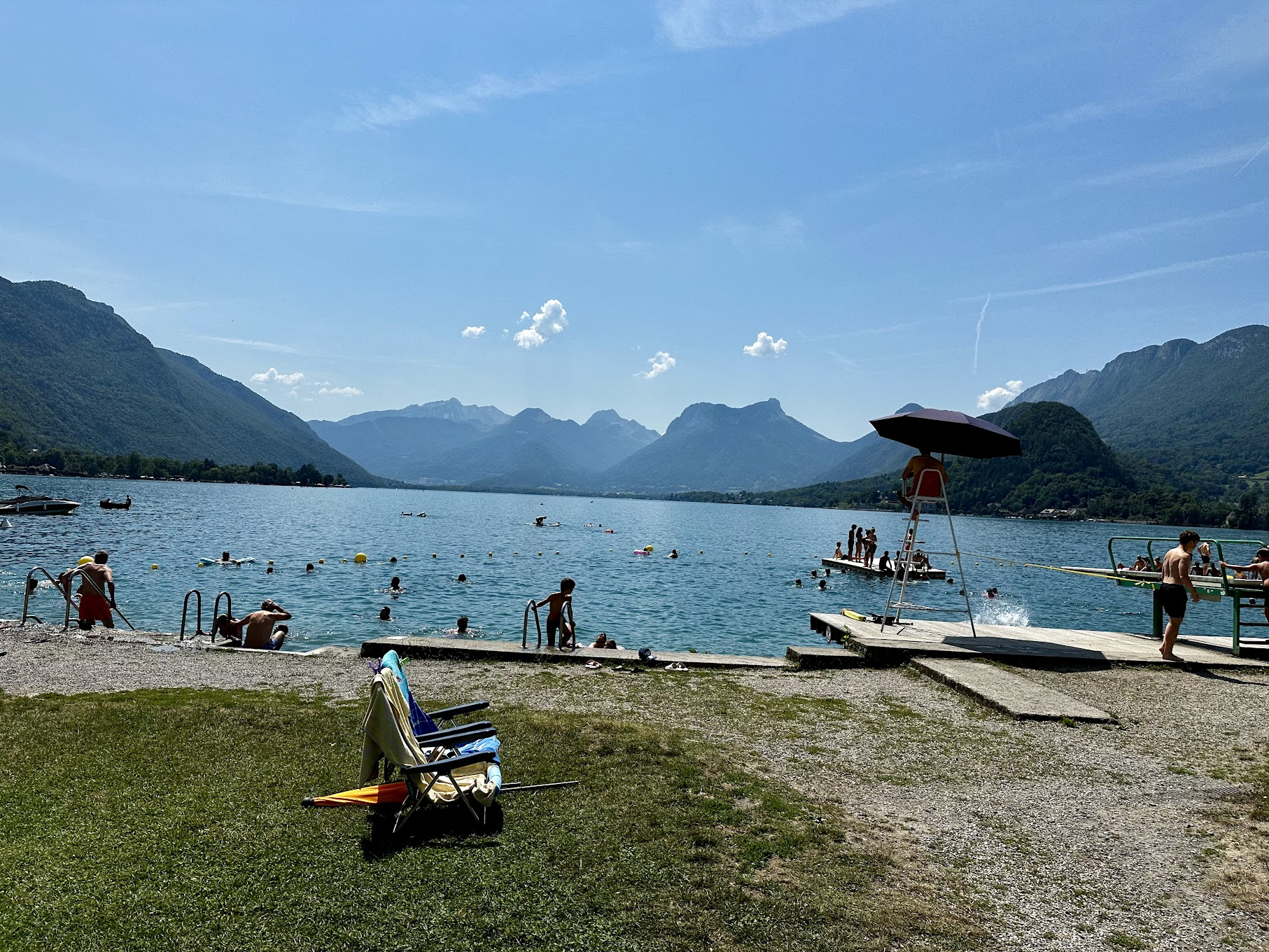
    The larger diving platforms were probably its biggest advantage, and we can see why it would appeal especially to teenagers or groups who want a little more going on than simply swimming and relaxing beside the lake.

    Busy swimming area and large diving platform at Saint-Jorioz on Lake Annecy, with mountains behind.
    Busy lakeside beach and swimming area at Saint-Jorioz on Lake Annecy.

    Our children were perfectly happy at Talloires, but if the priority was bigger diving platforms and a livelier atmosphere, Saint-Jorioz would probably be the better choice.

    It was also the busiest of the three places we visited and felt more like a substantial organised bathing area. That is not necessarily a negative, but it did make the experience feel less relaxed to us.

    Food and drink were readily available, although the setup felt a little more canteen or fast-food orientated than Talloires. Saint-Jorioz was also the only one of the three where we paid to enter.

    What swimming in Lake Annecy actually felt like

    The lake temperature was lovely for summer swimming.

    It was cool enough to be refreshing but not the sort of cold that makes you gasp when you first get in. We could stay in comfortably rather than treating the swim as a quick dip.

    One thing we would definitely recommend is lake or river shoes. The bottom could be rough underfoot, and they made getting in and out much more comfortable.

    Doussard and Saint-Jorioz were particularly good if you prefer a gently shelving entry into the water. All three places also had some form of diving platform or structure, although Saint-Jorioz was strongest if diving was a major part of the attraction.

    What to take

    • Lake or river shoes: the bottom can be rough.
    • Towels: useful not just for drying off but for sitting on the grass.
    • Shade: the shaded areas can fill up, so a beach umbrella or small canopy is worth considering.

    The six main positives

    1. The water: the blue-green colour was beautiful and inviting, and the lake generally felt clear — especially at Talloires.
    2. The setting: mountain and lake views made all three places feel special.
    3. Family-friendly swimming: marked areas, gradual access in places and diving platforms suited different ages.
    4. Useful facilities: toilets, changing and food or drink were available at each place we tried.
    5. Grass and shade: we preferred having grassy areas and trees rather than sitting on a conventional beach all day.
    6. Enough activity for older children: particularly at Saint-Jorioz and Doussard.

    Five things to be aware of

    1. They get busy: especially in high summer, with Saint-Jorioz the busiest of the three for us.
    2. Parking can be competitive: we managed at all three, but none was empty.
    3. Busy shallows can look cloudy: at Doussard in particular, lots of feet stirred up the bottom.
    4. Shade disappears quickly: arriving earlier helps if sitting under trees matters to you.
    5. Saint-Jorioz charged for entry: it was the only one of the three where we paid to get in.

    Which Lake Annecy swimming spot should you choose?

    If you only have time for one, we would choose Talloires.

    For us it had the best water, the prettiest surroundings, the most relaxed atmosphere and our favourite place to eat beside the lake.

    If you have time for two, we would add Doussard. It gave us a different view of the lake, had a beautiful mountain setting and felt more natural than Saint-Jorioz.

    Choose Saint-Jorioz instead if larger diving platforms and a more energetic atmosphere are higher priorities than tranquillity.

    Would we return?

    Yes — to all three.

    Talloires would be the first place we returned to and somewhere we would now make a full day of. Doussard would be next on our list, while Saint-Jorioz would still be worth revisiting when we wanted something livelier.

    Trying several swimming spots was part of what made Lake Annecy enjoyable for us. They were different enough that visiting more than one never felt repetitive.


    For the rest of our stay, read Our Week at Lake Annecy: Swimming, Cycling & Annecy Old Town, or see how this fitted into our full 11-night Interlaken & Lake Annecy trip.
  • 3 Nights in Sedona: What We Did, Where We Stayed & Where We Ate

    3 Nights in Sedona: What We Did, Where We Stayed & Where We Ate

    Sedona was somewhere we’d wanted to visit since learning about it on an earlier trip to Arizona. We arrived with high expectations.

    We stayed for three nights at Amara Resort & Spa, exploring viewpoints, walking in Red Rock State Park and swimming in Oak Creek. The town was nice to have for meals and evenings out, but the scenery was the star by a mile.

    Getting to Sedona from Las Vegas

    Sedona was the second main stop on our USA road trip. We turned the journey from Las Vegas into a full day out, stopping at Hoover Dam before heading through Kingman, along Historic Route 66 and on through Seligman and Flagstaff.

    The old roadside sights were part of the experience, and we encountered some impressive summer storms around Seligman. Then the scenery began to change: the relatively barren uplands gave way to greener, more mountainous country around Flagstaff.

    The final drive down towards Sedona was glorious, through plunging red-rock canyons scattered with lush green vegetation. It was one of the most memorable approaches to anywhere we stayed on the trip. As Cars fans, it also reminded us of Lightning and Sally’s countryside drive – a personal resemblance we’ve explored in our Radiator Springs article.

    Where we stayed: Amara Resort & Spa

    We chose Amara because we wanted great scenery and somewhere we could walk out in the evening. Tucked below the main road beside Oak Creek, it felt calm and private while still being within walking distance of shops, bars and restaurants.

    Amara’s terrace and seating areas, with trees and Sedona’s red rocks beyond.
    Amara’s relaxed setting, with the red rocks beyond.

    The hotel had a smart but rustic boutique feel that suited Sedona.

    The pool, the service and our evening routine

    Amara’s infinity pool with trees and Sedona’s red rocks beyond.
    Amara’s pool, with trees and red rocks beyond.

    The infinity pool was the standout feature, looking across the creek towards the red rocks. It was one of the reasons we’d happily go back to the same hotel.

    We had drinks at Amara before heading out every night. It was a lovely, chilled setting with fabulous views, and that simple evening routine became one of our favourite parts of staying there.

    Amara gave us the best overall service of the seven hotels on our USA trip. We’ve compared them in our USA hotel reviews.

    What we did in Sedona

    We were happy simply being outdoors here. Driving between places, stopping for views and spending time around Oak Creek were a large part of the pleasure. We didn’t feel the need to fill every hour with organised activities.

    Slide Rock and Oak Creek

    Slide Rock State Park was one of our favourite stops. Swimming in the creek was wonderfully refreshing in the July heat and gave us a different way to enjoy the landscape. Red rocks and water made a memorable combination.

    Oak Creek winding between red-rock ledges at Slide Rock State Park.
    Oak Creek winding between red-rock ledges at Slide Rock State Park.

    Airport Mesa and the Chapel of the Holy Cross

    We drove up to Airport Mesa for the broad views across Sedona. Seeing the town spread out beneath the surrounding formations helped us appreciate how completely the red rocks define the place. The panorama below captures that view.

    The view from Airport Mesa across Sedona’s red-rock formations.
    The view from Airport Mesa across Sedona’s red-rock formations.

    The Chapel of the Holy Cross was another worthwhile stop, particularly for the extensive views across the surrounding landscape. For us, the setting was every bit as much a reason to visit as the chapel itself.

    Red Rock State Park and getting around

    We also walked in Red Rock State Park. Experiencing the landscape at ground level made a good contrast to the viewpoints.

    We used a car to get between the parks, Airport Mesa and the Chapel of the Holy Cross.

    Where we ate in Sedona

    The Hudson

    The Hudson was our best meal in Sedona: a more upmarket take on American dining, with excellent food.

    Open Range Grill & Tavern

    Open Range was particularly memorable for the views and drinks. The food was good, straightforward pub-style American food rather than anything fancy, but looking out across those red rocks was the real attraction.

    The view from Open Range Grill & Tavern.
    The view from Open Range Grill & Tavern.

    Eating at Amara

    We ate at Amara one evening and thought both the food and service were very good. Breakfast was excellent too, with varied, proper American-style choices.

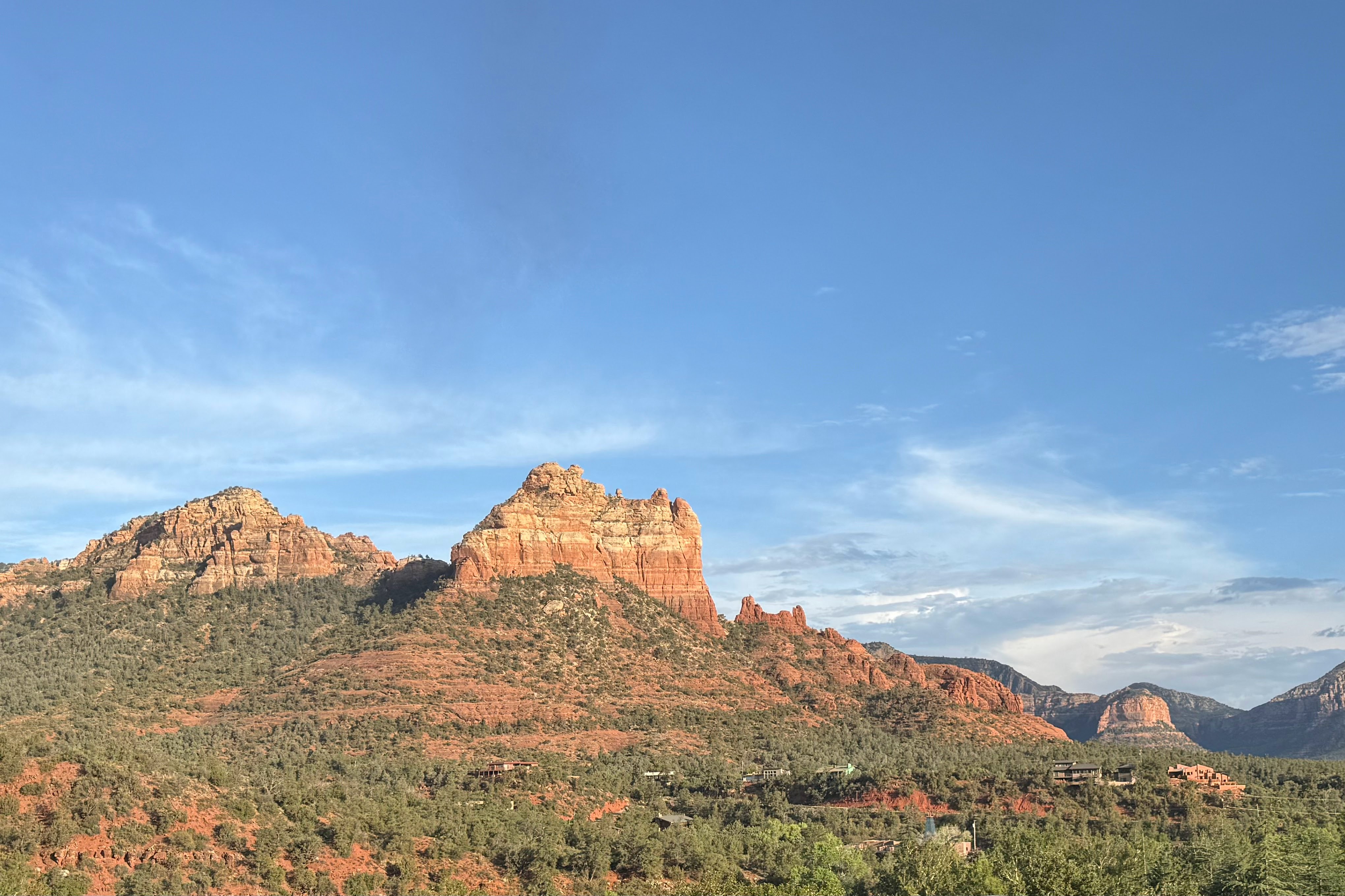
    Sedona’s red-rock formations beneath a blue sky, with trees and rooftops in the foreground.
    Sedona’s red rocks, blue skies and scattered greenery.

    Were three nights in Sedona enough?

    We feel like we have unfinished business in Sedona. We’d have liked more time to do some hikes, spend a few more lazy days at the swimming spots nearby on the creek and just chill out by the Amara pool. A week would easily be doable. But if three nights is all you have, it is well worth it.

    We’ve been to Uluru, the Olgas, the Swiss Alps, the Grand Canyon and many other gorges and craggy places. But Sedona is a unique fusion of parts of all these places. The shape of the rocky outcrops with their stratified colours, combined with the deep blue Arizona sky and the lush green smatterings of vegetation, make it like nowhere we’ve ever been before. Travelling to Red Rock Country was a key driver for our US road trip, and Sedona blew us away.

    For the full journey before and after Sedona, including our onward drive to the Grand Canyon and Monument Valley, see Our 18-Night USA Road Trip Itinerary.

    Planning a similar trip? This trip took a lot of research and planning. About a week of evenings, 30 to 40 hours. Our 36-page USA Road Trip Pack puts all that planning in one place, to help you plan your trip in a fraction of the time: every base and how many nights, which legs we drove and which we flew, what to book first, where we ate and a printable checklist. £14.99 launch price until 31 January (usually £19.99).

    Planning a stay at Amara? Check current prices and availability at Amara Resort & Spa on Booking.com.

    Affiliate link: if you book through this link, we may receive a commission at no extra cost to you.

  • Our Week at Lake Annecy: Swimming, Cycling & Annecy Old Town

    Our Week at Lake Annecy: Swimming, Cycling & Annecy Old Town

    Our stay: summer 2024. This story and its photographs reflect our seven-night stay at Lake Annecy, following four nights in Interlaken.

    After four nights around Interlaken, we travelled by train to Geneva, collected a hire car and drove on to Lake Annecy for the second half of our Interlaken & Lake Annecy trip.

    We had expected Lake Annecy to be beautiful. Even so, arriving there in the summer sunshine was one of those occasions when the reality comfortably matched the pictures. The lake was strikingly clear and blue-green, the mountains rose around it and the whole area felt immediately inviting.

    There were obvious similarities with Switzerland because of the Alpine scenery, but the atmosphere felt different. Interlaken had been dramatic: huge mountain walls, glaciers, waterfalls and active days built around trains and excursions. Lake Annecy felt softer somehow. The mountains were still there, but the lake, villages and warmer summer rhythm gave this half of the holiday a much more relaxed feel.

    That change of pace was exactly what we wanted.

    Settling into a different rhythm

    We spent seven nights at Camping Les Fontaines, towards the southern end of Lake Annecy.

    Our days quickly developed their own pattern.

    Breakfast was usually outside our cabin before we headed off somewhere around the lake. We might spend the day swimming, exploring a village, visiting Annecy or cycling, then return to the campsite later in the afternoon.

    Early evening often meant a drink at the campsite bar before deciding whether to eat at the restaurant or cook back at the cabin.

    After the more active Swiss half of the trip, that routine felt wonderfully easy.

    Camping Les Fontaines worked well as our base

    Les Fontaines was exactly the sort of campsite we had hoped for.

    The setting was excellent, with mountains all around, and the site felt friendly and relaxed rather than enormous or overly resort-like. Our accommodation was clean and comfortable, and having our own outdoor space made a big difference.

    The pools and waterslides were a major part of the appeal, particularly for the boys. Even after a full day out, they were keen to spend another couple of hours in the pool.

    Swimming pools and waterslide at Camping Les Fontaines beneath the mountains.

    The bar was pleasant too, with a slightly cosmopolitan holiday feel, and we enjoyed the restaurant.

    The location was both a strength and the one thing we might change.

    Being slightly back from the lake made the campsite peaceful, and it was a good base for exploring the southern end. But if we were planning the same holiday again, we would probably look for somewhere equally attractive right beside the lake or within easy walking distance of a lakeside village.

    The campsite shop was also fairly limited. That did not bother us much because shopping for food elsewhere became part of the enjoyment of the week.

    Our lodge at Camping Les Fontaines beneath the wooded Alpine foothills.

    The food shopping became part of the holiday

    This was one of the less obvious highlights.

    Going into the local supermarkets and choosing from the fresh meat, vegetables and huge range of other food and drink was genuinely enjoyable. There always seemed to be something good to bring back to the cabin.

    The ready-made kebab-style meat selections became particular favourites for the plancha, and there was no shortage of interesting beers and wines to try alongside them.

    Cooking outside gradually in the evening, rather than rushing out to a restaurant every night, became proper relaxing family time.

    It is the sort of detail that might not make many conventional Lake Annecy guides, but it is something we remember very fondly.

    Talloires was our favourite place to swim

    We tried several swimming spots around the lake, but Talloires was probably our favourite.

    It was extremely pretty without feeling overdone. The setting felt relatively low-key, the water was beautiful and there were still proper diving boards and swimming facilities to make it fun rather than simply scenic.

    You could spend time in the water, sit looking across the lake towards the mountains and feel as though you were somewhere quite special without the place feeling too formal or crowded.

    If we went back to Lake Annecy tomorrow, Talloires would be one of the first places we would return to.

    Lakeside swimming area and diving facilities at Talloires, with mountains across Lake Annecy.

    For a side-by-side look at all three places, read our Lake Annecy swimming comparison of Talloires, Doussard and Saint-Jorioz.

    Saint-Jorioz was bigger and busier — but still well worth visiting

    We also swam at Saint-Jorioz.

    It had a different feel to Talloires. It was larger and noticeably busier, but we still enjoyed it a lot.

    The swimming area was very good, and the larger diving platform was great fun. It felt more like a substantial lakeside bathing area than the quieter experience at Talloires.

    We would not choose one and dismiss the other. Talloires was our favourite aesthetically, but Saint-Jorioz was still very much worth including.

    That became something of a theme around Lake Annecy: the beaches were not identical, so trying more than one was part of the fun.

    Doussard and the quieter southern end

    We also visited Doussard, close to the southern end of the lake.

    This part of Lake Annecy had a particularly attractive setting, with plenty of mountain scenery and a slightly calmer feel than the busier northern end around Annecy itself.

    The south end suited us well as a base.

    It was scenic, gave us easy access to beaches and outdoor activities, and meant we could enjoy the quieter side of the lake while still driving up to Annecy and the busier villages whenever we wanted.

    Annecy town was even better than we expected

    We left Annecy itself until later in the week.

    That was probably a mistake.

    We visited once, but if we had realised beforehand quite how much we would like it, we would almost certainly have gone twice.

    Annecy was beautiful, but it was more than simply picturesque. It felt grand, lively, elegant and exceptionally clean.

    The canals and historic buildings gave the old town a completely different character from the lakeside villages. Flowers seemed to be everywhere, the water running through the town had that distinctive green-blue Alpine colour, and parts of it looked almost theatrical.

    At times it felt like walking through a medieval film set.

    Purple flowers beside a tree-lined canal with moored boats in Annecy.

    There was enough going on to give the town real energy without spoiling its appearance. We wandered around the canals, saw the Palais de l’Île, stopped for food and drinks and generally enjoyed being there without needing a rigid sightseeing plan.

    We only spent part of a day there, but you could easily spend a full day and evening in Annecy.

    It was busy when we visited, including the roads and parking areas, but we did not have any particular difficulty finding somewhere to leave the car. There seemed to be plenty of parking; you just had to accept that a beautiful Alpine town in the middle of summer was never going to be empty.

    Annecy ended up being one of the highlights of the French half of the trip.

    The stone Palais de l’Île between two channels in Annecy old town.
    Clear shallow water, boats and mountains along the lakeside at Annecy.

    Cycling around Lake Annecy

    Lake Annecy is clearly a place built for cycling.

    We hired bikes from K2 Outdoor, down the road from Les Fontaines, rather than relying on bikes from the campsite.

    Cycling gave us another way of experiencing the lake and its surroundings, and we could easily see why so many people choose to explore the whole area this way.

    The only problem was the weather.

    It was very hot during our visit.

    That did not stop plenty of other people cycling long distances around the lake, but we were less enthusiastic about spending hours melting in the midday sun. We still enjoyed riding, but the heat meant we sometimes chose the car when we might otherwise have cycled further.

    In more moderate temperatures, cycling would be very high on our list of ways to explore Lake Annecy.

    Did we need a car?

    Not necessarily — but we were very glad we had one.

    If you booked accommodation close to the lake, were happy staying relatively locally and were prepared to cycle or use public transport, you could certainly have a good Lake Annecy holiday without driving all week.

    For the way we wanted to explore, though, the car made a big difference.

    It meant we could visit beaches on different parts of the lake, get into Annecy town easily, reach the viewpoints above the water and change our plans depending on the heat.

    So we would describe the car as useful rather than essential.

    Above the lake at Montmin and Col de la Forclaz

    One experience I did not personally do, but my wife and son did, was heading up above the lake towards Montmin and the Col de la Forclaz.

    This is the area where many of the paragliders launch.

    They loved it.

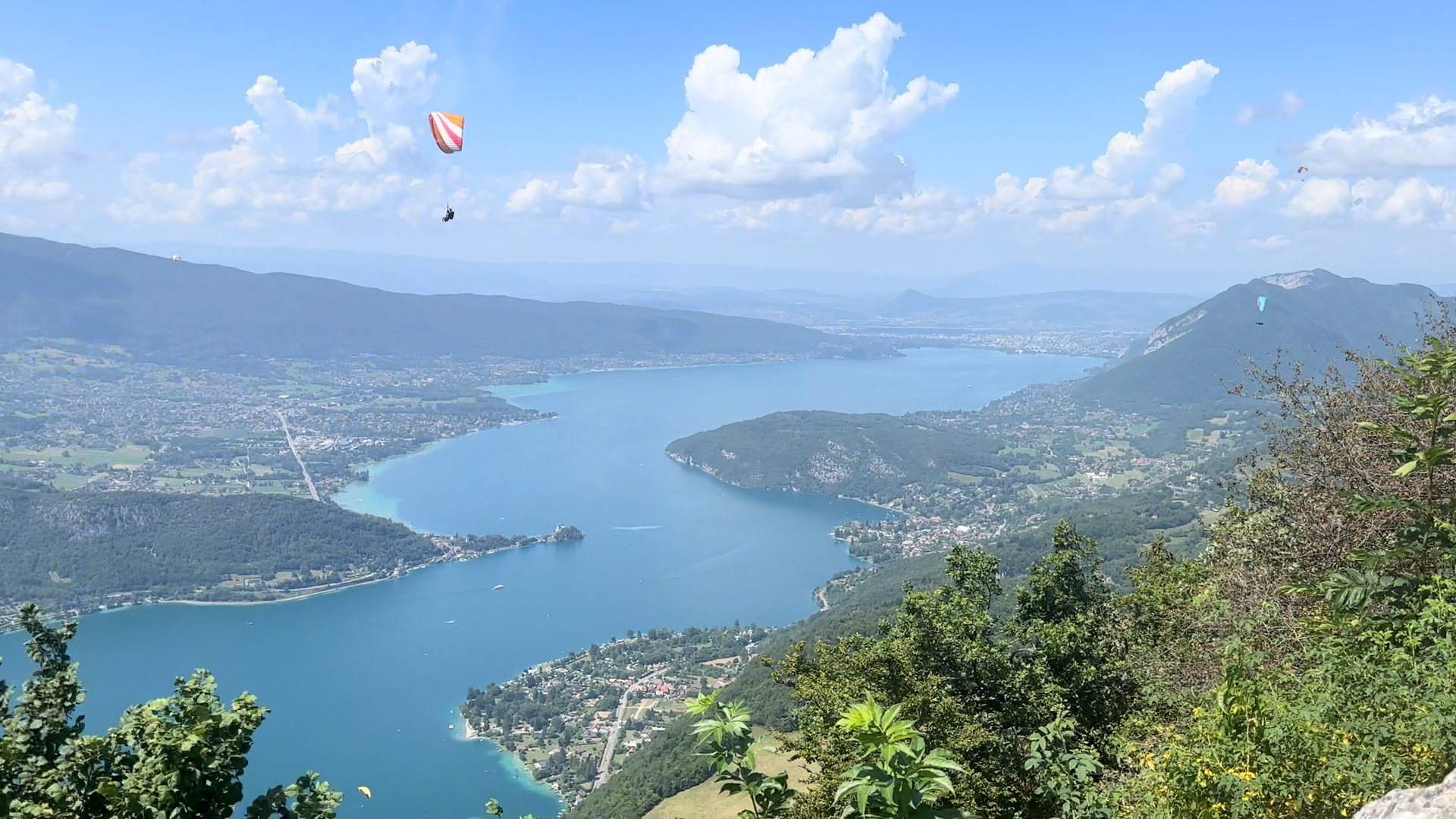
    From high above the lake, the views stretched almost the full length of Lake Annecy, with mountains rising either side. The paragliders launching from the hillside added another dimension to it.

    We had already seen plenty of them floating above the lake from below, so seeing where they actually took off from tied the whole thing together.

    The images they brought back are among the strongest views we have from the French part of the trip.

    Even if you have no intention of paragliding yourself, the view alone makes the mountain road up there worthwhile.

    Yellow paraglider canopy raised above the grassy launch slope at Montmin, with mountains beyond.
    Yellow paraglider in flight above the wooded mountains and valley near Lake Annecy.
    Both Montmin images are stills from our family’s video.

    What we would recommend for a first week at Lake Annecy

    We would definitely spend time at Talloires, visit Annecy town properly rather than rushing it, try more than one of the lake beaches and make time for the views from the mountains above the lake.

    Leave some room in the itinerary too, rather than planning an outing for every spare hour.

    Would Lake Annecy work as a holiday on its own?

    Easily.

    There was enough around the lake to fill a full week without needing to combine it with anywhere else. We did not even get around to a boat trip, kayaking or paddleboarding.

    With more time, we would still recommend pairing it with Interlaken: mountain excursions in Switzerland followed by a slower week beside the lake.

    For the Swiss part of the holiday, our Hotel Interlaken review covers our family room, breakfast and the location near Interlaken Ost.

    Would we go back?

    Yes.

    Lake Annecy was beautiful, easy to enjoy and gave us exactly the kind of summer week we had hoped for.

    If we changed anything, we would probably choose accommodation right on the lake or within walking distance of a village. We would also make sure we spent more time in Annecy town.


    For more stories from our travels, browse Travel Guides & Reviews.

  • Koukounaries or Banana Beach? Skiathos Beaches Compared

    Koukounaries or Banana Beach? Skiathos Beaches Compared

    One of the things we liked most about staying at Elivi Skiathos was having several very different beaches within easy reach of the hotel.

    Although they’re all close together, they don’t feel the same.

    Some are larger and livelier, some are quieter and more sheltered, and some have much more of a beach-club atmosphere.

    We spent time at the four main beaches around the Elivi area:

    Big Banana → Koukounaries → Xenia / Ambelakia → Little Banana / Black Bird

    If you’re staying at Elivi, or choosing where to spend a beach day in this part of Skiathos, this is how we found each one.

    Big Banana Beach

    Big Banana was probably our favourite overall.

    For us, it had the best balance between feeling lively enough to have a proper holiday atmosphere without becoming too busy or full-on.

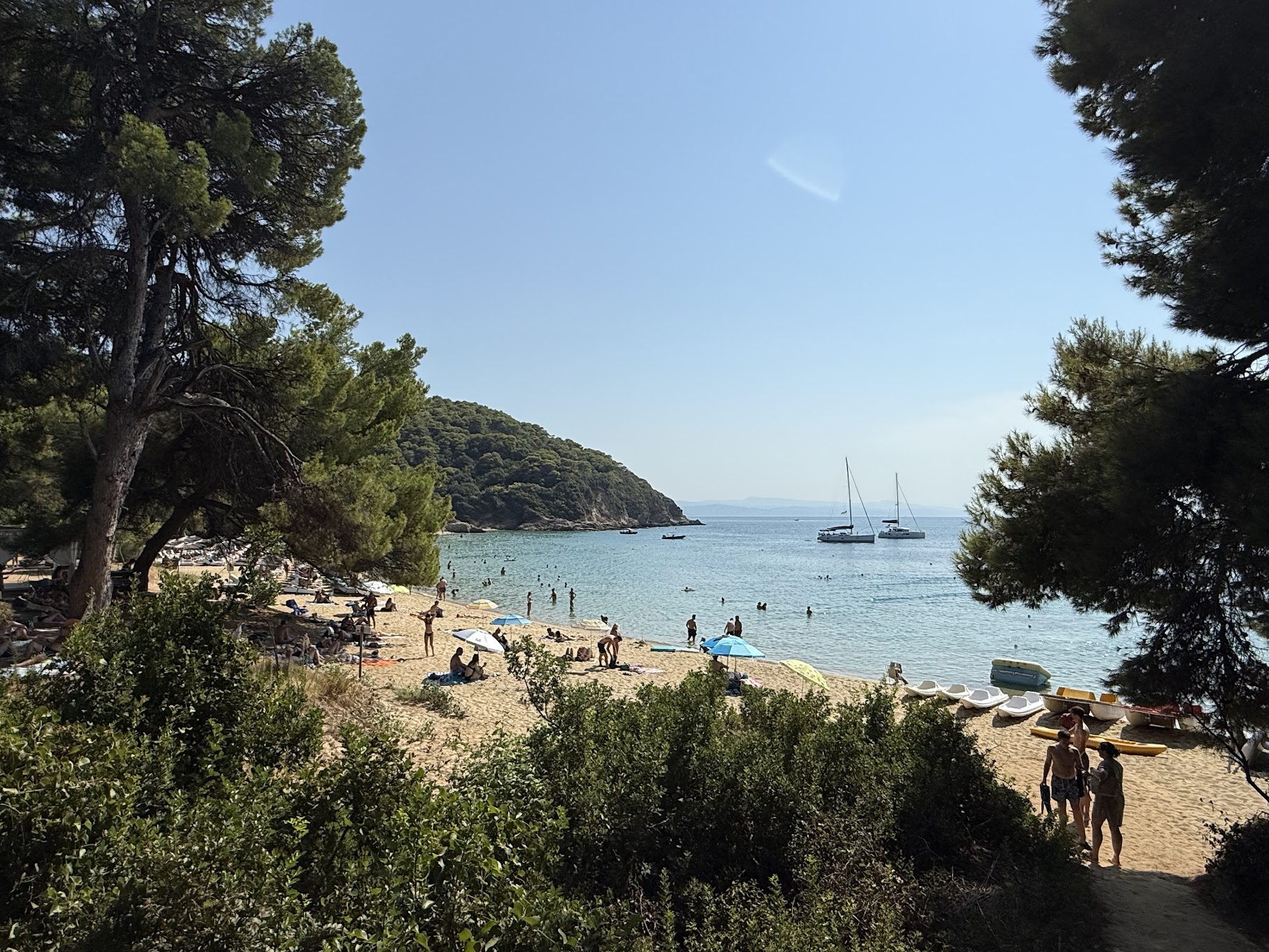
    The beach itself is beautiful, with clear water, soft sand and the pine-covered backdrop that makes this part of Skiathos so distinctive.

    It felt more intimate than Koukounaries but still had plenty going on.

    The atmosphere was one of its biggest strengths. It had more energy than Xenia but didn’t feel as lively as Black Bird.

    We also liked the shape of the bay. At one end there are rocks and a more enclosed cove feel, which made it interesting for swimming and snorkelling.

    We saw plenty of fish and seagrass, and on one swim even spotted an octopus, which was a brilliant little surprise. The water was generally very clear, so Big Banana was one of the most interesting beaches for us to explore in the water.

    There were also watersports available, and the views across the water towards the mainland helped give it a more open feel.

    For us, Big Banana was the best all-round beach.

    Koukounaries Beach

    Koukounaries is much bigger.

    It’s a long, wide sweep of sand backed by pine trees, with shallow turquoise water and a much more expansive feel than the other beaches.

    It’s probably the most visually impressive in terms of scale.

    There are more facilities, more activity and more people.

    That has advantages — there’s plenty going on, it feels well established and there’s a broader choice of places to eat, drink or hire equipment.

    But it also means it can feel significantly busier.

    One practical advantage we hadn’t really appreciated at the time is the amount of natural shade available beneath the pine trees behind the beach. Other visitors regularly mention this, although the shaded areas can become busy.

    We really liked Koukounaries, but if we had to choose between it and Big Banana, we’d probably choose Big Banana.

    That’s largely because we preferred the smaller scale and slightly more relaxed feel.

    If Koukounaries had been less crowded, though, our view might have been different.

    Xenia / Ambelakia Beach

    Xenia was probably the most peaceful of the four.

    It’s much smaller than Koukounaries and feels more sheltered.

    Xenia / Ambelakia Beach with clear water, sandy shoreline, pine-covered headland and Elivi loungers.

    The combination of sand, very clear water and pine-covered surroundings made it especially attractive, and it had a more intimate feel than the larger beaches nearby.

    For anyone wanting a quieter beach day, this could easily be the best choice.

    It felt particularly suited to sitting, swimming and relaxing rather than looking for lots of activity.

    There were Elivi loungers available during our stay, and the Grace beach area gave it a more refined feel.

    We liked it a lot.

    For a couple looking for peace and quiet, Xenia might actually be the most appealing of the four.

    For us as a family, Big Banana probably offered slightly more variety.

    Little Banana / Black Bird

    Little Banana and the Black Bird area felt the most different.

    It’s smaller again and has much more of a beach-club atmosphere around the organised part of the beach.

    Little Banana / Black Bird Beach with rows of Elivi loungers, straw parasols and clear blue water.

    Music, drinks and the overall setup make it feel livelier and more stylised than the other beaches.

    That will appeal to some people more than others.

    The setting itself is still beautiful — clear water, a more enclosed bay and a distinctive feel.

    When we visited, the naturist area was very much confined to one end of the beach, away from the Elivi loungers, so it didn’t really affect our experience of the organised part of the beach.

    Little Banana has long been known as a naturist-friendly beach, but our experience was that the hotel and naturist areas felt quite separate.

    We enjoyed seeing it, but with hindsight, this is probably the beach day we’d swap out.

    If we had another day, we’d probably spend that time at Big Banana, Xenia or exploring another beach elsewhere on the island.

    Which Elivi beach was our favourite?

    1. Big Banana
    Best overall balance of scenery, atmosphere, swimming and enough activity without feeling too busy.

    2. Xenia / Ambelakia
    Best for a quieter, more relaxed beach day.

    3. Koukounaries
    Probably the most impressive in scale, but also the busiest.

    4. Little Banana / Black Bird
    Interesting and very different, but less suited to what we personally wanted from a beach day.

    That ranking is very subjective.

    Someone looking for a bigger, livelier beach might easily put Koukounaries first.

    A couple wanting peace and quiet might prefer Xenia.

    Someone looking for a stronger beach-club atmosphere might rank Little Banana / Black Bird much higher.

    Which beach is best for what?

    Best all-rounder: Big Banana
    Best for peace and quiet: Xenia / Ambelakia
    Best for facilities and space: Koukounaries
    Best for a livelier beach-club feel: Little Banana / Black Bird

    That’s probably the simplest way we’d distinguish them.

    What they all had in common

    Despite their differences, all four shared the things we liked most about this part of Skiathos:

    • clear blue water
    • sandy beaches
    • pine-covered surroundings
    • easy swimming
    • attractive natural scenery

    What changed from beach to beach was mainly the scale, atmosphere and level of activity.

    That variety was one of the reasons staying at Elivi worked so well for us.

    We never felt as though we were simply repeating the same beach day.

    What about prices and loungers?

    Some independent visitors regularly mention the cost of loungers, food and drinks at these beaches.

    That wasn’t really part of our experience because, as Elivi guests, the hotel loungers were included.

    So while price may be an important consideration for someone visiting independently, it wasn’t something that materially affected how we judged the beaches.

    The same applies to access.

    Independent visitors sometimes mention the walk down towards the Banana beaches, whereas staying at Elivi made getting between the hotel and beaches much easier.

    How our experience compares with other visitors

    Our impressions were broadly in line with what other visitors tend to say.

    Koukounaries is regularly praised for its scale, clear water, pine-backed setting and facilities, but it’s also the beach most often described as busy or crowded.

    Big Banana is widely liked for its sand, clear water and more relaxed atmosphere, which fits closely with why it was our favourite overall.

    Xenia / Ambelakia is generally praised for being quieter and attractive. Some non-hotel visitors are less enthusiastic about the amount of space taken by hotel loungers, but that clearly wasn’t an issue for us as Elivi guests.

    Little Banana has a particularly loyal following and is often rated very highly by visitors who specifically like its more individual, naturist-friendly character and livelier atmosphere.

    So our ranking isn’t really a judgement that one beach is objectively better than another.

    It’s simply a reflection of what suited us best.

    Would we visit them all again?

    We’d definitely return to Big Banana, Xenia and Koukounaries.

    We’d probably skip Little Banana / Black Bird next time, not because there was anything wrong with it, but because the other beaches suited us better.

    That’s really the main point of this comparison: none of these beaches is objectively “best”.

    They just offer different types of beach day.

    Part of our Skiathos trip

    We visited these beaches during our week staying at Elivi Skiathos, as part of our wider trip to the island.

    For the full trip, including where we stayed, Skiathos Town, restaurants and getting around, see A Week in Skiathos: Why It Became Our Favourite Greek Island.

    Planning a stay at Elivi? Check current prices and availability at Elivi Skiathos on Booking.com.

    Affiliate link: if you book through this link, we may receive a commission at no extra cost to you.

  • Lake Tahoe to Yosemite: The Longer Route We Took via Jackson and Mariposa

    Lake Tahoe to Yosemite: The Longer Route We Took via Jackson and Mariposa

    Travelling from Lake Tahoe to Yosemite was one of the journeys we thought about most carefully when planning our USA road trip.

    The more direct summer option is generally to head towards US-395 and enter Yosemite from the east over Tioga Pass on Highway 120, when Tioga Road is open.

    We chose not to do that.

    Our concern wasn’t winding roads. We’re generally fine with those. What we were less comfortable with was spending long periods on roads with steep roadside drops and little between the car and the edge.

    So instead, we took a much longer route around the western side of the Sierra Nevada:

    South Lake Tahoe → Jackson → Mariposa → Highway 140 → Yosemite Valley

    It added a significant amount of driving, but for us it was the right choice — and the journey turned out to be an interesting part of the trip in its own right.

    The route we took from Lake Tahoe to Yosemite

    We were staying in South Lake Tahoe and our destination was Yosemite Valley.

    Rather than heading south along the eastern side of the Sierra Nevada towards US-395 and Tioga Pass, we headed west from Lake Tahoe towards Jackson, then continued south towards Mariposa.

    From Mariposa we took Highway 140 into Yosemite Valley.

    In simple terms, our route was:

    South Lake Tahoe → Jackson → Mariposa → Highway 140 → Yosemite Valley

    Google Maps was showing a journey of roughly five and a half hours when we planned it. We knew that was considerably longer than the more direct summer route, but journey time wasn’t our main concern.

    We wanted a route that suited us better because we’re comfortable with bends and hills but much less comfortable with prolonged stretches where there are steep drops immediately beside the road.

    Leaving Lake Tahoe

    The first part of the journey still included a couple of steeper sections as we left the Lake Tahoe area.

    We found them manageable, but it would be misleading to suggest that choosing this route meant avoiding elevated or winding roads altogether.

    It didn’t.

    For us, the important difference was that the journey didn’t involve the kind of prolonged exposed mountain driving we had been concerned about when looking at some of the alternatives.

    Lake Tahoe to Jackson

    As we moved farther away from Tahoe, the character of the journey changed quite noticeably.

    The alpine scenery gradually gave way to more open countryside and the sort of small American towns we had imagined seeing on a road trip through California.

    That was one of the unexpected things we enjoyed about taking the longer route.

    Rather than feeling like an inconvenient detour, it gave us another completely different view of the state.

    By the time we reached the Jackson area, the journey already felt very different from Lake Tahoe.

    Jackson to Mariposa

    The middle section of the drive was probably the least dramatic visually, but we enjoyed that too.

    We passed through flatter and more open countryside, agricultural areas and a succession of smaller communities.

    After the forests, lake and alpine scenery around Tahoe, it felt like another side of California altogether.

    This section also made the journey feel much less like one continuous mountain drive.

    That mattered to us.

    We could simply settle into the journey, enjoy the changing scenery and gradually work our way south towards Yosemite.

    Approaching Yosemite via Mariposa

    Eventually we reached Mariposa, which marked another change in the feel of the drive.

    From there, we took Highway 140 towards Yosemite Valley.

    Yosemite Valley with granite cliffs and pine trees

    The scenery gradually became more dramatic as we headed towards Yosemite, with the landscape becoming hillier and rockier and the road increasingly enclosed by the surrounding terrain.

    For us, this was one of the nicest parts of the journey.

    After travelling through such varied scenery during the day, the approach towards Yosemite felt like a gradual introduction to the park.

    It didn’t suddenly appear at the end of an otherwise ordinary drive.

    The landscape seemed to build towards it.

    Why we chose the longer route

    Our decision really came down to one personal preference.

    We don’t particularly mind:

    • winding roads
    • hills
    • slower rural roads
    • long drives

    What we’re much less keen on is long stretches of road with significant exposed drops close to the roadside.

    We’d already experienced a short section like that while driving around Lake Tahoe towards Emerald Bay.

    The views were spectacular, but it confirmed that we’d rather add time to a journey than spend several hours uncomfortable behind the wheel.

    That doesn’t mean our route is the right choice for everybody.

    Many drivers would take the more direct route towards US-395 and Tioga Pass without a second thought.

    This is simply the route we chose and how we found it.

    How long did the longer route take?

    This was effectively a full travelling day for us.

    When we planned it, Google Maps was showing roughly five and a half hours of driving, before allowing for stops, traffic or anything unexpected along the way.

    Journey times can vary significantly, so anyone considering the same route should check current conditions before setting off.

    For us, though, the extra time was an easy trade-off for a route we felt more comfortable taking.

    Was the longer route worth it?

    For us, yes.

    If the sole aim had been to get from Lake Tahoe to Yosemite as quickly as possible, it clearly wouldn’t have been the obvious choice.

    But that wasn’t our priority.

    We wanted to reach Yosemite using a route we felt comfortable driving.

    As a bonus, we also got:

    • a completely different view of California
    • small towns we otherwise wouldn’t have seen
    • wide agricultural landscapes
    • plenty of variety during the journey
    • and a really enjoyable final approach into Yosemite through Mariposa

    The additional driving therefore didn’t feel wasted.

    Would we take the same route again?

    Yes.

    If we were making the same journey again with the same concerns, we’d happily choose this route.

    It was longer, but we were comfortable with the trade-off.

    And rather than simply being a transfer day between two highlights of the trip, the drive became another memorable part of our road trip.

    Our route at a glance

    South Lake Tahoe
    ↓
    Jackson
    ↓
    Mariposa
    ↓
    Highway 140
    ↓
    Yosemite Valley

    If you’re considering a similar route because you prefer to avoid prolonged exposed mountain driving, hopefully our experience gives you another option to investigate.

    Road conditions, closures and journey times can change, particularly around Yosemite, so it’s always worth checking the latest information before travelling.

    Part of our wider USA road trip

    This journey formed part of our 18-night family road trip through Nevada, Arizona, Utah and California, which also included Las Vegas, Route 66, Sedona, the Grand Canyon, Monument Valley, Lake Tahoe and Los Angeles. For how we split six nights between the lake and the valley, see Can You Do Lake Tahoe and Yosemite in One Trip? Our Six Nights.

    For the complete itinerary, where we stayed and everything we did along the way, see Our 18-Night USA Road Trip Itinerary: Las Vegas, Grand Canyon, Yosemite and LA.

    Planning a similar trip? This trip took a lot of research and planning. About a week of evenings, 30 to 40 hours. Our 36-page USA Road Trip Pack puts all that planning in one place, to help you plan your trip in a fraction of the time: every base and how many nights, which legs we drove and which we flew, what to book first, where we ate and a printable checklist. £14.99 launch price until 31 January (usually £19.99).