Las Vegas, Route 66, Sedona, the Grand Canyon & Monument Valley in 8 nights
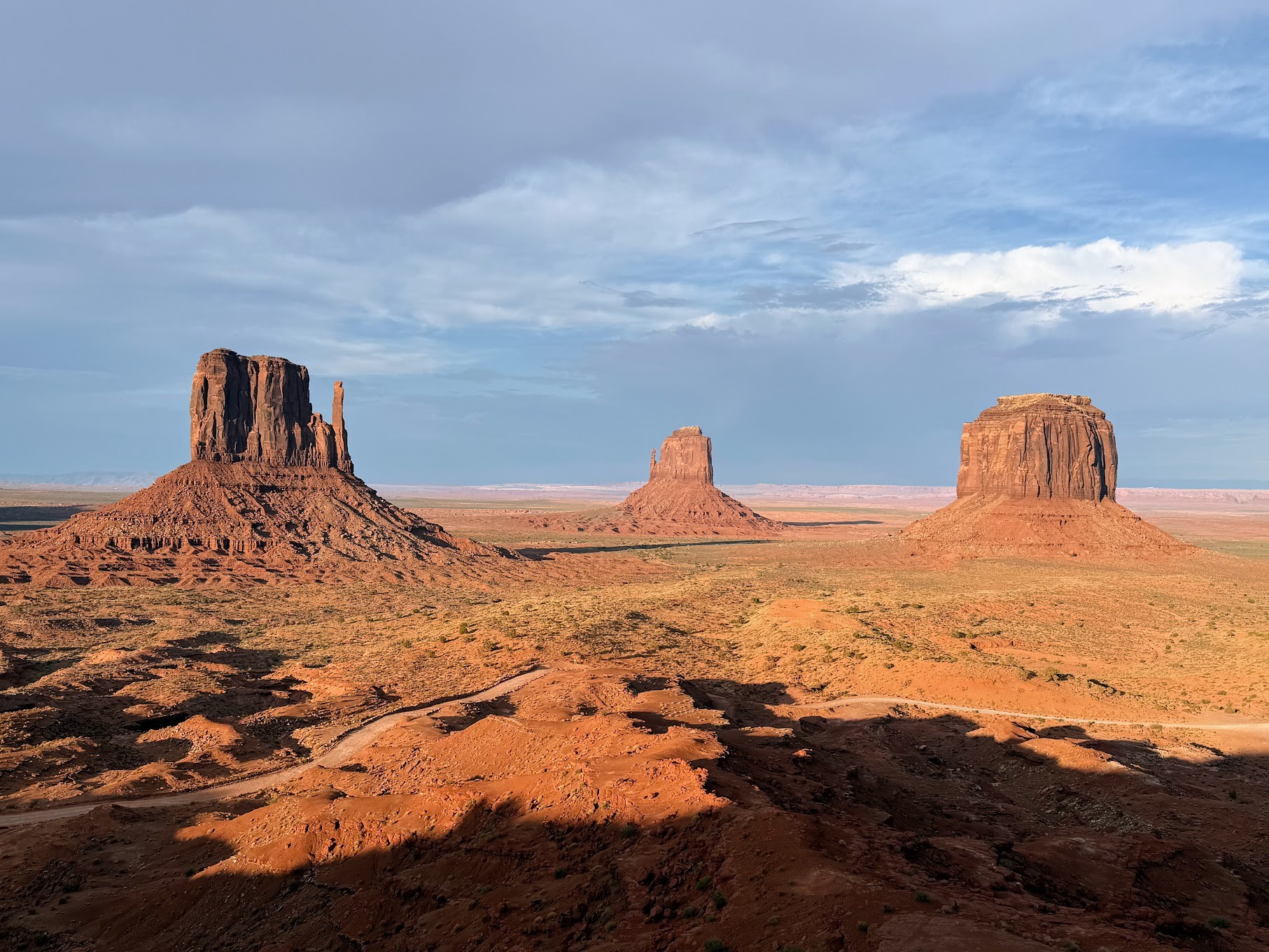
Monument Valley in the evening light, July 2026.
This post contains affiliate links. We may earn a small commission, at no extra cost to you.
In July 2026 we started our USA road trip with an 8-night loop out of Las Vegas: Hoover Dam, Route 66, Sedona, the Grand Canyon, Monument Valley and Horseshoe Bend, then back to Vegas. There were four of us, two adults and two teenagers. This is how we split the nights, how long each drive took, what we’d change, and whether 8 nights is enough.
The short answer: 8 nights was enough to see all of it, but not to linger. We had two hours at the Grand Canyon and one night at Monument Valley, and we’d do the loop again with one extra night.
Our loop at a glance
Nights: Las Vegas 3, Sedona 3, Monument Valley 1, Las Vegas 1
Order: Las Vegas, Hoover Dam, Route 66, Sedona, Grand Canyon South Rim, Monument Valley, Forrest Gump Point, Horseshoe Bend, Las Vegas
Who: two adults and two teenagers
Car: hire car collected from the Las Vegas airport rental car centre on the morning we left the city
Longest drives: Las Vegas to Sedona, and Monument Valley back to Las Vegas, both full days
When: July: dry heat in Vegas, monsoon storms in Arizona
Best moment: Monument Valley at sunset
Days 1 to 3: Las Vegas (3 nights)
It was our first visit to Las Vegas, and we stayed three nights at Mandalay Bay, towards the southern end of the Strip. The pool complex gave us some downtime, and the south end turned out not to be inconvenient at all.
We spent plenty of time simply exploring the Strip: the Bellagio fountains, the canals and painted sky of The Venetian, Paris Las Vegas and Luxor. Away from the casinos we did the Museum of Illusions, a retro arcade and the view from the top of the STRAT. July was hot, but it was a dry heat, which made it manageable.
Three nights gave us two full days plus the arrival evening, time to get over the flight before the driving started. More on Las Vegas and Mandalay Bay in Our USA Road Trip 2026.
Day 4: Las Vegas to Sedona via Hoover Dam and Route 66
Hoover Dam. Photo: Bureau of Reclamation
Drive: about 5 to 6 hours of driving and roughly 300 miles. With the stops, it took all day. We collected the car at the airport rental car centre, stopped at Hoover Dam and Kingman, and reached Sedona just before 8pm.
Route: Las Vegas, Hoover Dam, Kingman, Historic Route 66 through Hackberry to Seligman, Flagstaff, then down Oak Creek Canyon to Sedona.
Hoover Dam is one of those places where the scale is hard to appreciate until you’re standing there. We didn’t need hours there; it worked as the first stop out of Vegas.
At Kingman we joined Historic Route 66: a classic diner, an old Santa Fe steam locomotive in the park and the Route 66 sign. Further on we stopped at the Hackberry General Store, one of the old roadside stops on this stretch that helped inspire the world of Cars.
July is monsoon season in Arizona and we encountered some impressive storms around Seligman. Near Flagstaff the land turned greener and more alpine, and it was dropping dark as we drove from Flagstaff to Sedona. Even in fading light, the drive down through the red-rock canyon was one of the best approaches of the trip.
Don’t treat this as a transfer day: Hoover Dam and Route 66 are half the point. Leave Las Vegas early enough to reach Oak Creek Canyon in daylight, which we didn’t quite manage. More on the Cars connection in Is Radiator Springs Real?.
Days 5 and 6: Sedona (3 nights)
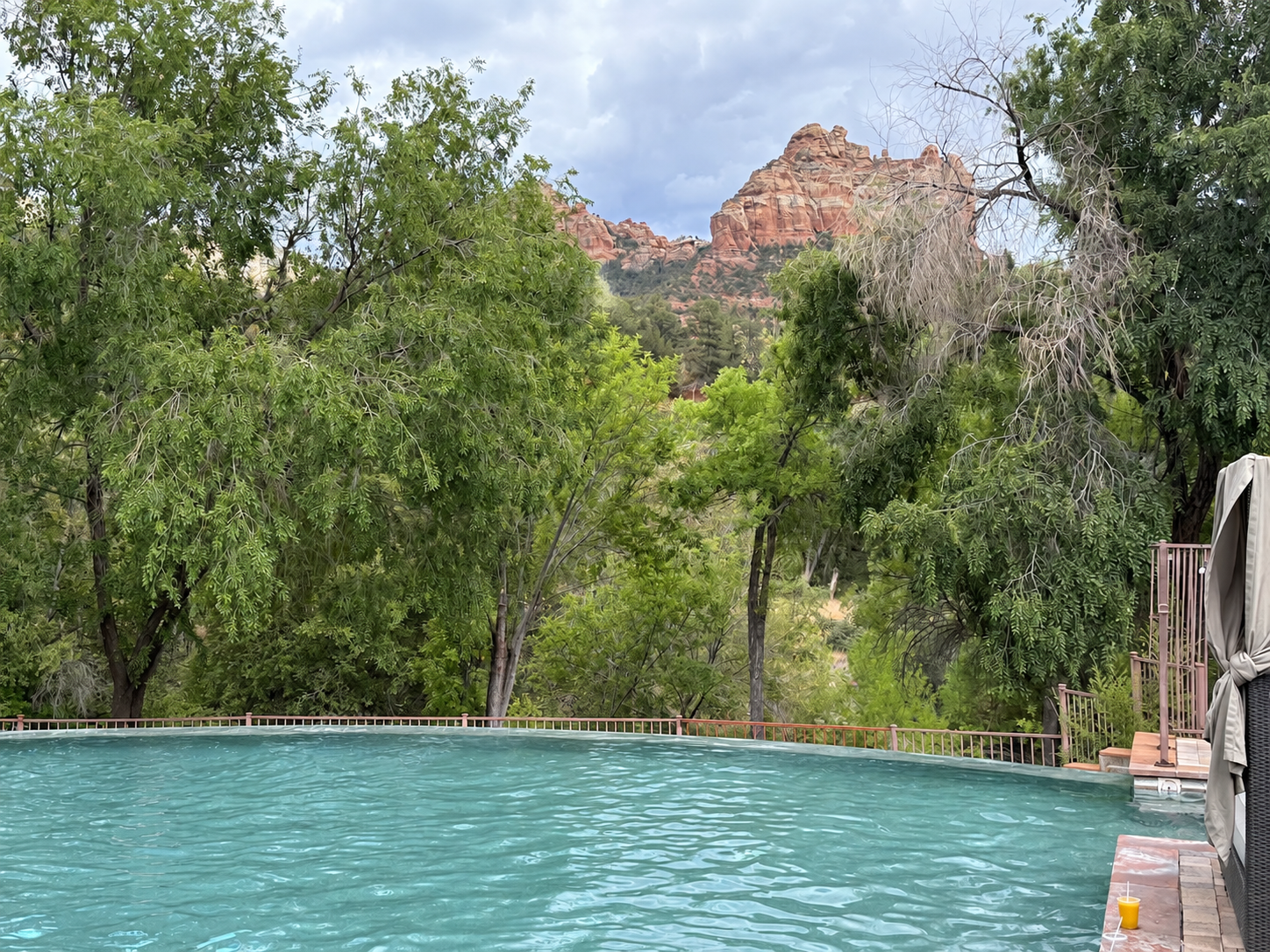
We stayed three nights at Amara Resort & Spa, by Oak Creek and within walking distance of Sedona’s bars and restaurants. Drinks at the infinity pool, looking across the creek to the red rocks, became our evening routine.
On our first full day we swam in the creek at Slide Rock State Park, which was wonderfully refreshing in the July heat, then went up to the Chapel of the Holy Cross for the view towards Cathedral Rock, and on to Airport Mesa for the views across the town. On the second we walked in Red Rock State Park.
Two full days covered the main viewpoints and time in the water. More in 3 Nights in Sedona.
Day 7: Sedona to Monument Valley via the Grand Canyon
Drive: about 2 hours from Sedona to the South Rim, then about 3 hours (160 to 180 miles) from the eastern viewpoints to Monument Valley. We left Moran Point just before 3pm and crossed into Utah just before 6pm Arizona time.
Route: Sedona, Flagstaff, Grand Canyon South Rim (Mather Point, then east along Desert View Drive to Grandview and Moran Points), out through Cameron and Kayenta to Monument Valley.
We left Sedona after breakfast and were at the rim by lunchtime. We stopped at several viewpoints, had a sandwich and spent about two hours there in all.
That was enough for a first look, not to explore. The hard part of this day is the timing: for sunset at Monument Valley in July, leave the last viewpoint by about 3pm. Our full account is in Is Two Hours at the Grand Canyon Enough?.
Night 7: Monument Valley (1 night)
We reached Monument Valley around 7pm local time, as the evening light caught the buttes.
We stayed at The View Hotel, inside the tribal park, for the location: the rooms look straight out at the Mittens. Cloud meant no clear night sky, but the morning views were beautiful. We didn’t drive the 17-mile Valley Drive; with one night, we were happy with the views from the hotel and the road.
Day 8: Monument Valley to Las Vegas via Forrest Gump Point and Horseshoe Bend
Drive: Google Maps puts Monument Valley to Las Vegas on our route at 397 miles and about 6 hours 20 minutes, before any stops. We left around 9:30, were at Forrest Gump Point by 10, Horseshoe Bend in the early afternoon and back on the Strip by about 9pm.
Route: north on US-163 to Forrest Gump Point and back, then Kayenta, Page and Horseshoe Bend, Kanab, Colorado City and St George, and the I-15 into Las Vegas. This road passes south of Zion.
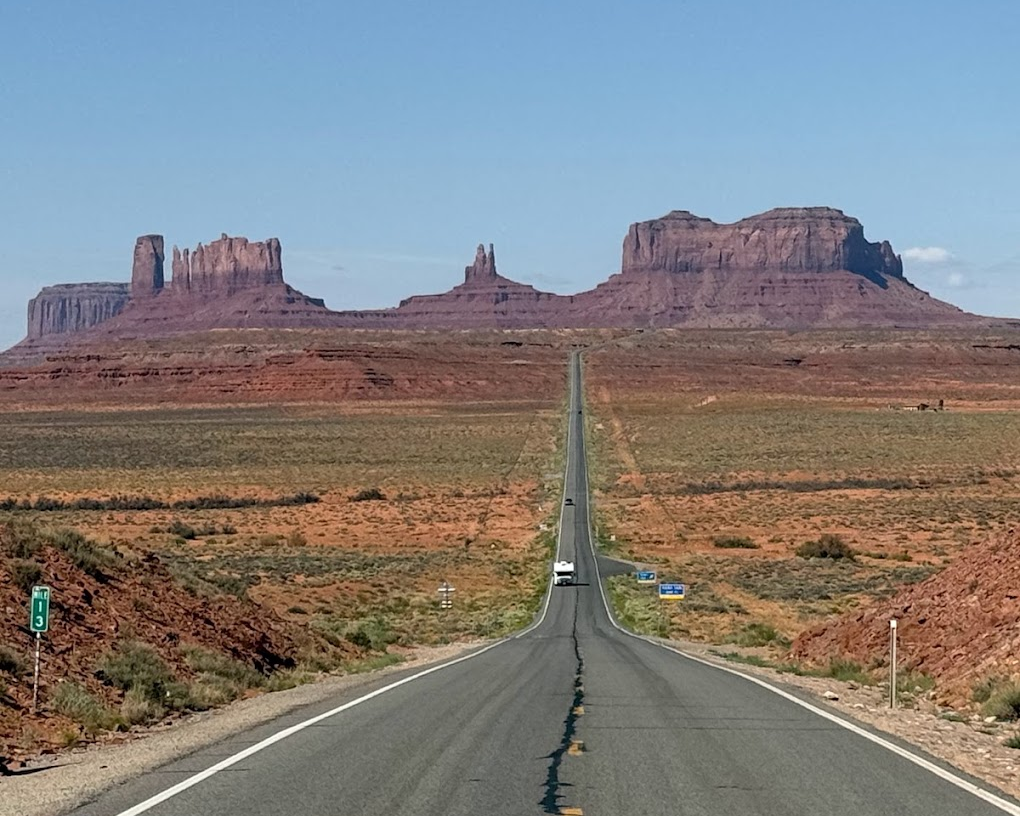
Forrest Gump Point is north of the park entrance, so if you’re heading for Page it’s a there-and-back of about 20 minutes each way, near mile marker 13 on US-163. We’d still do it. As Cars fans, driving this road with “Life Is a Highway” playing felt particularly fitting.
Horseshoe Bend made a natural break before the long drive back. We didn’t need to build the day around it.
Only our phones noticed, but it’s worth knowing: the Navajo Nation keeps summer time and the rest of Arizona doesn’t, so the clocks go back an hour between Monument Valley and Page. If you book a timed tour in Page, check which time it’s in.
Night 8: Las Vegas again (1 night)
For the last night we chose Virgin Hotels Las Vegas, smaller and more modern than Mandalay Bay, so the second stay didn’t feel like a repeat. We wished we’d had another night there. The next morning we flew on to Reno for Lake Tahoe.
Is 8 nights enough for Las Vegas, the Grand Canyon and Monument Valley?
For us, yes, if you accept some short stops: two long driving days and one tight one. What it doesn’t give you is time to explore the Grand Canyon properly.
Only 7 nights? Drop one of the first Las Vegas nights.
9 or 10 nights? Add a night near Zion on the way back, which splits the longest day.
Who the pace suits: families with teenagers, and anyone who enjoys the drive as part of the day. Who it doesn’t suit: families with small kids and people who hate long drives.
What it costs to get in (2026)
Grand Canyon: $35 per private vehicle for seven days, card only. Non-US residents aged 16 and over also pay $100 each, unless they have the $250 non-resident America the Beautiful pass. Monument Valley is a Navajo Nation tribal park, so national park passes don’t cover it: entry is $10 per person. Horseshoe Bend parking is $10 per car, paid to the City of Page, and passes don’t cover that either. Fees change, so check before you go.
Affiliate links: if you book through one of these links, we may receive a commission at no extra cost to you.
Would we do the loop the same way again?
Yes: same order, same hotels, plus that night near Zion.
Want our full plan?
These 8 nights were the first part of our 18-night trip. All that planning took us about a week of evenings, 30 to 40 hours. Our 36-page USA Road Trip Pack puts it all in one place: every base and how many nights, which legs we drove and which we flew, what to book first, where we ate and a printable checklist. £14.99 launch price until 31 January (usually £19.99).
Not ready to book yet?
Leave your email and we’ll send you two free sample pages from our 18-night USA Road Trip Pack, plus the odd email about our trips and the pack. No spam, and you can unsubscribe at any time.
You’ll get a confirmation email from WordPress.com first. Click it and your pages arrive. How we use your email: Privacy page.
Monument Valley – inspired Ornament Valley in Cars
Monument Valley, on the Arizona–Utah border.
Radiator Springs isn’t a real town. But one of the inspirations for our American road trip was to find somewhere in the Southwest that felt like it.
Why we wanted to find Radiator Springs
One of the slightly unusual inspirations behind our 2026 USA road trip was a Pixar film. We have watched Cars plenty of times over the years, and somewhere along the way we started wondering whether it was possible to visit somewhere that genuinely felt like Radiator Springs.
We knew the town itself was fictional. We weren’t expecting Flo’s V8 Café, Mater’s yard and the Cozy Cone Motel to be sitting around a crossroads waiting for us. What we wanted was the feeling behind them: huge red rocks, open desert and roads disappearing towards distant formations, with a small roadside community somewhere among it all.
The town mattered as much as the scenery. We imagined a main street, a few shops and diners, old signs, perhaps some neon, and the sense that the road was part of the place. As the trip unfolded, we didn’t find all of that in one stop. We kept recognising different bits of it.
Pixar’s account of making Cars helps explain why. Its team travelled Route 66, gathering photographs and footage, and imagined Radiator Springs in the high desert somewhere between Gallup, New Mexico, and Kingman, Arizona. The film grew out of the character of the road and its communities.
Why now? Two anniversaries in 2026
In 2026, Cars turned 20, and Disney announced a cinema re-release from 4 September. It’s also Route 66’s 100th anniversary. Having driven part of that road ourselves this summer, it seemed the right moment to come back to the question that helped start our trip.
Sedona was where it first started to feel real
Of all the places we visited, Sedona was the first to make the landscape we had imagined feel convincing. Before the trip, it had seemed a good candidate simply because of its red rocks. As far as we can find, Sedona isn’t a documented Cars inspiration, and nor are several of the stops below. They’re here because of how they felt to us. Where there is a documented link, we say so.
But as those formations appeared, the resemblance felt obvious to us: distinctive shapes rising straight out of the landscape, with the colour and presence we remembered from Ornament Valley.
Parts of the town supplied the other half of what we had pictured: low-rise shops and businesses along a main road, with those enormous rocks behind them. Sedona is much bigger and busier than Radiator Springs, but there were moments when we could imagine a fictional town like it sitting in this landscape.
The Flagstaff–Sedona road reminded us of Lightning and Sally’s drive
The approach had already set the mood. The drive down from Flagstaff towards Sedona was the road that most reminded us of Lightning McQueen and Sally’s countryside drive away from Radiator Springs.
The landscape just changed as we dropped down into the valley, and it was stunning: steep red-rock sides with outcrops on top, vibrant green vegetation sprawled across them, and the road winding through. It was a captivating end to a long drive, and the closest we came to that scene from the film on our own trip.
We stayed at Amara, tucked below the main road beside Oak Creek. We had drinks there before heading out every night, looking across the creek to the red rocks, and it gave us the best service of all seven hotels on the trip. There’s more on that stay in our three nights in Sedona post.
Sometimes the desert drive was enough
Other stretches reminded us of the journey rather than a particular location. On those long Arizona roads, with desert spreading away on either side and an enormous horizon ahead, it was difficult not to think of Mack heading west in the early travel sequence, with Life Is a Highway playing.
We were finally travelling through the sort of American landscape that Cars had made familiar years before we saw it ourselves.
Kingman: a diner, an old police car and a very Cars-like moment
Earlier on the Route 66 part of the journey, around Kingman, it was the roadside details that caught our attention. At Mr D’z Route 66 Diner, the colourful building with a vintage police car parked outside looked almost too perfect. We ate there too. Inside, it looked and felt just like you’d expect a US roadside diner to, with bright colours and a bit of art deco, and the food was good American diner fare. The boys thought the diner and the police car were cool.
A bright old-fashioned diner already fitted our imagined Radiator Springs. Add an old police car and it was hard not to think of Flo’s and Sheriff. It was just one of those moments when real life looked like a scene from the film.
Hackberry really does have a Curios connection
Hackberry General Store had the same effect on us, but this time there was a documented reason. Old petrol pumps, weathered signs, memorabilia and vintage vehicles surrounded the little roadside store. Looking at it, we immediately thought of Lizzie and Radiator Springs Curios.
Seligman has the story, but we saw too little of it
Seligman belongs in any discussion of the places behind Radiator Springs. The Historic Route 66 Association of Arizona names it as one of the town’s real-life inspirations. Its wider history matters too: Angel Delgadillo’s work to revive Route 66 is closely tied to Seligman, and the fortunes of towns bypassed by the interstate echo the history Sally tells Lightning in the film.
Our own experience was much more limited. The weather was awful, we didn’t spend long there, and we saw too little to pretend we had explored it properly.
US-163 felt like the road into Ornament Valley
Later, around Monument Valley, the roads and the scenery started coming together. US-163, including the famous view associated with Forrest Gump Road, looked to us like the sort of approach you ought to drive if Radiator Springs existed somewhere beyond the horizon. We stopped at Forrest Gump Point for that view, with “Life Is a Highway” playing in the car, which we cover in our USA road-trip article.
A still from our drive towards Monument Valley.
The distant formations gave the journey a destination even when there was no town in sight. The road and the landscape together made the comparison for us.
Arriving at Monument Valley
Our Welcome to Utah photograph captures that arrival: a familiar roadside sign, with Monument Valley already there behind it. By this stage, the search had moved well beyond finding the right diner or main street.
Monument Valley made the whole thing click
The isolated formations and the sheer size of the place brought Ornament Valley straight to mind. Sedona had the red-rock colour; Monument Valley had the scale. To our eyes, Ornament Valley looks like a mix of the two.
There is a documented connection here. In KSL’s August 2026 interview with Pixar production designer Bob Pauley, who took part in the research trips, the report explains that Monument Valley inspired the name Ornament Valley. Pauley also described the wider influence of Utah’s scenery on the film.
Where we found our pieces of Radiator Springs
Place
Documented Cars link
What it felt like to us
Sedona
None documented
The red-rock setting we had imagined.
Flagstaff → Sedona
None documented
Lightning and Sally’s countryside drive.
Kingman / Mr D’z
None documented
Colourful diner and vintage Americana.
Hackberry
Curios inspiration, documented by Arizona’s Route 66 Association.
Lizzie’s shop, pumps and roadside memorabilia.
Seligman
Named among Radiator Springs’ inspirations; important Route 66 history.
A place we saw too little of in poor weather.
Monument Valley
Inspired Ornament Valley’s name, reported in the Pauley interview.
The scale and isolated formations that made it click.
US-163
None documented
The approach into our imagined Ornament Valley.
A few questions about visiting the real-world inspirations
Is Radiator Springs real?
No. It’s a fictional Route 66 town, which Pixar imagined somewhere between Gallup and Kingman. No single real town has everything from the film.
Is Seligman the real Radiator Springs?
No. It’s one of the documented inspirations, but the film borrowed from places all along the route.
Can you visit places that inspired Cars?
Yes. Hackberry General Store and Seligman are real Route 66 stops, and Monument Valley inspired Ornament Valley’s name.
Would we include this route in a Southwest road trip?
Definitely. Looking for Radiator Springs was one of the things that inspired ours, and the search became part of the pleasure of travelling. Our full USA road-trip article shows how the stops fitted together. We also included a short Grand Canyon visit between Sedona and Monument Valley; these are stages of a wider trip, rather than one compact Cars attraction.
Planning a similar trip? This trip took a lot of research and planning. About a week of evenings, 30 to 40 hours. Our 36-page USA Road Trip Pack puts all that planning in one place, to help you plan your trip in a fraction of the time: every base and how many nights, which legs we drove and which we flew, what to book first, where we ate and a printable checklist. £14.99 launch price until 31 January (usually £19.99).
So did we find Radiator Springs?
No, we didn’t find it. But travelling through places that looked and felt like Radiator Springs brought us about as close as we could imagine to being there, inside the film. Knowing that some of those places had actually helped inspire Cars made it feel even more as though we were retracing the story.
Life Is a Highway
“Life Is a Highway” is the song we associate with those long drives in Cars. During our week exploring Arizona and Utah, we spent whole days on the road ourselves. A film that had been such a big part of our boys growing up became part of our own lives for a while, as we travelled through that extraordinary red-rock landscape with Lightning McQueen and his friends in mind.
And then, when we reached Los Angeles, our hotel put on a movie night by the pool. The film? Cars. After everything we had just seen, it felt like fate had arranged one last scene for us.
On our 18-night road trip through Nevada, Arizona, Utah and California, we stayed in seven very different hotels — from huge Las Vegas resorts to historic lodges and luxury lakeside and beachfront hotels.
Some were chosen mainly for location, some for the experience, and some because we wanted a few genuinely special stays along the route.
This article contains affiliate links. If you book through one of these links, we may receive a commission at no extra cost to you.
Mandalay Bay — Las Vegas
Why we chose it
For our first Las Vegas stay, we wanted the full Vegas experience: a large resort, a great pool, plenty happening on site and easy access to the Strip.
What we thought
The room was spacious and had a great view along the Strip.
We wouldn’t describe it as especially luxurious or particularly modern, but it was very good and worked well for the stay.
Compared with some of the newer-looking rooms later in the trip, Mandalay Bay had more of the traditional ornate feel of a large American resort hotel.
The pool complex was a major strength, particularly for a family, and the hotel also gave us easy access to shops, restaurants and other attractions.
Best for
Families who want a large resort with plenty to do on site.
Would we stay again?
Yes.
If we could improve one room from the whole trip, though, Mandalay Bay would probably be the one we’d update. Not because it disappointed us, but because the room felt less modern and polished than Edgewood, Virgin and Regent.
This was one of those hotels where the reason for staying there was inseparable from the destination itself.
What we thought
The room wasn’t one of the smartest or most high-end of the trip, but that didn’t really feel like the point.
It was appropriate for the setting, and the character of the hotel added to the wider Monument Valley experience.
The absolute show-stopper by a mile was the view.
Being able to look straight out over Monument Valley at dusk and then again the following morning was unforgettable.
Best for
Anyone who wants the Monument Valley landscape to be part of the hotel experience itself.
Would we stay again?
Yes.
Virgin Hotels Las Vegas — Curio Collection
Why we chose it
After staying at Mandalay Bay earlier in the trip, we wanted somewhere different for our second Las Vegas stay.
What we thought
The room felt noticeably brighter, smarter and more modern than Mandalay Bay.
Mandalay had more of a traditional large-resort feel, whereas Virgin felt fresher and more contemporary. That may simply reflect the fact the rooms were probably fitted out many years apart.
The room layout was also slightly unusual in a good way, with a more relaxed lounge-like feel.
Virgin was one of the hotels that looked better in person than it did in the photos, and it also felt like the best value for money of the seven hotels.
Best for
Travellers who want a modern Las Vegas hotel close to the Strip without necessarily staying right in the middle of it.
Would we stay again?
Yes — and we would actually have liked another night there.
We wanted to stay inside Yosemite Valley so we could avoid wasting time driving in and out of the park, and we were also drawn to the hotel’s history.
What we thought
The room felt almost like a time capsule, and that seemed entirely intentional.
Rather than trying to feel modern, it carried the same historic, forest-lodge character as the rest of The Ahwahnee.
A bit like The View at Monument Valley, the room made more sense as part of the wider setting and experience.
You are paying not just for the room itself, but for the history, atmosphere and the fact that you are staying right in Yosemite Valley.
We’ve written a full Ahwahnee Yosemite review covering the room, historic atmosphere, service, grounds and why the Yosemite Valley location mattered so much to us.
Best for
Travellers who value history, atmosphere and location more than modern luxury.
For us, Edgewood Tahoe was the best overall hotel of the trip.
It had the strongest combination of room quality, atmosphere, setting, facilities and that sense of everything being exceptionally well done.
Regent Santa Monica Beach ran it very close for the room itself, while Amara Sedona stood out for service and how perfectly it fitted its location.
Best for different things
If we had to pick individual winners:
Best overall hotel: Edgewood Tahoe
Best room: Edgewood Tahoe, narrowly ahead of Regent Santa Monica Beach
Best service: Amara Sedona
Best value for money: Virgin Hotels Las Vegas
Best for families with teenagers: Mandalay Bay
Best view: The View Hotel, Monument Valley
Best historic experience: The Ahwahnee
Which hotels exceeded expectations?
Virgin Hotels Las Vegas, Edgewood Tahoe and Regent Santa Monica Beach all looked even better in person than we expected from the photos.
None of the seven hotels disappointed us.
That is probably worth stressing because they were all chosen for very different reasons and all did what we hoped they would do.
If we had to rank the rooms
It’s difficult to rank these hotels fairly because they offer very different experiences, locations and target different types of traveller.
So rather than pretending there is an objective “best”, we asked ourselves a simpler question:
How excited would we be if we were returning to the room tomorrow?
Edgewood Tahoe
Amara Sedona
Regent Santa Monica Beach
Virgin Hotels Las Vegas
Mandalay Bay
The Ahwahnee
The View Hotel
That ranking is not a criticism of the lower-placed hotels.
The Ahwahnee and The View, in particular, are places where the wider setting and experience are a huge part of what you are paying for rather than simply the room itself.
Where would we spend the money again?
One thing the trip reinforced for us was that spending more on a hotel makes most sense when it changes the experience of the destination.
That was particularly true at:
Edgewood, where being directly on Lake Tahoe mattered
The Ahwahnee, where staying inside Yosemite Valley changed how we explored the park
The View, where Monument Valley was effectively part of the room
Regent Santa Monica, where the beachfront location made the final part of the trip particularly easy
That is probably the biggest lesson we would use when planning another road trip.
Our overall verdict
There wasn’t one single “best” choice for every stop because each hotel was doing something different.
Mandalay Bay delivered the big Las Vegas resort experience we wanted. Amara fitted Sedona beautifully. The View gave us an unforgettable location. Virgin was modern, fun and excellent value. Edgewood was the standout overall. The Ahwahnee gave us history and Yosemite Valley on the doorstep. Regent was an exceptional way to finish the trip.
If we planned the same route again, we would be very happy staying at all seven again.
Planning a similar trip? This trip took a lot of research and planning. About a week of evenings, 30 to 40 hours. Our 36-page USA Road Trip Pack puts all that planning in one place, to help you plan your trip in a fraction of the time: every base and how many nights, which legs we drove and which we flew, what to book first, where we ate and a printable checklist. £14.99 launch price until 31 January (usually £19.99).
Travelling from Lake Tahoe to Yosemite was one of the journeys we thought about most carefully when planning our USA road trip.
The more direct summer option is generally to head towards US-395 and enter Yosemite from the east over Tioga Pass on Highway 120, when Tioga Road is open.
We chose not to do that.
Our concern wasn’t winding roads. We’re generally fine with those. What we were less comfortable with was spending long periods on roads with steep roadside drops and little between the car and the edge.
So instead, we took a much longer route around the western side of the Sierra Nevada:
South Lake Tahoe → Jackson → Mariposa → Highway 140 → Yosemite Valley
It added a significant amount of driving, but for us it was the right choice — and the journey turned out to be an interesting part of the trip in its own right.
The route we took from Lake Tahoe to Yosemite
We were staying in South Lake Tahoe and our destination was Yosemite Valley.
Rather than heading south along the eastern side of the Sierra Nevada towards US-395 and Tioga Pass, we headed west from Lake Tahoe towards Jackson, then continued south towards Mariposa.
From Mariposa we took Highway 140 into Yosemite Valley.
In simple terms, our route was:
South Lake Tahoe → Jackson → Mariposa → Highway 140 → Yosemite Valley
Google Maps was showing a journey of roughly five and a half hours when we planned it. We knew that was considerably longer than the more direct summer route, but journey time wasn’t our main concern.
We wanted a route that suited us better because we’re comfortable with bends and hills but much less comfortable with prolonged stretches where there are steep drops immediately beside the road.
Leaving Lake Tahoe
The first part of the journey still included a couple of steeper sections as we left the Lake Tahoe area.
We found them manageable, but it would be misleading to suggest that choosing this route meant avoiding elevated or winding roads altogether.
It didn’t.
For us, the important difference was that the journey didn’t involve the kind of prolonged exposed mountain driving we had been concerned about when looking at some of the alternatives.
Lake Tahoe to Jackson
As we moved farther away from Tahoe, the character of the journey changed quite noticeably.
The alpine scenery gradually gave way to more open countryside and the sort of small American towns we had imagined seeing on a road trip through California.
That was one of the unexpected things we enjoyed about taking the longer route.
Rather than feeling like an inconvenient detour, it gave us another completely different view of the state.
By the time we reached the Jackson area, the journey already felt very different from Lake Tahoe.
Jackson to Mariposa
The middle section of the drive was probably the least dramatic visually, but we enjoyed that too.
We passed through flatter and more open countryside, agricultural areas and a succession of smaller communities.
After the forests, lake and alpine scenery around Tahoe, it felt like another side of California altogether.
This section also made the journey feel much less like one continuous mountain drive.
That mattered to us.
We could simply settle into the journey, enjoy the changing scenery and gradually work our way south towards Yosemite.
Approaching Yosemite via Mariposa
Eventually we reached Mariposa, which marked another change in the feel of the drive.
From there, we took Highway 140 towards Yosemite Valley.
The scenery gradually became more dramatic as we headed towards Yosemite, with the landscape becoming hillier and rockier and the road increasingly enclosed by the surrounding terrain.
For us, this was one of the nicest parts of the journey.
After travelling through such varied scenery during the day, the approach towards Yosemite felt like a gradual introduction to the park.
It didn’t suddenly appear at the end of an otherwise ordinary drive.
The landscape seemed to build towards it.
Why we chose the longer route
Our decision really came down to one personal preference.
We don’t particularly mind:
winding roads
hills
slower rural roads
long drives
What we’re much less keen on is long stretches of road with significant exposed drops close to the roadside.
We’d already experienced a short section like that while driving around Lake Tahoe towards Emerald Bay.
The views were spectacular, but it confirmed that we’d rather add time to a journey than spend several hours uncomfortable behind the wheel.
That doesn’t mean our route is the right choice for everybody.
Many drivers would take the more direct route towards US-395 and Tioga Pass without a second thought.
This is simply the route we chose and how we found it.
How long did the longer route take?
This was effectively a full travelling day for us.
When we planned it, Google Maps was showing roughly five and a half hours of driving, before allowing for stops, traffic or anything unexpected along the way.
Journey times can vary significantly, so anyone considering the same route should check current conditions before setting off.
For us, though, the extra time was an easy trade-off for a route we felt more comfortable taking.
Was the longer route worth it?
For us, yes.
If the sole aim had been to get from Lake Tahoe to Yosemite as quickly as possible, it clearly wouldn’t have been the obvious choice.
But that wasn’t our priority.
We wanted to reach Yosemite using a route we felt comfortable driving.
As a bonus, we also got:
a completely different view of California
small towns we otherwise wouldn’t have seen
wide agricultural landscapes
plenty of variety during the journey
and a really enjoyable final approach into Yosemite through Mariposa
The additional driving therefore didn’t feel wasted.
Would we take the same route again?
Yes.
If we were making the same journey again with the same concerns, we’d happily choose this route.
It was longer, but we were comfortable with the trade-off.
And rather than simply being a transfer day between two highlights of the trip, the drive became another memorable part of our road trip.
Our route at a glance
South Lake Tahoe ↓ Jackson ↓ Mariposa ↓ Highway 140 ↓ Yosemite Valley
If you’re considering a similar route because you prefer to avoid prolonged exposed mountain driving, hopefully our experience gives you another option to investigate.
Road conditions, closures and journey times can change, particularly around Yosemite, so it’s always worth checking the latest information before travelling.
Part of our wider USA road trip
This journey formed part of our 18-night family road trip through Nevada, Arizona, Utah and California, which also included Las Vegas, Route 66, Sedona, the Grand Canyon, Monument Valley, Lake Tahoe and Los Angeles. For how we split six nights between the lake and the valley, see Can You Do Lake Tahoe and Yosemite in One Trip? Our Six Nights.
Planning a similar trip? This trip took a lot of research and planning. About a week of evenings, 30 to 40 hours. Our 36-page USA Road Trip Pack puts all that planning in one place, to help you plan your trip in a fraction of the time: every base and how many nights, which legs we drove and which we flew, what to book first, where we ate and a printable checklist. £14.99 launch price until 31 January (usually £19.99).
Desert, Neon, Red Rocks, Canyons, Lakes, Wilderness & Californian Coast in 18 nights
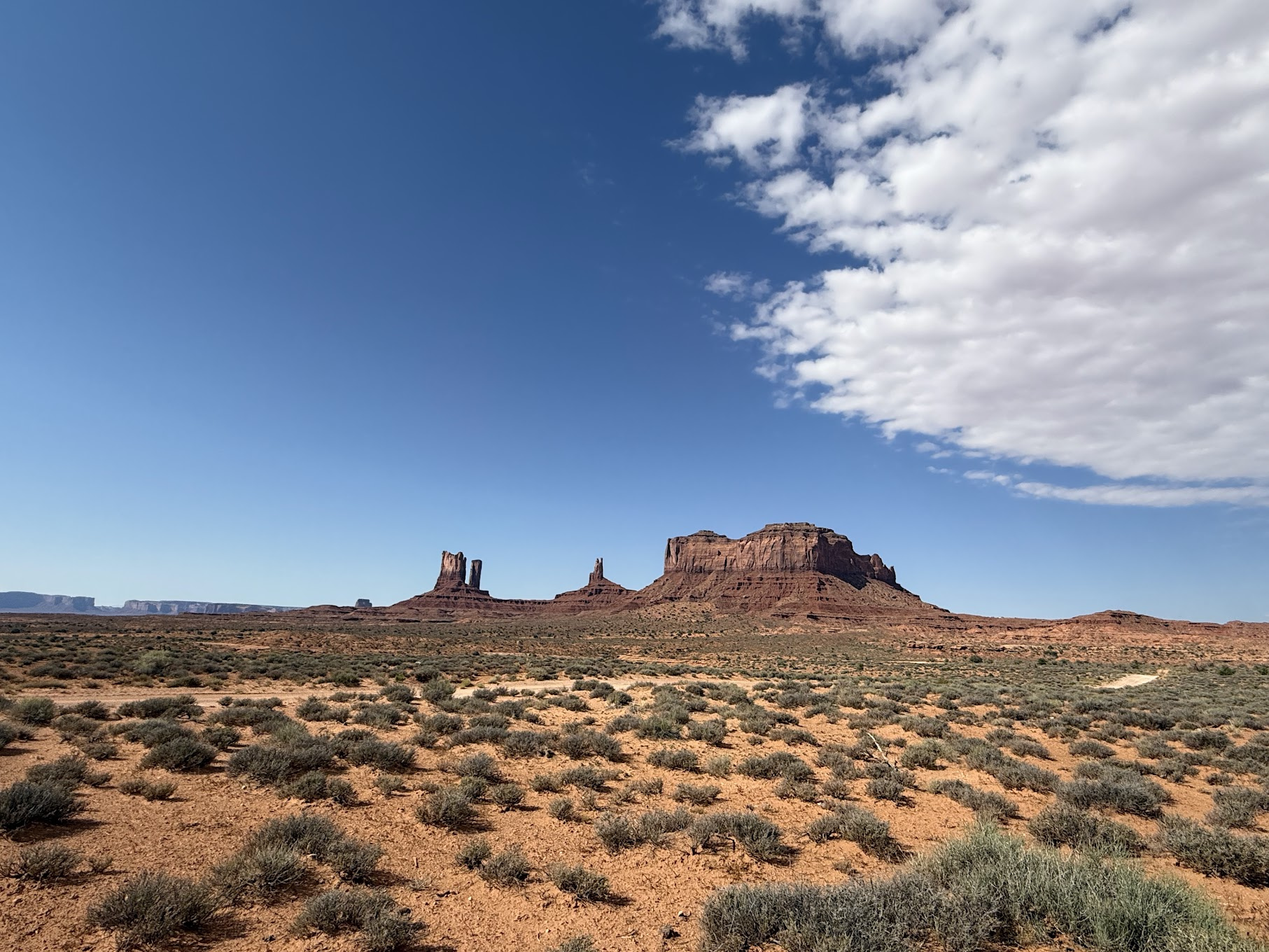
The view towards Monument Valley from Forrest Gump Point, July 2026.
This post contains affiliate links. We may earn a small commission, at no extra cost to you.
In summer 2026, we took a road trip through the American West, starting and finishing our first loop in Las Vegas before travelling on to Lake Tahoe, Yosemite and Los Angeles.
This is the trip as we actually experienced it: the route we drove, the hotels we stayed in, the places we visited, what the highlights were and what we’d do differently next time.
The route
Las Vegas → Hoover Dam → Route 66 → Sedona → Grand Canyon → Monument Valley → Horseshoe Bend → Las Vegas → Lake Tahoe → Yosemite → Los Angeles
Our route through Nevada, Arizona, Utah and California.
Trip at a glance
The trip
18-night family trip
The route
Nevada, Arizona, Utah and California
How we travelled
Two road-trip sections, with internal flights from Las Vegas to Reno and Fresno to Los Angeles
Las Vegas: where the trip began
We started the trip in Las Vegas. It was our first visit, and we wanted somewhere that would give us the full Vegas experience while still working well for a family travelling with teenagers.
The Las Vegas Strip, with the Eiffel Tower at Paris Las Vegas.
Where we stayed: Mandalay Bay
We chose to stay at Mandalay Bay, towards the southern end of the Strip. The pool was important to us for some downtime, as was having plenty of bars, restaurants and other facilities on site. More than anything, though, we wanted that big, larger-than-life Las Vegas resort experience.
Our room was spacious with a great view along the Strip. We wouldn’t describe it as especially luxurious or particularly modern, but it was very good and worked well for the stay. Compared with some of the rooms later in the trip, Mandalay Bay had more of the traditional ornate feel of a large American resort hotel.
We’d wondered whether being at the south end of the Strip might be inconvenient, but in practice it worked really well.
Mandalay Bay’s Shark Reef Aquarium was great too, and an easy attraction to visit without even leaving the resort.
Of all the hotels on the trip, Mandalay Bay was probably the one we’d most readily recommend purely as a property for a family with teenagers, largely because of the pool complex and easy access to shops and attractions.
We spent plenty of time simply exploring the Strip. The Bellagio fountains were a must for us, particularly as we’re fans of Ocean’s Eleven, and we enjoyed walking through some of the other famous hotels. The Venetian, with its canals and extraordinary indoor sky, Paris Las Vegas and the huge interior of Luxor were all worth seeing in their own right.
The indoor canals at The Venetian.
Away from the traditional Strip attractions, we visited AREA15, the Museum of Illusions and a retro arcade. Las Vegas worked just fine with teenagers who enjoyed the varied sights and the general buzz of Vegas. They obviously couldn’t take part in the casino side of Vegas, but there was still more than enough to keep everyone entertained. Just being in such a cool, larger than life place was plenty to keep everyone excited and entertained.
Was Las Vegas worth it?
Absolutely. We went because we wanted to experience Las Vegas for ourselves, and it also served as a great starting point for the trip. It didn’t disappoint. The heat in July was intense but was a dry heat which made it manageable.
We’d happily return. As it turned out, we did later in the same trip.
Hoover Dam and Route 66: the road trip begins
Leaving Las Vegas, we picked up our hire car and headed towards Arizona, with Hoover Dam as our first stop. It was an easy way to break up the journey and somewhere we’d wanted to see anyway before continuing towards Route 66.
Hoover Dam
Hoover Dam is one of those places where the scale is difficult to appreciate until you’re actually standing there. We didn’t need to spend hours exploring it. For us, it worked perfectly as the first stop on the drive from Las Vegas towards Arizona.
Our first taste of Route 66
From Hoover Dam we continued towards Kingman, where we joined historic Route 66. This was one of the parts of the trip we’d particularly been looking forward to. There is something special about actually driving a road you’ve heard about for years rather than simply using it to get from one place to another.
We stopped at one of the old Route 66 petrol stations along a stretch of the road that helped inspire the world of Cars. As fans of the films, that made the stop particularly memorable, but even without the connection it was a great place to get a feel for the history and character of the old road.
As we continued towards Seligman, the weather changed dramatically. July is monsoon season in Arizona and we encountered some impressive storms before eventually heading down from the relatively barren uplands to the more alpine landscape near Flagstaff and down towards Sedona. It is a gloriously scenic drive from Flagstaff to Sedona through plunging red rock canyons scattered with lush green vegetation. Apparently this route is a favourite of fans of the Cars film because of its similarities to the scenery on the film. After a long drive, our kids were genuinely captivated by the scenery and excited for the next leg of our journey.
The drive: Las Vegas to Sedona
Driving time: Allow around 5–6 hours of actual driving, depending on the Route 66 detours you take. With Hoover Dam, stops along Route 66 and breaks along the way, this can easily become a full day’s journey.
Our route: Las Vegas → Hoover Dam → Kingman → Route 66 → Seligman → Flagstaff → Sedona.
We wouldn’t rush this drive. Hoover Dam and the Route 66 section deserve proper time on the way to Sedona. The roads for most of the journey were straightforward, and the changing scenery made this one of the most memorable driving days of the trip. We saw diners, old locomotives, vintage Route 66 sights and really felt like we’d lived Route 66 not just driven on it. As Cars film fans, you could spot where the Pixar team had drawn inspiration for the film from this part of Route 66.
The old police car outside Mr D’z Route 66 Diner.
Sedona: red rocks and one of our favourite hotels
Arriving in Sedona felt like entering a completely different landscape. After the long drive from Las Vegas, Route 66 and Flagstaff, the red rock scenery surrounding the town was spectacular. We immediately understood why Sedona is such a popular stop on an Arizona road trip. I had learned about Sedona on a previous visit to Arizona and always wanted to visit this unique, iconic and beautiful landscape.
Sedona’s red rocks.
We stayed at Amara Resort and Spa, which turned out to be an excellent choice. We wanted somewhere within walking distance of shops, bars and restaurants, but also somewhere that felt part of the landscape.
Where we stayed: Amara Resort and Spa
Amara is a smart, rustic boutique hotel in a setting that worked brilliantly for us. It sits tucked away from the main road down by Oak Creek, which made it feel calm and private while still being within walking distance of Sedona’s shops, bars and restaurants.
The standout feature was the view from the infinity pool across the creek towards Sedona’s red rocks. It was one of those hotel settings that felt completely connected to the destination.
We also thought the service at Amara was excellent. In fact, of all seven hotels on the trip, Amara gave us the best overall service experience.
What we did in Sedona
Sedona was somewhere we were happy simply being outdoors. We drove up to Airport Mesa for the views across the red rocks, walked in Red Rock State Park and spent time around Oak Creek. The scenery is the main attraction here, and we found we didn’t need to pack the days with organised activities.
Slide Rock State Park was one of our favourite stops. It was easy to access, and swimming in the creek was wonderfully refreshing in the Arizona heat. For a family travelling in summer, we’d definitely recommend allowing some time for the water rather than spending the whole visit hiking in the heat.
A trip up to the Chapel of the Holy Cross is a must to get 360 degree views of the majestic red rock scenery surrounding Sedona.
Oak Creek at Slide Rock State Park.
Was Sedona worth it?
Definitely. Sedona was one of the places that exceeded our expectations. The scenery is spectacular, but what we particularly liked was the combination of the landscape with a town where we could walk to restaurants and bars in the evening.
We’d also happily stay at Amara again. Its location was a major part of why Sedona suited us so well.
We’ve now written a separate first-hand account of our stay, including Amara Resort & Spa, Slide Rock, Airport Mesa, the Chapel of the Holy Cross, where we ate and whether three nights felt long enough: 3 Nights in Sedona: What We Did, Where We Stayed & Where We Ate.
Grand Canyon: spectacular, even on a tight schedule
We left Sedona after breakfast and drove north to the South Rim of the Grand Canyon. This was one of the days when our itinerary was fairly tight: we wanted to experience the Grand Canyon but also needed to reach Monument Valley in time to see it before dark.
In the end, we spent around two hours at the South Rim, stopping at several viewpoints. Obviously, that isn’t enough time to explore the Grand Canyon in any depth, but it was enough to appreciate the extraordinary scale of the place and made far more sense to us than missing it altogether.
Looking across the Grand Canyon from the South Rim.
Is two hours at the Grand Canyon enough?
It depends what you want from the visit. If the Grand Canyon is one of the main reasons for your trip, we’d certainly allow much longer and ideally stay nearby. But as part of a wider road trip, we found that two hours at the South Rim was genuinely worthwhile.
We didn’t try to cram too much in. We concentrated on seeing the canyon from a few different viewpoints before continuing east towards Monument Valley. With limited time, that worked well for us.
Driving time: This was effectively a full day’s journey once our stop at the Grand Canyon was included.
Our route: Sedona → Flagstaff → Grand Canyon South Rim → Monument Valley.
The challenge was timing rather than the driving itself. We wanted enough time at the Grand Canyon to make the visit worthwhile, but we were also keen to reach Monument Valley before dark to see the sunset. It meant keeping the day moving, but arriving as the light was beginning to fade turned out to be a memorable way to see Monument Valley for the first time.
Monument Valley: somewhere we’d always wanted to see
Monument Valley was one of the stops we were most excited about when planning the route. There is a mystique to the place from seeing it so often in films and photographs, and arriving towards dusk made the first view particularly impressive.
The weather wasn’t completely on our side. July falls within the summer monsoon season, and the cloud meant we didn’t get the clear night skies we’d hoped for. Fortunately, the views the following morning were beautiful.
Monument Valley’s rock formations.
Where we stayed: The View Hotel
We stayed at The View Hotel, inside Monument Valley Tribal Park. For us, the main reason for choosing it was simple: the location. The rooms look directly out towards the famous Monument Valley landscape, so rather than having to drive somewhere for the views, they were right outside our window.
The room itself wasn’t one of the smartest or most high-end of the trip, but that didn’t really feel like the point of staying there. It suited the setting, and the character of the hotel added to the wider Monument Valley experience.
The absolute show-stopper by a mile was the view. Being able to look straight out over Monument Valley made the hotel feel like it belonged there.
Forrest Gump Point
The next morning we drove out to the famous view along the road towards Monument Valley. It’s one of those locations that looks instantly familiar, even before you stop the car. This view of the road cutting through the desert was already iconic when it featured in Forrest Gump.
As big fans of the Cars films, there was also something particularly fitting about driving through this landscape with “Life Is a Highway” playing in the car. It was one of those moments that ended up becoming a great memory from the trip.
Monument Valley’s buttes from the roadside, on our drive out the next morning.
Was Monument Valley worth it?
Absolutely. Monument Valley absolutely lived up to the mystique we’d built up around it before the trip. Staying at The View Hotel made a real difference because we were able to experience the landscape at dusk and again first thing the following morning rather than simply driving in, taking some photographs and leaving.
If we were doing the trip again, we’d stay there again. Even though the weather prevented us from seeing the night sky at its best, Monument Valley was still one of the most memorable stops of the road trip.
Horseshoe Bend and back to Las Vegas
We left Monument Valley in the morning and headed west via Page before continuing back to Las Vegas. Rather than treating it simply as a long driving day, we stopped at Horseshoe Bend along the way.
Horseshoe Bend
Horseshoe Bend is an easy place to recognise from photographs, but seeing the scale of it in person is quite different. It made a natural stop on our route and gave us a chance to break up the journey before the longer drive back towards Las Vegas.
We didn’t need to devote a huge part of the day to it. For us, it worked well as a stop on the journey rather than a destination around which we’d build an entire day.
Horseshoe Bend, near Page.
The drive back to Las Vegas
From Page, we continued west towards Las Vegas, passing close to Zion National Park on the way. This was another driving day where the journey itself was part of the appeal: long, open roads, blue skies and landscapes that seemed to change constantly as we travelled.
We didn’t visit Zion on this trip, but even the drive through this part of Utah made us realise how much there is to come back and explore another time.
Las Vegas again: a very different second stay
Returning to Las Vegas part-way through the trip gave us a chance to experience a different side of the city. Rather than going back to Mandalay Bay, we deliberately chose somewhere different for our second stay.
The Strip at night, with the Eiffel Tower and the Bellagio lake.
Where we stayed: Virgin Hotels Las Vegas
For our second visit we stayed at Virgin Hotels Las Vegas. It felt quite different from Mandalay Bay. It was smaller in scale, quirkier and more contemporary, which was exactly what we wanted.
The room was particularly memorable and felt brighter, smarter and more modern than Mandalay Bay. Mandalay had more of the traditional large-resort feel, whereas Virgin felt fresher and more contemporary.
The layout was unusual too, with a table between the beds that almost made the whole area feel like one large sofa. It gave the room a relaxed, lounge-like feel rather than a completely conventional hotel layout.
Of all seven hotels on the trip, Virgin probably represented the best value for money. It was one of the hotels that impressed us more in person than we expected from the photos.
The Mexican bar and restaurant was lively and busy, and the hotel had a relaxed atmosphere that we really enjoyed. In fact, we liked the stay enough that we wished we’d had another night there.
Was returning to Las Vegas worth it?
Definitely. Building Las Vegas into the route twice turned out to be a better decision than we expected. The two hotels gave us quite different experiences, and the second visit didn’t feel like simply repeating the first.
It also gave us a natural break between the desert road-trip section through Arizona and Utah and the next part of the journey at Lake Tahoe.
The Welcome to Fabulous Las Vegas sign.
Lake Tahoe: even better than we’d hoped
Lake Tahoe was one of the stops we were most excited about before the trip, largely because of those photographs of turquoise water, huge boulders and pine-covered mountains.
Even with those expectations, it didn’t disappoint. The combination of clear blue water, beaches and mountain scenery made it feel completely different from the desert landscapes we’d been travelling through only a short time earlier. It is visually stunning. We were excited about being in ‘Bear Country’ too! But despite much hope and keeping a look out for them, the bears remained elusive!
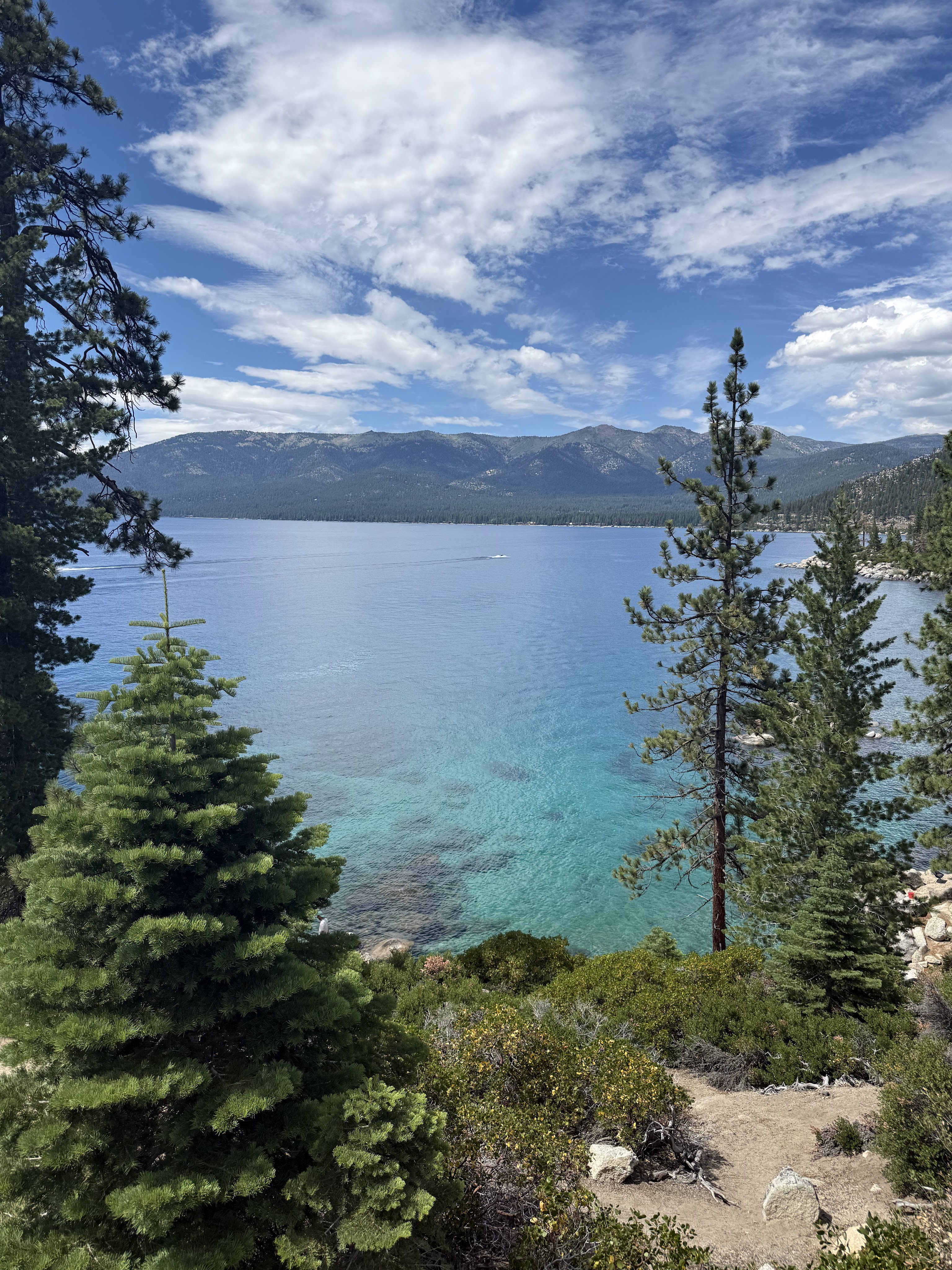
Lake Tahoe, with pine trees and mountains.
Getting to Lake Tahoe from Las Vegas
We flew from Las Vegas to Reno rather than driving all the way to Lake Tahoe. For our itinerary, this made much more sense than spending another full day in the car after the long driving days we’d already had through Arizona and Utah.
We picked up another hire car at Reno airport and drove from there to Lake Tahoe. Reno is relatively close to Tahoe, so this gave us the flexibility of having a car for exploring the area without having to drive the entire distance from Las Vegas.
Where we stayed: Edgewood Tahoe
We chose Edgewood Tahoe because we wanted a lakeside hotel with a real mountain-lodge feel, while still being close to South Lake Tahoe and its restaurants and bars. It turned out to be our favourite hotel of the entire trip.
The room made an immediate impression. It was luxurious and seriously smart, but still had an earthy, upmarket log-cabin feel that seemed completely right for Lake Tahoe. The layout was beautifully thought out, with a fabulous large bath and an enormous shower. It was one of those hotel rooms where we all walked in and immediately felt excited about staying there.
Looking back across the entire trip, Edgewood was our favourite hotel overall. The room was probably the best we stayed in too, although Regent Santa Monica ran it very close.
What pushed Edgewood ahead was the complete package: the lakeside location, room, grounds, facilities and the grand, luxurious feel of the whole resort. Everything felt superbly done.
The setting was just as impressive. Edgewood has large lawns leading towards the lake, its own beach and a lovely pool, so the hotel felt like somewhere to spend time.
One of the things we particularly liked was that it worked just as well for us as a family as it did as a luxury hotel. There was plenty of room for teenagers to enjoy the lawns while we relaxed nearby, and we really enjoyed having food and drinks at the golf club bar. The whole place had a relaxed feel despite being extremely smart.
For much more detail on the room, private beach, pool, service and why it became our favourite hotel of the trip, see our Edgewood Tahoe Review: Was It Worth It?
Edgewood Tahoe and its lawns, South Lake Tahoe.
What we did at Lake Tahoe
We didn’t feel the need to fill every day with activities at Lake Tahoe. A large part of the appeal was simply being beside the lake, and having Edgewood’s beach, pool and grounds meant we were quite happy spending time at the hotel too.
We did, however, want to see some of the places we’d associated with Lake Tahoe before the trip.
Sand Harbor
Sand Harbor was probably the classic Lake Tahoe scenery we’d pictured beforehand: clear turquoise water, huge granite boulders, beaches and pine trees rising behind them.
It was well worth making the trip from South Lake Tahoe. The combination of the water and mountain scenery was spectacular and very different from the beaches we’d experienced elsewhere on the trip.
We parked just north of Sand Harbor and caught the free shuttle bus, which saved us trying to find a parking space at Sand Harbor itself, as that can be difficult at busy times.
Clear water and granite boulders at Sand Harbor.
Taylor Creek and Emerald Bay
We also walked at Taylor Creek, which gave us another side of Tahoe. Rather than being about beaches and dramatic lake views, this was a quieter walk through the natural landscape around the southern end of the lake. We had high hopes of a bear sighting here (they are very common) but alas, no luck!
From Taylor Creek, we continued by car towards Emerald Bay. The drive itself became part of the experience, with lovely views and scenery as we made our way around this part of the lake.
Emerald Bay was another of those places that looked exactly as we’d hoped Lake Tahoe would look. The elevated views across the water and surrounding mountains were impressive and made this one of the most memorable scenic parts of our time at Tahoe.
One thing worth knowing about this drive is that there is a short stretch with some very steep drops beside the road and relatively little in the way of barriers. We were fine with it, and the section didn’t last long, but anyone with a particularly strong fear of heights may find this part of the drive uncomfortable. We were certainly pleased when the road returned to more level ground!
South Lake Tahoe
We also spent some time in South Lake Tahoe itself. One of the advantages of staying at Edgewood was being close enough to head into town easily for food and drinks, while still having the lakeside setting of the hotel.
We particularly liked The Woods, a relaxed sports bar that suited us well as a family. There were other good eateries and bars in the same vicinity. It was the sort of place where we could get something to eat, have a drink and watch sport without needing to plan the evening around a restaurant reservation.
South Lake Tahoe itself is quite different from the quieter, more scenic parts of the lake we’d explored during the day, but we liked having both. We could spend the day around the lake and then have plenty of choice for somewhere casual to eat or drink in the evening.
Driving around Lake Tahoe
Having a car made exploring Lake Tahoe much easier. The distances around the lake are greater than they can appear on a map, so being able to drive between places such as Sand Harbor, Taylor Creek and Emerald Bay gave us much more flexibility.
Most of the driving we did was straightforward and the scenery was always beautiful. There are, however, some stretches of road around the lake that are more elevated and exposed than others. If you’re particularly uncomfortable with heights, it’s worth looking at your route beforehand rather than assuming that every lakeside road will feel the same.
For us, the benefits of having a car easily outweighed this. It allowed us to stay at Edgewood, explore different parts of the lake at our own pace and still have South Lake Tahoe nearby for restaurants and bars in the evening.
Was Lake Tahoe worth it?
Absolutely. Lake Tahoe was one of the places we’d been most excited about before the trip, and it was even better than we’d hoped. The combination of clear blue water, huge boulders, beaches, pine forests and mountains really is as spectacular as it looks in photographs.
Staying at Edgewood was a big part of the experience for us. It wasn’t simply somewhere to sleep between days exploring the lake. The beach, pool, lawns and setting meant we genuinely enjoyed spending time at the hotel too.
If we returned, we’d happily stay at Edgewood again and we’d allow plenty of time simply to enjoy the lake rather than trying to fill every day with sightseeing. Lake Tahoe ended up being one of our favourite stops of the entire road trip.
Clear turquoise water and pines on the Lake Tahoe shore.
Getting from Lake Tahoe to Yosemite
Rather than taking the more direct route from Lake Tahoe towards Yosemite via US-395 and Tioga Pass, we chose the longer route around the western side of the mountains and approached Yosemite via Mariposa and Highway 140. This was to avoid driving along exposed high roads with steep drops.
There were a couple of steeper sections as we headed away from Lake Tahoe, but we found them absolutely fine. After that, the drive was surprisingly varied. We came out of the mountains onto the flatter plains and passed through some classic American small towns before eventually turning back towards the hills.
The final part of the journey towards Yosemite was particularly beautiful. The landscape gradually became hillier and more dramatic again as we approached the park, so the drive from Lake Tahoe to Yosemite stayed interesting all the way.
The route took longer than the more direct option, but we were happy with our choice. For anyone who isn’t keen on very exposed mountain roads or steep roadside drops, it may be an alternative worth considering.
For Yosemite, our priority was staying inside the valley rather than driving in and out each day. As well as making it easier to explore without worrying about traffic and parking, we liked the idea of staying in a traditional mountain-lodge-style hotel that felt part of Yosemite itself.
That led us to The Ahwahnee.
Yosemite Valley’s granite cliffs.
Where we stayed: The Ahwahnee
Arriving at The Ahwahnee felt a little like stepping back in time. We’d known about the hotel’s history and some of its famous visitors before we arrived, but actually being there was quite different. The building, its interiors and its setting give the whole place a sense of history that is difficult to recreate in a modern hotel.
Our room added to that feeling. It felt almost like a time capsule, and that seemed entirely intentional. Rather than trying to feel modern, it carried the same historic, forest-lodge character as the rest of The Ahwahnee.
A bit like The View at Monument Valley, the room made most sense as part of the wider setting and experience. The historic atmosphere, the lodge itself and the extraordinary Yosemite Valley location are all part of what you’re paying for.
The location is perhaps even more remarkable. The hotel feels tucked away in Yosemite Valley, surrounded by meadow, trees and the enormous rock faces rising around it.
We hadn’t chosen The Ahwahnee because we wanted a conventional modern luxury hotel. We chose it for the location, the mountain-lodge character and the history, and those were exactly the things that made staying there memorable.
Once we’d checked into The Ahwahnee, we didn’t try to cram too much into our first evening. We headed out to El Capitan Meadow, where we could simply take in the scale of the valley and the enormous rock face towering above us.
It was a great introduction to Yosemite. After the journey from Lake Tahoe, being able to leave the car behind and spend some time in the meadow surrounded by the scenery was exactly what we’d hoped for from staying inside the valley.
Exploring Yosemite by bike
The following day we hired bikes from Yosemite Village and set off to explore the valley, following the loop trail anti-clockwise from The Ahwahnee.
The bikes were simple single-speed hire bikes, which were perfectly suited to the paved paths but rather harder work on some of the rougher sections of the loop. It is possible to ride the route on them (we did), but with hindsight we’d simply have got off and pushed the bikes over some of the rockier sections. On mountain bikes those parts would have been considerably easier.
Despite that, the ride was great fun and one of the best ways we found to get a real feel for Yosemite Valley. The terrain and scenery constantly changed as we made our way around, with the river rarely far away.
Some of the most memorable moments came as we emerged from the woods and suddenly found the enormous rock faces towering above the valley, drenched in sunlight. However many photographs you’ve seen of Yosemite, experiencing the sheer scale of those cliffs from the valley floor is something else entirely.
Cathedral Beach
We stopped at Cathedral Beach during the ride for a much-needed swim in the river. After cycling around the valley, getting into the water was incredibly refreshing and it was a fantastic place to take a break before continuing the ride.
By the time we eventually made it back to The Ahwahnee, we certainly felt as though we’d earned the cold beer at the hotel afterwards. The bikes may not have been ideal for every part of the trail, but we’d definitely explore the valley by bike again. We’d just be quicker to get off and push them over the rougher sections next time.
The Merced River at Cathedral Beach.
Staying inside Yosemite Valley
One of the best decisions we made at Yosemite was staying inside the valley. Once we’d arrived at The Ahwahnee, we barely needed the car. We could walk, cycle or simply head out from the hotel and immediately feel as though we were in the middle of Yosemite.
That was particularly valuable because we’d heard how busy the roads and parking in Yosemite can become. Rather than spending part of our stay driving in and out or looking for somewhere to park, we could leave the car behind and concentrate on enjoying the valley.
Staying at The Ahwahnee was certainly more expensive than staying outside the park, but for this particular part of the trip we felt the location was worth paying for.
Was Yosemite worth it?
Absolutely. Yosemite is one of those places where photographs don’t really prepare you for the scale of the landscape. Standing on the valley floor with the huge cliffs rising around you is quite extraordinary.
What we particularly liked was that we didn’t need a complicated itinerary to enjoy it. An evening at El Capitan Meadow, cycling around the valley, swimming in the river and simply spending time surrounded by the scenery gave us the Yosemite experience we’d hoped for.
We’d definitely return. We’d also stay inside the valley again if the budget allowed. Being able to leave the car behind for much of our stay made a real difference.
The drive from Yosemite to Fresno
We left Yosemite for Fresno Airport and deliberately chose the route out through Mariposa rather than taking the more direct mountain roads south. For us, it was a good choice.
The drive out of Yosemite towards Mariposa was scenic and varied, before the landscape gradually opened out as we reached the Central Valley. From there, the journey took us through agricultural country and some of the smaller towns of central California before continuing south towards Fresno.
One of the reasons we chose this route was that we were keen to avoid roads with long stretches of exposed drops. We found the route comfortable to drive and, rather than feeling like wasted travelling time, the changing scenery made it an interesting final drive through California’s interior.
At Fresno Airport we returned our hire car and took the very short flight down to Los Angeles for the final part of the trip. After several days of mountains, lakes and national parks, finishing beside the Pacific in Santa Monica felt like another complete change of scenery.
Los Angeles: finishing the trip in Santa Monica
Los Angeles was the final stop on our road trip and, after the deserts, mountains and national parks of the previous couple of weeks, arriving on the California coast felt like another completely different part of the holiday.
Rather than staying in central Los Angeles, we chose Santa Monica. We wanted to be beside the beach, somewhere we could walk to restaurants, shops and the pier, while still being able to visit the other parts of Los Angeles we wanted to see.
We stayed at Regent Santa Monica Beach, right beside the ocean, and it proved to be an excellent base for the final few days of the trip.
Santa Monica beach and pier at sunset.
Where we stayed: Regent Santa Monica Beach
We chose Regent Santa Monica Beach because we wanted to finish the trip somewhere special, right beside the ocean but also within easy reach of Santa Monica Pier, shops and restaurants.
The hotel itself felt clean, spacious and extremely smart. There was lots of stone throughout the interior, with calming neutral tones that gave it a contemporary, luxurious feel. What we particularly liked was that it managed to feel very upmarket without becoming stuffy or pretentious. The atmosphere was relaxed but chic, with a chilled feel that suited its beachfront location perfectly.
The pool was another highlight. It overlooks the beach and ocean, but rather than feeling like a huge resort pool area, it felt quite compact and secluded, tucked between the hotel buildings. It was a great place to relax while still feeling very much as though we were staying beside the Pacific.
The biggest surprise was our room. Walking through the door gave us a genuine wow moment.
It was large, bright and genuinely luxurious, with a slightly Art Deco feel. More than anything, it felt like a penthouse apartment rather than a conventional hotel room.
The huge television, curved sofas, enormous beds and generous bathroom area all added to the sense of space.
It was one of the two best rooms of the entire trip and ran Edgewood very close for the top spot.
The Regent Santa Monica Beach, looking out over the Pacific.
Santa Monica
Santa Monica worked extremely well for us as a base in Los Angeles. We liked being able to leave the hotel and walk to the beach, pier, shops, restaurants and bars rather than having to get into a car every time we wanted to go somewhere.
Before the trip, we’d wondered a little about how Santa Monica would feel, particularly in the evenings, but we felt comfortable walking around and found plenty of places that worked well for a family with teenagers. There was a good choice of casual restaurants and bars, as well as plenty of shopping within easy walking distance.
Santa Monica Pier was perhaps a little more faded around the edges than we’d imagined, but that was actually part of its appeal. It felt like a genuine old Californian seaside pier rather than something that had been polished into a modern tourist attraction. There was something slightly nostalgic about it, almost the sort of atmosphere we’d associated with California from films such as The Lost Boys.
What we particularly liked was the contrast. We could spend some time around the pool or beach, wander into Santa Monica for food and shopping, but still use it as a base for completely different days elsewhere in Los Angeles.
Visiting the USS Iowa
One of our days away from Santa Monica was spent visiting the USS Iowa. We were particularly interested in seeing the battleship, so getting the chance to go aboard such a huge and famous ship was always going to be a highlight.
There’s a predetermined route that takes you around the ship, with helpful volunteers along the way who can explain what you’re looking at and answer questions. We found this worked really well because there’s an enormous amount to take in.
The ship itself is a stunning piece of engineering, steeped in history. The sheer scale is difficult to appreciate until you’re actually standing on board, not least the size of the guns, which are quite extraordinary. But there’s much more to the visit than the weaponry. You also get a fascinating insight into the complexity of the ship and what day-to-day life was like for the sailors who served aboard her.
We spent around three to four hours there and never felt as though the visit was only for serious naval enthusiasts. Whether you’re interested in battleships, engineering and technology, military history or simply curious about how thousands of people lived and worked aboard a ship like this, there’s plenty to see.
For our son, being able to explore a real battleship of this scale was one of the highlights of the whole trip. Even without a particular interest, though, anyone would have found it difficult not to be impressed by the size, complexity and sheer aura of the Iowa.
The main deck and gun turrets of the USS Iowa.
Disneyland California Adventure
One of the things we’d been looking forward to most in Los Angeles was visiting Disney California Adventure, particularly Cars Land. We’d been fans of the Cars films for years, and after driving parts of historic Route 66 earlier in the trip, this felt like a fitting way to bring that particular thread of the holiday full circle.
Walking into Cars Land for the first time was quite emotional. It really did feel as though we’d somehow arrived in Radiator Springs. It was much bigger than we’d expected and the attention to detail was fantastic. For long-time Cars fans, it was difficult to imagine how they could have done it much better.
Radiator Springs Racers was the highlight. We’d expected it to be good, but the ride was considerably better than we’d anticipated and ended up being one of our favourite attractions of the day. Experiencing it after finally seeing Cars Land for ourselves made it even more memorable.
The rest of California Adventure impressed us too. We’ve previously visited Disney and Universal parks in Florida and didn’t feel that this was a lesser experience. If anything, we preferred some aspects of it. The park felt more compact and manageable, while still having far more to do than we could fit into a single day.
It was busy, but pleasantly so. We didn’t encounter the sort of enormous queues that can dominate a theme-park day, and we were able to spend our time enjoying the park rather than feeling as though the whole day revolved around waiting for rides.
We could easily have spent three days exploring the Disney parks rather than the single day we’d allowed. But for this particular trip, California Adventure, and especially finally getting to experience Radiator Springs, was one of the perfect ways to finish our journey across the American West.
Radiator Springs at Disney California Adventure.
Getting around Los Angeles
We didn’t hire a car for our time in Los Angeles. Around Santa Monica we simply walked, which was another reason we were pleased we’d chosen to stay there. The beach, pier, shops, restaurants and bars were all within easy reach of the hotel.
For the trips further afield, we used Uber. We took one to the USS Iowa and another to Disney California Adventure, which meant we didn’t have to worry about Los Angeles traffic, navigating or parking.
For Disney California Adventure, we left Santa Monica at around 8am and the journey took less than an hour. The return journey was similarly straightforward. We’d wondered whether staying beside the coast might make visiting other parts of Los Angeles inconvenient, but in practice the combination of walking around Santa Monica and using Uber for the longer journeys worked extremely well for us.
Was Los Angeles worth it?
Definitely. Santa Monica gave us a completely different ending to the trip after the deserts, mountains and national parks we’d travelled through beforehand. Being able to finish beside the Pacific, with the beach immediately outside the hotel and plenty to do within walking distance, worked brilliantly.
We also liked that we didn’t need to spend our whole time sightseeing around Los Angeles. The USS Iowa and Disney California Adventure gave us two very different days out, while the rest of the time could be spent enjoying Santa Monica, the beach and the hotel.
If we returned, we’d happily stay in Santa Monica again. We’d also be tempted to allow more time for the Disney parks, but for this trip the balance felt about right. It was a great place to finish what had been an incredibly varied journey.
What we’d change if we did the trip again
For the time we had available, there honestly isn’t much we’d change. We could easily have spent longer at almost every stop, but that would have meant either extending the trip or leaving somewhere else out. Looking back, the balance felt about right.
If we’d had just one extra day, the one change we’d probably have made would have been on the journey from Monument Valley back to Las Vegas. Rather than doing it all in one day via Horseshoe Bend, we’d have been tempted to stay somewhere overnight and use the extra time to visit Zion National Park. We drove close to Zion on our way back to Las Vegas, and the scenery alone made us wish we’d had time to explore it properly.
Lake Tahoe was another place where we could happily have stayed longer. Edgewood was fantastic and the lake itself was every bit as spectacular as we’d hoped. If there was one slight downside, it was that South Lake Tahoe didn’t quite have the distinct, walkable resort centre we’d perhaps imagined: somewhere with everything clustered together that you could simply wander around in the evening. There were plenty of restaurants, bars and things to do, but they felt a little more spread out.
Other than that, we’d genuinely keep the itinerary much as it was. It was busy without feeling as though we were constantly rushing, and the variety was probably what made the trip work so well: Las Vegas, Route 66, red-rock desert, the Grand Canyon, Monument Valley, Lake Tahoe, Yosemite and finally the Pacific coast all felt completely different from one another.
And although we called it a road trip, breaking up the longer distances with flights from Las Vegas to Reno and Fresno to Los Angeles was something we’d definitely do again. It allowed us to cover a huge amount of the American West without turning too many days into long motorway journeys.
Planning this route: quick answers
How long is this trip?
We had 18 nights. If we did it again we’d add a night after Monument Valley and stop at Zion on the way back to Vegas.
What order did we go in?
We started and finished the desert part in Las Vegas, going via Hoover Dam, Route 66 and Sedona to the Grand Canyon, then Monument Valley and Horseshoe Bend. We then flew to Reno for Lake Tahoe, drove down to Yosemite and flew from Fresno to Los Angeles.
Did we drive all of it?
No, we took two short internal flights. Driving from Vegas to Tahoe or from Yosemite to LA would each have used up most of a day.
Do you need to pay extra to visit the national parks?
If you live outside the US, yes. Since 1 January 2026, visitors who aren’t US residents pay an extra $100 each (aged 16 and over), on top of the normal entry fee, at 11 of the busiest national parks. The Grand Canyon and Yosemite are both on the list. The other option is the $250 non-resident annual pass, so it’s worth working out which costs less for your group. Monument Valley is different: it’s a Navajo tribal park with its own entry fee, and national park passes aren’t accepted there. Prices change, so check the National Park Service and Navajo Parks websites before you go.
Is it a good trip with teenagers?
Ours enjoyed it. Every few days the scenery changed completely, and they liked spotting places from the Cars films on Route 66 before we got to Cars Land.
Our USA road trip: final thoughts
This trip took a lot of research and planning, so perhaps the biggest satisfaction was that it turned out every bit as good as we’d hoped, if not better.
From the beginning, one of the things we wanted most was variety. We wanted the neon and spectacle of Las Vegas, the red rocks of Arizona, Route 66, the vast landscapes of the Grand Canyon and Monument Valley, the clear blue water and mountains of Lake Tahoe, Yosemite Valley and finally the beaches of California. Looking back, it was the contrast between all of those places that made the journey so memorable.
There were also lots of connections to things we’d enjoyed as a family long before the trip. We’re big Cars fans, so driving through the red-rock landscapes of the American West and feeling like Lightning McQueen and Mack Truck out on the highways brought some of that childhood magic to life. Finishing the trip at Cars Land and walking into what genuinely felt like Radiator Springs was a fitting way to bring that part of the journey full circle.
That helped make the trip work particularly well when travelling with teenagers. Some stops connected directly with things they’d loved growing up or are interested in now, while the sheer variety meant that the holiday was constantly changing. Just as we’d become accustomed to one landscape or type of place, we’d move on to something completely different.
Most of all, though, we simply loved the trip. We came home with so many memories that we’ll remember forever. There are plenty of places we’d happily return to and plenty more of America we’d like to see, but for the time we had available, we wouldn’t change the journey we took.
It was the road trip we’d spent so long planning and, in the end, it was even better than we’d imagined.
Affiliate links: if you book through one of these links, we may receive a commission at no extra cost to you.
Want our full plan?
All that planning took us about a week of evenings, 30 to 40 hours. Our 36-page USA Road Trip Pack puts it all in one place: every base and how many nights, which legs we drove and which we flew, what to book first, where we ate and a printable checklist. £14.99 launch price until 31 January (usually £19.99).
Not ready to book yet?
Leave your email and we’ll send you two free sample pages from our 18-night USA Road Trip Pack, plus the odd email about our trips and the pack. No spam, and you can unsubscribe at any time.
You’ll get a confirmation email from WordPress.com first. Click it and your pages arrive. How we use your email: Privacy page.