Tag: Outdoors & scenery

  • A Week in Provence With Teenagers: Our Itinerary From Lourmarin

    A Week in Provence With Teenagers: Our Itinerary From Lourmarin

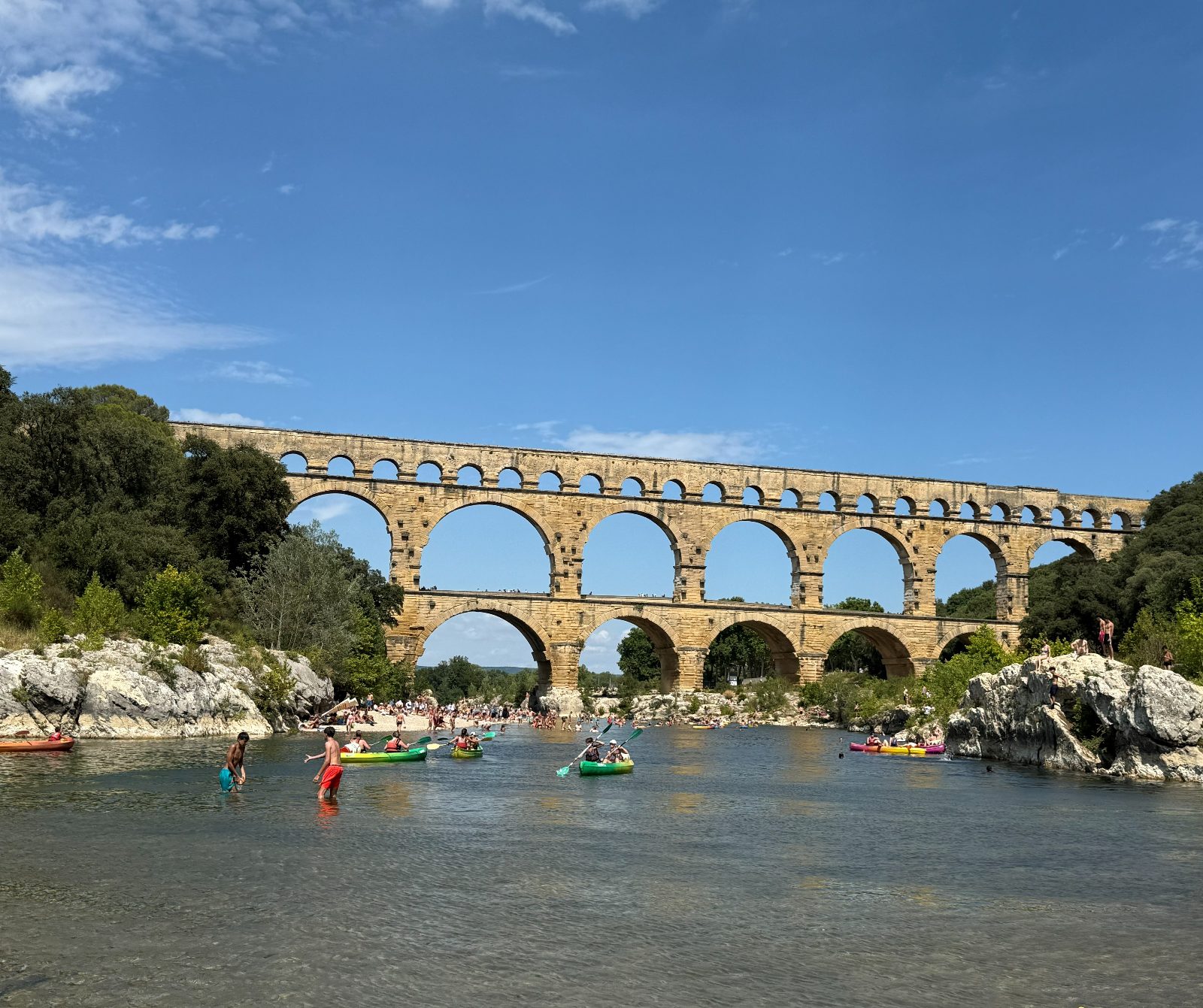
    Canoes on the Gardon below the arches of the Pont du Gard
    Provence – France 🇫🇷

    Beautiful Rivers, Town & Villages in Provence from a Lourmarin base

    Canoes below the Pont du Gard, July 2025.

    This post contains affiliate links. We may earn a small commission, at no extra cost to you.

    In July 2025 we spent a week in Provence with our two teenagers, based at a campsite just outside Lourmarin in the Luberon. Seven nights turned out to be a good length. Below is our week day by day, with what the teens thought and what we’d do differently.

    We’d enjoyed staying on this kind of campsite in Annecy and enjoyed having our own space and being able to sit and cook outside. So we sought somewhere similar in a location that would let us explore Provence. The trigger for the trip was that we fancied a campsite holiday in France again, so we decided on a region and looked for a base in that region. We wanted a pool and facilities for the kids, pretty surroundings, and to be able to walk out to a local town or village with things to do.

    Our week at a glance

    BaseCampasun Les Hautes Prairies, Lourmarin, in a Chalet Luberon 4 Jacuzzi
    WhenLate July 2025, seven nights
    WhoTwo adults and two teenagers
    Getting thereFlew to Marseille and hired a car at the airport, about an hour’s drive from Lourmarin
    Car needed?Yes. Every day out was a drive. Compare car hire at Marseille Airport
    Longest drivesThe beach and the Pont du Gard, each 75 to 90 minutes each way
    Best daysThe two river days, too close to call
    What we’d skipNothing

    Is Lourmarin a good base for Provence?

    Lourmarin's Protestant temple and bell tower among olive trees, with the village behind
    Lourmarin’s Protestant temple, with the village and château behind

    Yes. It sits in the middle of the Luberon, so most of what we wanted to see was a day trip away.

    It was a very good hub giving us a good reach.

    Lourmarin was great for a late-afternoon wander: slow paced, with a typical French atmosphere. The walk to the village from the campsite was about 10 minutes down the hill. We’d walk in for a few hours in the late afternoon or early evening, then head back to the site, where most nights we ate at the poolside restaurant or cooked fresh food on the plancha. We did eat out in Lourmarin a couple of times, and there’s a good choice of restaurants, ranging from simple and relaxed to more sophisticated. There are lots of interesting places to pop into too, from cafés and wine bars to a fabulous pottery shop that sold some really nice bespoke stuff.

    What surprised us most was how much we liked Lourmarin itself. Along with the rivers, it was the part of the week that beat our expectations.

    Day 1: Arriving in Lourmarin

    A shady gravel lane between mobile homes and pine trees at the campsite
    Our lane at the campsite, a 10-minute walk from the village

    We flew to Marseille and picked up a hire car at the airport. The drive up was easy.

    First impressions were that this is picture-postcard France.

    Day 2: Fontaine-de-Vaucluse and canoeing the Sorgue

    Our first day out was to Fontaine-de-Vaucluse, about 50 minutes from Lourmarin, where the Sorgue rises from a deep green pool under the cliffs. From there we canoed downriver with Kayak Vert.

    This was my personal highlight. I love being on/by the water and canoeing twice down the Sorgue and the Gardon, two beautiful rivers, was just the best way to spend hot sunny days.

    It took us two to three hours on the water, I’d say. We didn’t rush.

    The teenagers loved the chutes, the small weirs you slide down in the canoe along the way. Kayak Vert runs the Sorgue trip from mid-May to the end of September. In July 2026 it costs €29 for adults and €15 for under-14s (Kayak Vert’s site, checked November 2026).

    Day 3: A beach day on the Côte Bleue

    Swimmers in the clear shallow water at Plage du Verdon, with a rocky headland beyond
    Plage du Verdon at La Couronne, near Martigues

    We fancied a beach day to break things up. I did some research which indicated Plage du Verdon, at La Couronne near Martigues, was a nice accessible beach with good parking and facilities. It probably took 90 minutes or so to get there. It was an interesting drive during the less urban parts. We wouldn’t have wanted to drive that far every day, but we’d heard the coast was pretty. There’s plenty to do in the region, so if people don’t fancy the drive then fair enough.

    Google Maps puts it at about an hour and a quarter in light traffic. The beach is free, but you pay to park.

    Day 4: Avignon

    I’d always wanted to visit Avignon. The place drips with centuries of history, intrigue and life.

    In Avignon we just had a mosey round. We had a drink in the square, looked at the palace, went to a few shops (one sold good smelly soap that the Missus loved), grabbed a bit of lunch and then looked at the bridge.

    Avignon is about an hour from Lourmarin by the motorway (there are tolls), or an hour and a quarter on the D900.

    Day 5: Gordes, then an evening in Lourmarin

    Gordes and the other hilltop villages were charming places: picture-postcard France, with the views, blue skies and bustling old streets in a classic French style. It was busy, but that’s to be expected. I wouldn’t let it put anyone off going. We only stayed in Gordes for a couple of hours.

    Gordes is often called the prettiest village in the Luberon, and having seen it we can see why, though we didn’t get to all the contenders. Lourmarin is a different kind of pretty: a classic French village with its square, winding streets and château.

    Both are on the official list of Les Plus Beaux Villages de France. Gordes is about 45 minutes from Lourmarin.

    Some of the roads, particularly driving through the villages, can be tight if there’s someone coming the other way. It is annoying, but you can still get around. Again, it’s not a reason not to drive to or through these places unless you’re a nervous or impatient driver.

    Back in Lourmarin we spent the evening in the village, including a drink at Le Tonneau, a small wine bar and épicerie. (Hours vary by season, so check before you go.)

    Day 6: A rest day: the château, the market and the pool

    We did decide to have a lower driving rest day which was nice.

    We stayed in Lourmarin, went to the Friday market (every Friday morning, 8am to 1pm) and visited the Château de Lourmarin.

    It was a busy, varied market with plenty of stalls and customers. Worth a mosey round for an hour.

    Another classic French setting. The château against the backdrop of the town was stunning. The château had many historical items and lots of explanation of its history. The kids were interested. We were only there a couple of hours max.

    The château is open every day of the year apart from mid-January, Christmas Day and New Year’s Day. In 2026 adult tickets cost €8 (checked November 2026).

    That evening was a barbecue at the campsite.

    The campsite pool at dusk, with the sun low over the trees
    The campsite pool as the sun went down
    Sausages, skewers and steaks cooking on a plancha
    Rest-day barbecue on the plancha

    Day 7: Canoeing under the Pont du Gard

    Can you canoe and swim under the Pont du Gard?

    Yes. We canoed down the Gardon with Kayak Vert from Collias, about 8 km, and stopped to swim below the bridge on the way. A shuttle brings you back to the base at Collias. Collias is about an hour and a half from Lourmarin.

    Brilliant. A big highlight. We all loved it. The rivers are stunning.

    Walking onto the bridge is free, and parking at the Pont du Gard site costs €9 per car. Swimming is at your own risk and there are no lockers (Pont du Gard official site, checked November 2026). The 8 km Kayak Vert trip from Collias costs €27 for adults and €14 for children aged 6 to 13 in 2026, including the shuttle back (Kayak Vert’s site, checked November 2026).

    Where we stayed: Campasun Les Hautes Prairies

    The pool and clubhouse at Campasun Les Hautes Prairies
    The pool and clubhouse at Campasun Les Hautes Prairies

    Campasun Les Hautes Prairies is a four-star campsite on the edge of Lourmarin, with a water park, slides, a heated pool and a restaurant and bar. It opens from April to early October (2026 dates). We had a Chalet Luberon 4 Jacuzzi, a chalet for four with a covered terrace and its own hot tub, and we’d choose the same again. For four of us in peak July, the chalet felt good value next to a hotel.

    Bed linen, towels and end-of-stay cleaning are paid extras, so ask for them when you book. Some chalets come with a plancha, and you can hire one at reception if yours doesn’t. There’s a €500 card deposit on arrival. Barbecues with an open flame aren’t allowed anywhere on the site, but planchas are fine and there’s a shared barbecue area.

    Apart from a couple of days, we tended to arrive at the pool once we’d returned from our travels, so although it was busy, sunbeds were easy to get. At peak times it was pretty crowded, but we did manage to get some.

    There was a buzz near the restaurant and bar but it was quiet near the accommodation. There were pretty clear skies at the site: we could see the Milky Way. There was loads of room on open ground for the kids to play football and so on.

    The campsite team were very friendly and helpful but some did have limited English (albeit a lot better than my French!). I do speak enough French though to get by and this helped enormously. That’s not to say that if you don’t speak any French you’ll struggle but my wife was pleased I speak French – let’s put it that way!

    There was a mix of nationalities, and the site was just as the listing showed it. We booked months ahead and nothing was sold out.

    Is a Provence campsite good with teenagers?

    The campsite had families of all ages. But the site and the nature of it, along with the nature of our trips are better suited to teenagers.

    Planning a stay?

    Where we stayed: Campasun Les Hautes Prairies, Lourmarin. We booked direct.

    If you’d rather a hotel: check hotels in Lourmarin on Booking.com (we didn’t stay at these).

    Car hire: compare car hire at Marseille Airport

    Affiliate links: if you book through one of these links, we may receive a commission at no extra cost to you.

    What we’d change

    The only drawback of our trip was that it was a lot of driving to go to all the places we saw. We’ve no regrets because they were all great. We’d maybe add another lower-driving rest day if we went for a week again.

    One thing I wish I’d known was that the lavender wouldn’t be out. We were tied to going during the school holidays, but in an ideal world we would have gone when the lavender was in full bloom.

    In the Luberon the lavender usually starts to flower in mid-June and is at its best from late June into early July, with the harvest under way during July. Dates shift with the weather each year.

    We could easily have stayed a few days longer. We’d have slowed down a bit, spent longer in the villages maybe and had long lunches. There are other places to visit too, like the Calanques near Marseille, the Gorges du Verdon to the east and other villages.

    What if it rains?

    We had great weather all week, so it’s hard to say from experience. The towns and villages we visited all had plenty of shops, cafés and restaurants to duck into, Avignon has plenty going on, and Marseille is within reach if you want lots of choice.

    Who this week suits

    This week suits families with teenagers who like being on the water as much as wandering villages. The weather was hot and settled, apart from one short, spectacular storm, eating out felt fairly priced, and paying for parking at the sights was fine.

    It suits less well if you don’t enjoy driving, want a pure beach holiday, or have toddlers.

    People who would prefer hotel facilities perhaps wouldn’t like the site, but they can always find other accommodation in Lourmarin.

    Would we do it again?

    Yes.

    It’s a good base to just totally relax in Lourmarin, which is lovely, or to travel round the sights in the wider region like we did.

    More from our trips

    Our campsite stay in Annecy is what started this trip: see our Interlaken & Lake Annecy trip and swimming in Lake Annecy.
  • Can You Do Lake Tahoe and Yosemite in One Trip? Our Six Nights

    Can You Do Lake Tahoe and Yosemite in One Trip? Our Six Nights

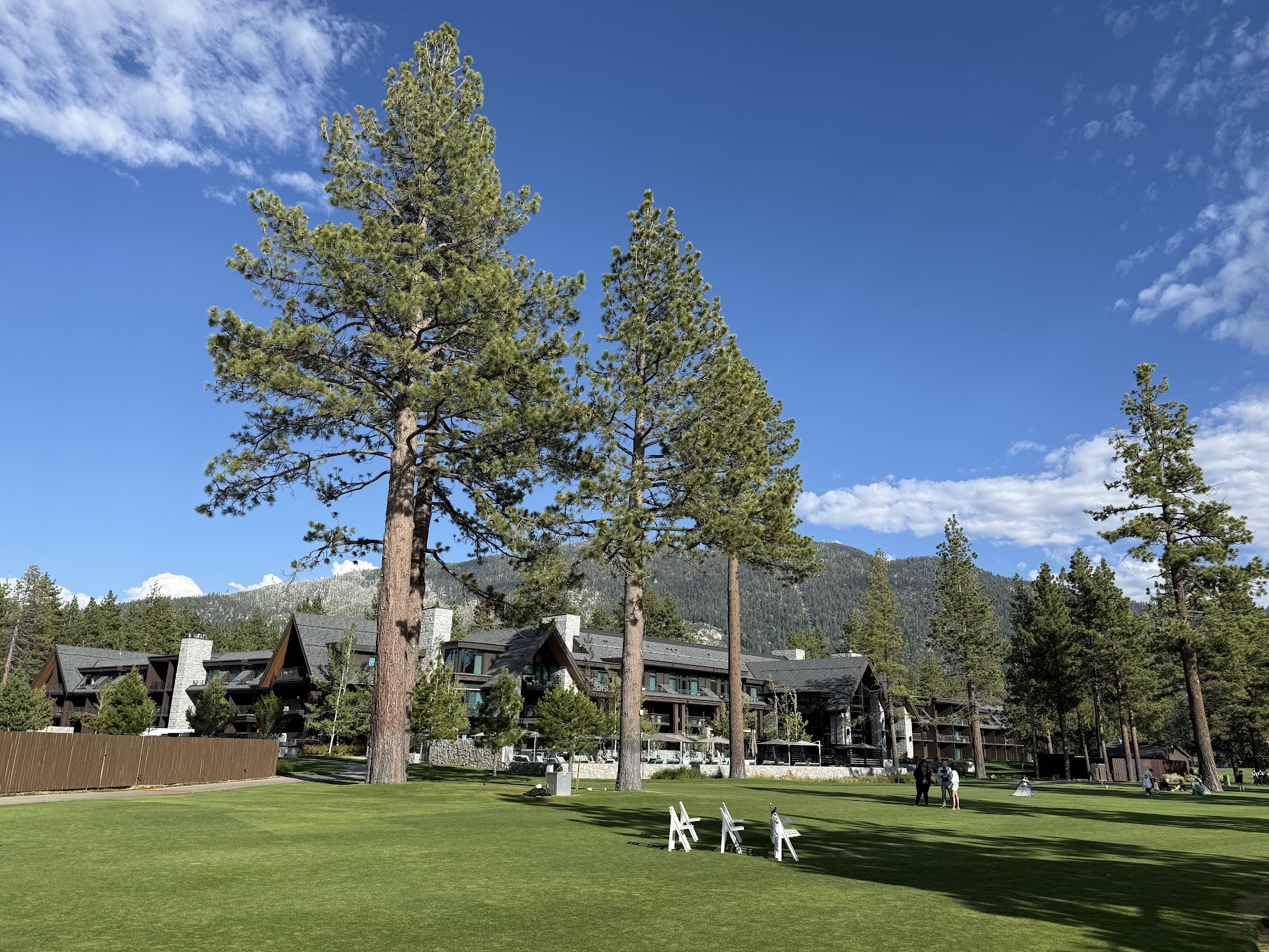
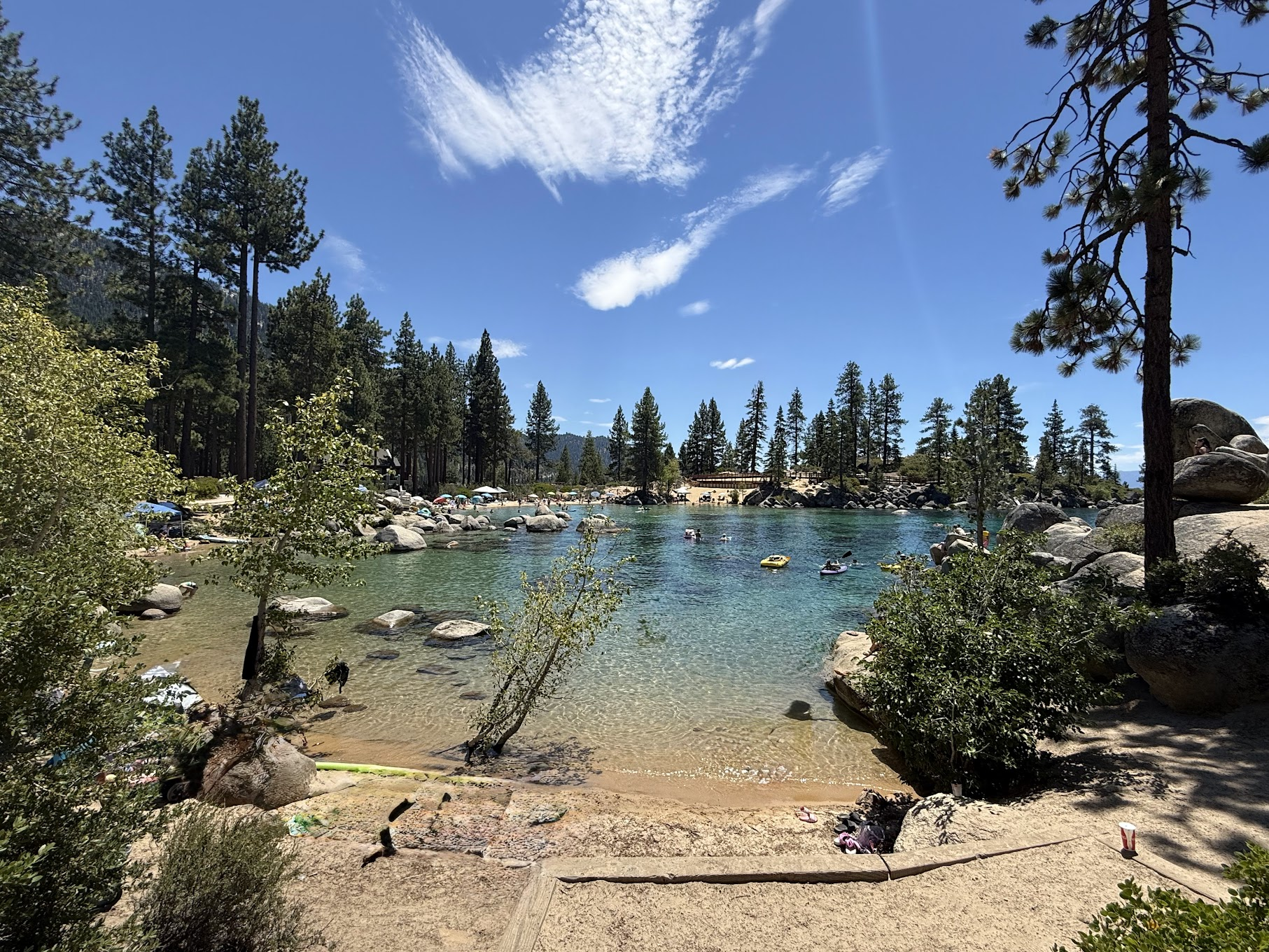
    Clear turquoise water and granite boulders at Sand Harbor, Lake Tahoe, with pine trees behind
    Lake Tahoe and Yosemite – USA 🇺🇸

    Similar in many ways; but can offer subtly different experiences.

    Sand Harbor on Lake Tahoe’s east shore.

    Affiliate links: if you book through one of these links, we may receive a commission at no extra cost to you.

    The short answer

    Yes. We spent four nights at Lake Tahoe and two in Yosemite Valley in July, with a travelling day between them.

    In many ways they are similar: lovely climate in summer, forest and water surroundings and able to either explore or chill.

    How our six nights worked

    WhenWhereHow we got aroundDriving time
    Day 1Las Vegas to South Lake TahoeFlight to Reno, then a hire carAbout 1½ hours from Reno airport
    Days 1 to 4Lake Tahoe, four nights at Edgewood TahoeOn foot, by Uber and by carShort drives around the lake
    Day 5Lake Tahoe to Yosemite ValleyBy car, via Jackson, Mariposa and Highway 140About 5½ hours before stops
    Days 5 and 6Yosemite Valley, two nights at The AhwahneeOn foot and on hire bikesVery little
    Day 7Yosemite to Los AngelesBy car to Fresno airport, then a flightAbout 2¾ hours to Fresno
    Driving times are from our route plans before the trip, not timed on the day.

    Four nights at Lake Tahoe

    We included Tahoe in our itinerary because we’d always wanted to visit, primarily because of the iconic lake and forest scenery but also because we were ready for some slower days after lots of travelling. Tahoe was perfect for easy trips out during the day, coupled with lots of relaxing on the beach, in the pool and in the grounds of the hotel.

    At Sand Harbor we swam in the beautiful little bay beside the shop and restaurant, perching on rocks in and around the water. After a walk at Taylor Creek, we drove to Emerald Bay and looked out from the high viewpoint beside the car park. The alpine scenery was just what we had hoped for.

    Turquoise shallows of Lake Tahoe seen between pine trees, with mountains across the lake
    The water at Lake Tahoe is this clear close to the shore.
    Emerald Bay on Lake Tahoe with Fannette Island, seen from a high viewpoint through pine trees
    Emerald Bay from the viewpoint beside the car park.

    We popped out in an evening for drinks and some food, and we particularly liked The Woods, a relaxed sports bar that suited us well as a family. If there was one slight downside, it was that South Lake Tahoe didn’t quite have the distinct, walkable resort centre we’d perhaps imagined. There were plenty of restaurants, bars and things to do, but they felt a little more spread out.

    It was a beautiful place to relax for a few days, and one where we could happily have stayed longer.

    Pine trees silhouetted against a pink and orange sunset over Lake Tahoe
    Sunset from the lawn at Edgewood.

    The drive between them

    There are two main ways to drive between Lake Tahoe and Yosemite Valley. The quicker one runs down the eastern side of the Sierra Nevada and enters the park over Tioga Pass on Highway 120. Tioga Road closes for the winter. Between 1933 and 2022 it opened on average around 28 May and closed around 3 November, so outside summer the western route is the way in. Our route planner showed the quicker options at about 4 to 4¾ hours, against about 5½ for the route we took.

    Our concern wasn’t winding roads. We’re generally fine with those. What we were less comfortable with was spending long periods on roads with steep roadside drops and little between the car and the edge. So instead, we took a much longer route around the western side of the Sierra Nevada:

    South Lake Tahoe → Jackson → Mariposa → Highway 140 → Yosemite Valley

    We only had very brief stops because we wanted to get to Yosemite in decent time. There were loads of places to stop at regular intervals. We could have stopped at fast food places, services and more bespoke diners along the way if we had wanted to. Our main stop was in a small town near Jackson for a quick sandwich at a petrol station. The final part of the journey towards Yosemite was particularly beautiful.

    This is simply the route we chose and how we found it. We’ve written up the whole drive in Lake Tahoe to Yosemite: The Longer Route We Took via Jackson and Mariposa.

    Two nights in Yosemite Valley

    Two nights was all we could allocate to Yosemite to fit it into our wider itinerary. We could easily have stayed twice as long but 2 nights certainly wasn’t a waste of time. We got to see a lot of the valley properly on the bikes so we felt we got a proper look at it.

    Granite cliffs rising above pine trees and a meadow path in Yosemite Valley
    Granite cliffs above the floor of Yosemite Valley.

    We visited El Capitan Meadow at dusk on our first evening. The next day we hired bikes in Yosemite Village, emerging from woods beneath sunlit cliffs and stopping for a refreshing river swim at Cathedral Beach.

    Shallow clear river with a sandy bank and a granite cliff behind, Yosemite Valley
    Cathedral Beach on the Merced River.

    We explored on foot and on single-gear hire bikes. Rougher sections were heavy going; we felt a mountain bike would have handled them more easily.

    Two cyclists on a dirt path through a meadow below El Capitan, Yosemite
    Cycling the valley floor below El Capitan.
    Golden meadow in Yosemite Valley with Half Dome and granite walls on the skyline
    One of the lovely views we had riding round the valley.

    Once we’d arrived at The Ahwahnee, we barely needed the car. We could walk, cycle or simply head out from the hotel and immediately feel as though we were in the middle of Yosemite.

    Yosemite was also relaxing, particularly in an evening sitting outside the Ahwahnee surrounded by the fabulous scenery. But Yosemite felt more like a place it would be a real shame not to explore. There were folks there who were probably camping and just enjoying the river every day but we didn’t have time.

    Tahoe or Yosemite, if you can only fit in one

    Tahoe is the better choice for slower days, and Yosemite for days spent out exploring.

    Tahoe has more in the evenings, being a bigger town, and more resorts like Edgewood where you can spend a day with your feet up. Equally there were plenty of activities you could keep busy with at Tahoe.

    Yosemite feels more suitable for the outward bound and it just has to be explored due to its variety of spectacular views and settings. To us, it would be a waste just sitting all day in Yosemite.

    Practical points

    • Breaking up the longer distances with flights from Las Vegas to Reno and Fresno to Los Angeles was something we would do again.
    • We picked up a hire car at Reno airport and dropped it off at Fresno airport, so one hire covered Tahoe, the drive and Yosemite.
    • For Sand Harbor, we caught the East Shore Express at Tunnel Creek. For vehicle entry, Sand Harbor requires day-use reservations from 15 May to 30 September.
    • Cycling is permitted on roads and paved bike paths.
    • Yosemite charges US$35 per private car for seven days, plus US$100 for each non-US visitor aged 16 or over.
    • There was no entry reservation for Yosemite in summer 2026, but the rules have changed from year to year, so check the park’s website before you go.
    • July averages are about 27°C by day and 6°C at night in South Lake Tahoe, and 32°C and 14°C in Yosemite Valley.

    Where we stayed

    One thing the trip reinforced for us was that spending more on a hotel makes most sense when it changes the experience of the destination. Edgewood Tahoe ended up being our favourite hotel of the entire USA trip. We chose The Ahwahnee because we only had a short time in Yosemite and wanted to stay right in the heart of the valley.

    Read our full reviews: Edgewood Tahoe Review: Was It Worth It? and The Ahwahnee Review: Is Yosemite’s Historic Hotel Worth It?.

    Planning a stay?

    Check current prices and availability at Edgewood Tahoe and The Ahwahnee on Booking.com.

    Affiliate links: if you book through one of these links, we may receive a commission at no extra cost to you.

    Would we do it the same way again?

    Yes. Four nights at Lake Tahoe gave us the slower days we were ready for, and two nights in Yosemite Valley were enough to see a good deal of it by bike. Flying into Reno and out of Fresno kept the long driving to the one day between them.

    More from this trip

    Planning a similar trip? This trip took a lot of research and planning. About a week of evenings, 30 to 40 hours. Our 36-page USA Road Trip Pack puts all that planning in one place, to help you plan your trip in a fraction of the time: every base and how many nights, which legs we drove and which we flew, what to book first, where we ate and a printable checklist. £14.99 launch price until 31 January (usually £19.99).

  • Is Interlaken a Good Base? What We Reached in Four Days by Train

    Is Interlaken a Good Base? What We Reached in Four Days by Train

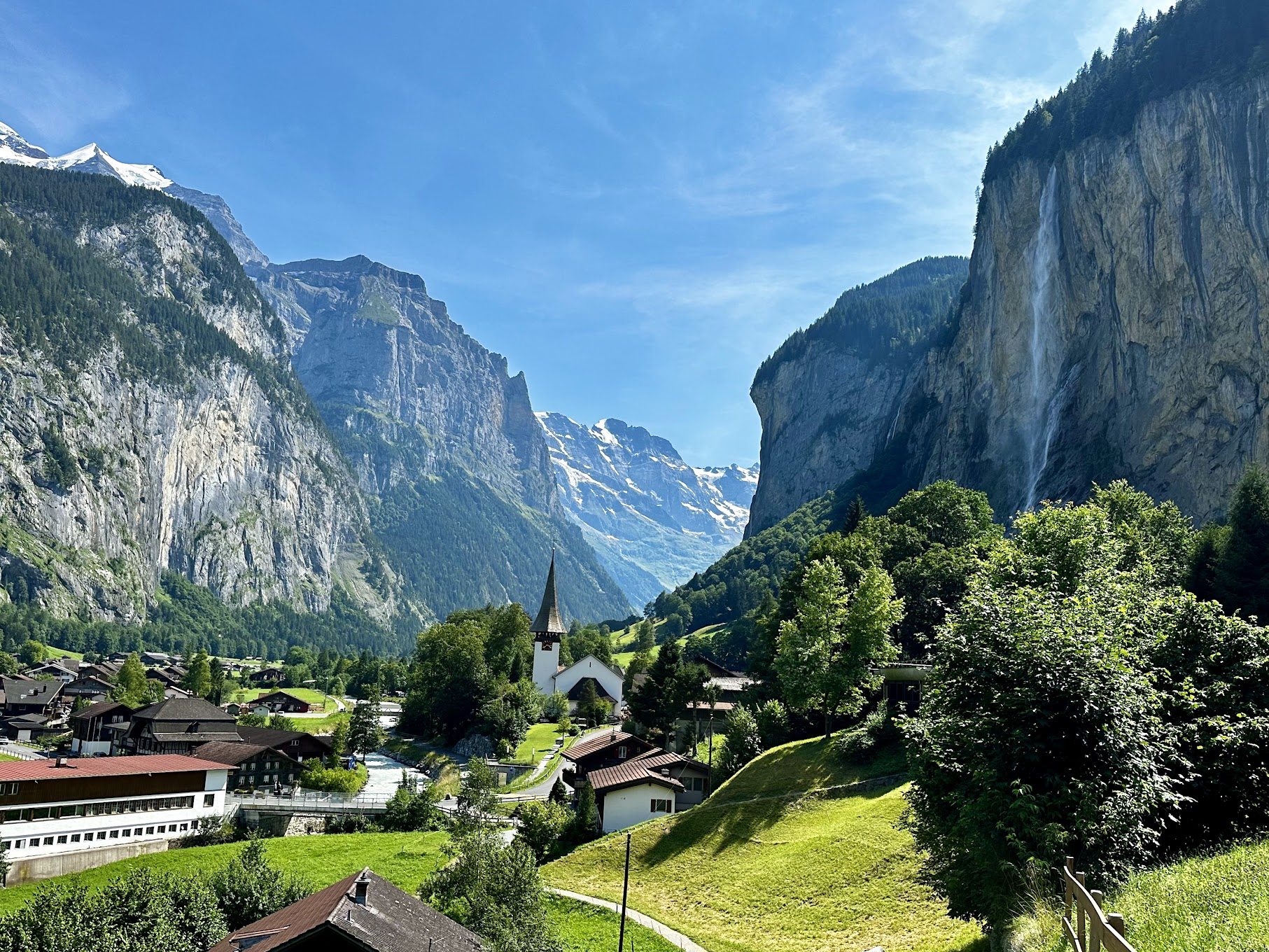
    Lauterbrunnen church beneath steep valley cliffs and Staubbach Falls.
    Interlaken – Switzerland 🇨🇭

    The best hub for seeing a bit of everything.

    Lauterbrunnen church and Staubbach Falls.

    Some links in this post are affiliate links. We may earn a small commission if you book, at no extra cost to you. More at the end.

    The short answer

    Yes, if you want to see a bit of everything. We spent four nights in Interlaken in July and reached Lauterbrunnen, Wengen, Grindelwald, Jungfraujoch, Lake Thun and Thun by train and boat, without ever needing a car.

    We did a lot of research before booking. We drew up a shortlist of the things we wanted to do, and on balance Interlaken was the best hub for all of them. The other places seemed to be spokes on the wheel rather than a hub.

    If all you want is to hike and ski high, some of the mountain villages would be better.

    What we reached from Interlaken

    When and whereHow we got thereJourney time (researched)
    Arrival: a lido on Lake BrienzWalked from the hotelWalking distance
    Day 2: Lauterbrunnen, cycling the valley, Trümmelbach Falls, then WengenTrain, hired bikes, then the train up to WengenLauterbrunnen 25 min; Wengen 11 to 14 min more
    Day 3: Grindelwald and JungfraujochTrain to Grindelwald, then the Eiger ExpressGrindelwald 35 min; Jungfraujoch about 1.5 hrs
    Day 4: Lake Thun and Thun old townPaddle steamer from Interlaken West, train backAbout 2 hrs by boat; about 35 min back by train
    Leaving: GenevaTrainAbout 2.5 to 3 hrs, one change
    Journey times are from the SBB, BLS and Trainline timetables, checked in October 2026, and will vary by connection.
    Aletsch Glacier stretching through the high Alps at Jungfraujoch.
    The Aletsch Glacier from Jungfraujoch, about 1.5 hours from Interlaken by train.

    Why it worked as a base for us

    1. The best hub for everything on our list

    From Interlaken we could reach the valleys, the mountains and both lakes. Staying in Lauterbrunnen or Grindelwald would have put one of those on the doorstep and made the rest a longer trip.

    A sheer rock wall above a green meadow and wooden barn in the Lauterbrunnen valley.
    On the bike ride up the valley. Lauterbrunnen is 25 minutes from Interlaken Ost by train.
    Walkways and rushing water inside the gorge at Trümmelbach Falls.
    Trümmelbach Falls, a short ride up the valley from Lauterbrunnen.

    2. We never needed a car

    The trains were superb and seemed to run like clockwork. There was never a point where we thought a hire car would have improved the Swiss half. We used a Swiss Travel Pass, and none of the journeys felt long.

    3. Lakes as well as mountains

    On our first afternoon we walked from the hotel to a lido on Lake Brienz for a swim. On our last full day we took the paddle steamer across Lake Thun to Thun. After the valleys and mountains, the boat trip was a welcome change.

    Brienz Lido beside Lake Brienz, with the outdoor pool and mountains beyond.
    The lido on Lake Brienz, within walking distance of the hotel.
    Turquoise Lake Thun with the pyramid-shaped Niesen mountain on the far shore.
    Lake Thun from the paddle steamer, with the Niesen on the left.
    Oberhofen Castle and its lakeside tower on the shore of Lake Thun.
    Oberhofen Castle, one of the stops on the boat from Interlaken West to Thun.

    4. A bigger town for the evenings

    Interlaken is the bigger town, so we felt it would give us more variety in the evenings. We could spend the day in the mountains or on the lakes, then come back to plenty of restaurants and bars.

    Thun Castle above the old town square, with shuttered buildings and a Bern flag.
    The square below Thun Castle, where we stopped for lunch.

    5. Easy in and out

    We arrived by train from Zurich airport and left by train for Geneva, where we picked up a hire car for Lake Annecy. Both journeys were easier from Interlaken, and our hotel was five minutes’ walk from Interlaken Ost.

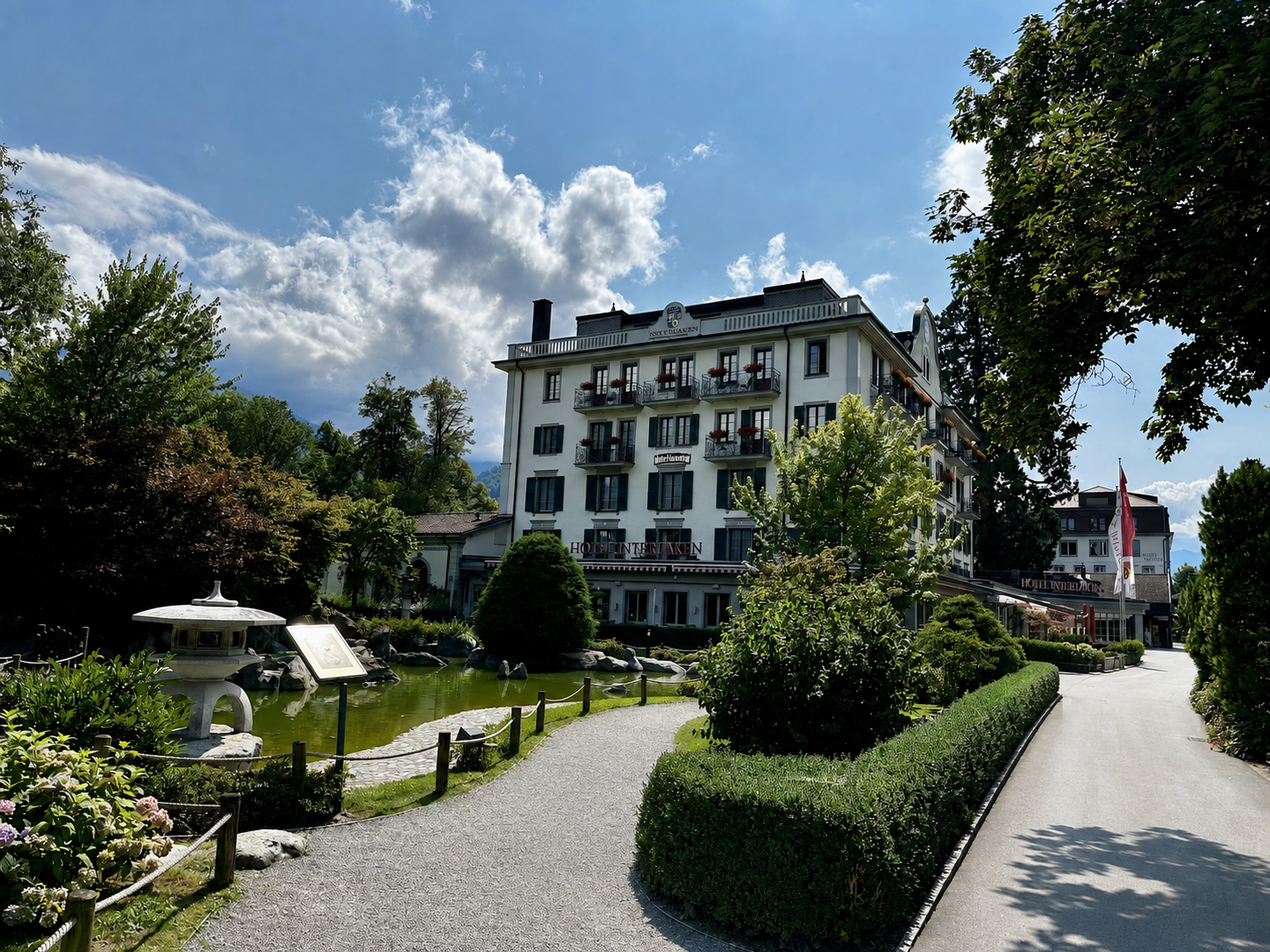
    Hotel Interlaken beside the Japanese garden.
    Hotel Interlaken, a five-minute walk from Interlaken Ost.

    6. A bit of everything

    We were less bothered about going up every mountain and more about seeing a bit of everything. On the day we went to Grindelwald, the boys and their mum went up to Jungfraujoch on the Eiger Express, while one of us stayed in Grindelwald and had a beer in the sun.

    Alpine panorama above Grindelwald, with green meadows, chalets and mountain peaks.
    Grindelwald, 35 minutes from Interlaken by train.

    What to weigh up

    Other travellers raise three points against Interlaken: every mountain day starts with a train back up the valleys, the town is busier, and it has less of an Alpine village feel than Wengen or Mürren.

    All three are undoubtedly true. It is busier and we knew it would be, but that fitted with the other things we liked about Interlaken. If you want to do Thun, Brienz, Lauterbrunnen, Grindelwald and Wengen and get to and from Zurich and Geneva, the other places would not be as convenient.

    Paragliders above the Höhematte in Interlaken, with the Jungfrau beyond.
    Paragliders over the Höhematte, a short walk from the hotel.

    When another base might suit you better

    We didn’t stay in the villages, so this comes from guides and other travellers rather than our trip. The Jungfrau Region tourism site has a page for each one.

    • Grindelwald: the village most guides suggest for a first visit. It’s bigger, with more hotels and restaurants, and the Eiger Express is close by.
    • Lauterbrunnen: quieter, at the foot of the valley we cycled, with fewer and simpler hotels.
    • Wengen: no cars, and a short train ride up from Lauterbrunnen.
    • Mürren: no cars and big mountain views, but fewer restaurants and shops.

    Where we stayed

    We stayed four nights at Hotel Interlaken. It was central, neat, tidy and cosy, with an excellent location for getting around. We would happily stay there again. Read our full Hotel Interlaken review.

    Planning a stay in Interlaken?

    Check current prices and availability at Hotel Interlaken on Booking.com

    Affiliate link: if you book through this link, we may receive a commission at no extra cost to you.

    More from this trip

  • Swimming in Lake Annecy: Talloires, Doussard & Saint-Jorioz Compared

    Swimming in Lake Annecy: Talloires, Doussard & Saint-Jorioz Compared

    Our experience: summer 2024. We swam at Talloires, Doussard and Saint-Jorioz during our week at Lake Annecy. This comparison is based on those visits, not on places we did not personally try.

    Swimming in Lake Annecy was one of the highlights of our week there.

    The water was pleasantly cool rather than shockingly cold, the mountain scenery was superb and each of the three places we tried had a noticeably different feel.

    If we had to rank them from our own experience, we would put Talloires first, Doussard second and Saint-Jorioz third. That does not mean Saint-Jorioz was poor — far from it. It simply suited us slightly less than the other two.

    Our quick verdict

    • Talloires: our favourite overall — prettiest, clearest water, most relaxing and least busy.
    • Doussard: our second choice — beautiful mountain views, good facilities and a more natural feel than Saint-Jorioz.
    • Saint-Jorioz: best for activity — larger diving platforms and a livelier atmosphere, particularly if you are travelling with teenagers.

    1. Talloires — our favourite

    Talloires had the best overall combination for us.

    The scenery across the lake was beautiful and interesting, but what we liked just as much was the atmosphere immediately beside the water. The grassed area felt more like a pleasantly busy village park than a conventional crowded beach.

    It almost felt as though the village happened to have the lake backing directly onto its village green.

    Talloires also felt more compact and cosy than the other two places we tried. The pace was slower, there were fewer people in the water and we found it the most relaxing place of the three.

    The water seemed clearest here too. Whether that was because of the quay-style edge rather than a sandy beach, or simply because there were fewer swimmers stirring up the bottom, it was noticeably clearer to us.

    Grassy lakeside swimming area at Talloires, with swimmers and mountains across Lake Annecy.

    Chiringuito was another reason we liked Talloires so much. It had a relaxed, slightly cool feel, with proper tables, good food and drinks and excellent views across the lake. We could sit down for lunch without the experience feeling like a queue for fast food.

    If we returned, we would happily make a full day of Talloires rather than treating it as somewhere to stop for a couple of hours.

    2. Doussard — beautiful views and a more natural feel

    Doussard was our second favourite.

    The mountain backdrop at the southern end of the lake was impressive and the water itself was lovely. It felt more natural than Saint-Jorioz, although not quite as intimate or peaceful as Talloires.

    It was busy when we visited, and the number of people in the shallows meant the sand and sediment were being kicked up. That made the water look cloudier than it did at Talloires, even though the lake itself was just as inviting.

    Swimming at Doussard on Lake Annecy with the mountains rising behind the lake.
    Busy swimming area and platform at Doussard on Lake Annecy, with mountains beyond.

    Doussard had a useful cluster of facilities nearby and we found the changing arrangements better than at Talloires. The gently shelving entrance also made getting into the water straightforward.

    We would definitely go back. For us it offered a good balance: active enough to be interesting, scenic enough to feel special and slightly less lido-like than Saint-Jorioz.

    3. Saint-Jorioz — best for activity

    Saint-Jorioz was the most activity-focused of the three.

    The larger diving platforms were probably its biggest advantage, and we can see why it would appeal especially to teenagers or groups who want a little more going on than simply swimming and relaxing beside the lake.

    Busy swimming area and large diving platform at Saint-Jorioz on Lake Annecy, with mountains behind.
    Busy lakeside beach and swimming area at Saint-Jorioz on Lake Annecy.

    Our children were perfectly happy at Talloires, but if the priority was bigger diving platforms and a livelier atmosphere, Saint-Jorioz would probably be the better choice.

    It was also the busiest of the three places we visited and felt more like a substantial organised bathing area. That is not necessarily a negative, but it did make the experience feel less relaxed to us.

    Food and drink were readily available, although the setup felt a little more canteen or fast-food orientated than Talloires. Saint-Jorioz was also the only one of the three where we paid to enter.

    What swimming in Lake Annecy actually felt like

    The lake temperature was lovely for summer swimming.

    It was cool enough to be refreshing but not the sort of cold that makes you gasp when you first get in. We could stay in comfortably rather than treating the swim as a quick dip.

    One thing we would definitely recommend is lake or river shoes. The bottom could be rough underfoot, and they made getting in and out much more comfortable.

    Doussard and Saint-Jorioz were particularly good if you prefer a gently shelving entry into the water. All three places also had some form of diving platform or structure, although Saint-Jorioz was strongest if diving was a major part of the attraction.

    What to take

    • Lake or river shoes: the bottom can be rough.
    • Towels: useful not just for drying off but for sitting on the grass.
    • Shade: the shaded areas can fill up, so a beach umbrella or small canopy is worth considering.

    The six main positives

    1. The water: the blue-green colour was beautiful and inviting, and the lake generally felt clear — especially at Talloires.
    2. The setting: mountain and lake views made all three places feel special.
    3. Family-friendly swimming: marked areas, gradual access in places and diving platforms suited different ages.
    4. Useful facilities: toilets, changing and food or drink were available at each place we tried.
    5. Grass and shade: we preferred having grassy areas and trees rather than sitting on a conventional beach all day.
    6. Enough activity for older children: particularly at Saint-Jorioz and Doussard.

    Five things to be aware of

    1. They get busy: especially in high summer, with Saint-Jorioz the busiest of the three for us.
    2. Parking can be competitive: we managed at all three, but none was empty.
    3. Busy shallows can look cloudy: at Doussard in particular, lots of feet stirred up the bottom.
    4. Shade disappears quickly: arriving earlier helps if sitting under trees matters to you.
    5. Saint-Jorioz charged for entry: it was the only one of the three where we paid to get in.

    Which Lake Annecy swimming spot should you choose?

    If you only have time for one, we would choose Talloires.

    For us it had the best water, the prettiest surroundings, the most relaxed atmosphere and our favourite place to eat beside the lake.

    If you have time for two, we would add Doussard. It gave us a different view of the lake, had a beautiful mountain setting and felt more natural than Saint-Jorioz.

    Choose Saint-Jorioz instead if larger diving platforms and a more energetic atmosphere are higher priorities than tranquillity.

    Would we return?

    Yes — to all three.

    Talloires would be the first place we returned to and somewhere we would now make a full day of. Doussard would be next on our list, while Saint-Jorioz would still be worth revisiting when we wanted something livelier.

    Trying several swimming spots was part of what made Lake Annecy enjoyable for us. They were different enough that visiting more than one never felt repetitive.


    For the rest of our stay, read Our Week at Lake Annecy: Swimming, Cycling & Annecy Old Town, or see how this fitted into our full 11-night Interlaken & Lake Annecy trip.

  • 3 Nights in Sedona: What We Did, Where We Stayed & Where We Ate

    3 Nights in Sedona: What We Did, Where We Stayed & Where We Ate

    Sedona was somewhere we’d wanted to visit since learning about it on an earlier trip to Arizona. We arrived with high expectations.

    We stayed for three nights at Amara Resort & Spa, exploring viewpoints, walking in Red Rock State Park and swimming in Oak Creek. The town was nice to have for meals and evenings out, but the scenery was the star by a mile.

    Getting to Sedona from Las Vegas

    Sedona was the second main stop on our USA road trip. We turned the journey from Las Vegas into a full day out, stopping at Hoover Dam before heading through Kingman, along Historic Route 66 and on through Seligman and Flagstaff.

    The old roadside sights were part of the experience, and we encountered some impressive summer storms around Seligman. Then the scenery began to change: the relatively barren uplands gave way to greener, more mountainous country around Flagstaff.

    The final drive down towards Sedona was glorious, through plunging red-rock canyons scattered with lush green vegetation. It was one of the most memorable approaches to anywhere we stayed on the trip. As Cars fans, it also reminded us of Lightning and Sally’s countryside drive – a personal resemblance we’ve explored in our Radiator Springs article.

    Where we stayed: Amara Resort & Spa

    We chose Amara because we wanted great scenery and somewhere we could walk out in the evening. Tucked below the main road beside Oak Creek, it felt calm and private while still being within walking distance of shops, bars and restaurants.

    Amara’s terrace and seating areas, with trees and Sedona’s red rocks beyond.
    Amara’s relaxed setting, with the red rocks beyond.

    The hotel had a smart but rustic boutique feel that suited Sedona.

    The pool, the service and our evening routine

    Amara’s infinity pool with trees and Sedona’s red rocks beyond.
    Amara’s pool, with trees and red rocks beyond.

    The infinity pool was the standout feature, looking across the creek towards the red rocks. It was one of the reasons we’d happily go back to the same hotel.

    We had drinks at Amara before heading out every night. It was a lovely, chilled setting with fabulous views, and that simple evening routine became one of our favourite parts of staying there.

    Amara gave us the best overall service of the seven hotels on our USA trip. We’ve compared them in our USA hotel reviews.

    What we did in Sedona

    We were happy simply being outdoors here. Driving between places, stopping for views and spending time around Oak Creek were a large part of the pleasure. We didn’t feel the need to fill every hour with organised activities.

    Slide Rock and Oak Creek

    Slide Rock State Park was one of our favourite stops. Swimming in the creek was wonderfully refreshing in the July heat and gave us a different way to enjoy the landscape. Red rocks and water made a memorable combination.

    Oak Creek winding between red-rock ledges at Slide Rock State Park.
    Oak Creek winding between red-rock ledges at Slide Rock State Park.

    Airport Mesa and the Chapel of the Holy Cross

    We drove up to Airport Mesa for the broad views across Sedona. Seeing the town spread out beneath the surrounding formations helped us appreciate how completely the red rocks define the place. The panorama below captures that view.

    The view from Airport Mesa across Sedona’s red-rock formations.
    The view from Airport Mesa across Sedona’s red-rock formations.

    The Chapel of the Holy Cross was another worthwhile stop, particularly for the extensive views across the surrounding landscape. For us, the setting was every bit as much a reason to visit as the chapel itself.

    Red Rock State Park and getting around

    We also walked in Red Rock State Park. Experiencing the landscape at ground level made a good contrast to the viewpoints.

    We used a car to get between the parks, Airport Mesa and the Chapel of the Holy Cross.

    Where we ate in Sedona

    The Hudson

    The Hudson was our best meal in Sedona: a more upmarket take on American dining, with excellent food.

    Open Range Grill & Tavern

    Open Range was particularly memorable for the views and drinks. The food was good, straightforward pub-style American food rather than anything fancy, but looking out across those red rocks was the real attraction.

    The view from Open Range Grill & Tavern.
    The view from Open Range Grill & Tavern.

    Eating at Amara

    We ate at Amara one evening and thought both the food and service were very good. Breakfast was excellent too, with varied, proper American-style choices.

    Sedona’s red-rock formations beneath a blue sky, with trees and rooftops in the foreground.
    Sedona’s red rocks, blue skies and scattered greenery.

    Were three nights in Sedona enough?

    We feel like we have unfinished business in Sedona. We’d have liked more time to do some hikes, spend a few more lazy days at the swimming spots nearby on the creek and just chill out by the Amara pool. A week would easily be doable. But if three nights is all you have, it is well worth it.

    We’ve been to Uluru, the Olgas, the Swiss Alps, the Grand Canyon and many other gorges and craggy places. But Sedona is a unique fusion of parts of all these places. The shape of the rocky outcrops with their stratified colours, combined with the deep blue Arizona sky and the lush green smatterings of vegetation, make it like nowhere we’ve ever been before. Travelling to Red Rock Country was a key driver for our US road trip, and Sedona blew us away.

    For the full journey before and after Sedona, including our onward drive to the Grand Canyon and Monument Valley, see Our 18-Night USA Road Trip Itinerary.

    Planning a similar trip? This trip took a lot of research and planning. About a week of evenings, 30 to 40 hours. Our 36-page USA Road Trip Pack puts all that planning in one place, to help you plan your trip in a fraction of the time: every base and how many nights, which legs we drove and which we flew, what to book first, where we ate and a printable checklist. £14.99 launch price until 31 January (usually £19.99).

    Planning a stay at Amara? Check current prices and availability at Amara Resort & Spa on Booking.com.

    Affiliate link: if you book through this link, we may receive a commission at no extra cost to you.

  • Our Week at Lake Annecy: Swimming, Cycling & Annecy Old Town

    Our Week at Lake Annecy: Swimming, Cycling & Annecy Old Town

    Our stay: summer 2024. This story and its photographs reflect our seven-night stay at Lake Annecy, following four nights in Interlaken.

    After four nights around Interlaken, we travelled by train to Geneva, collected a hire car and drove on to Lake Annecy for the second half of our Interlaken & Lake Annecy trip.

    We had expected Lake Annecy to be beautiful. Even so, arriving there in the summer sunshine was one of those occasions when the reality comfortably matched the pictures. The lake was strikingly clear and blue-green, the mountains rose around it and the whole area felt immediately inviting.

    There were obvious similarities with Switzerland because of the Alpine scenery, but the atmosphere felt different. Interlaken had been dramatic: huge mountain walls, glaciers, waterfalls and active days built around trains and excursions. Lake Annecy felt softer somehow. The mountains were still there, but the lake, villages and warmer summer rhythm gave this half of the holiday a much more relaxed feel.

    That change of pace was exactly what we wanted.

    Settling into a different rhythm

    We spent seven nights at Camping Les Fontaines, towards the southern end of Lake Annecy.

    Our days quickly developed their own pattern.

    Breakfast was usually outside our cabin before we headed off somewhere around the lake. We might spend the day swimming, exploring a village, visiting Annecy or cycling, then return to the campsite later in the afternoon.

    Early evening often meant a drink at the campsite bar before deciding whether to eat at the restaurant or cook back at the cabin.

    After the more active Swiss half of the trip, that routine felt wonderfully easy.

    Camping Les Fontaines worked well as our base

    Les Fontaines was exactly the sort of campsite we had hoped for.

    The setting was excellent, with mountains all around, and the site felt friendly and relaxed rather than enormous or overly resort-like. Our accommodation was clean and comfortable, and having our own outdoor space made a big difference.

    The pools and waterslides were a major part of the appeal, particularly for the boys. Even after a full day out, they were keen to spend another couple of hours in the pool.

    Swimming pools and waterslide at Camping Les Fontaines beneath the mountains.

    The bar was pleasant too, with a slightly cosmopolitan holiday feel, and we enjoyed the restaurant.

    The location was both a strength and the one thing we might change.

    Being slightly back from the lake made the campsite peaceful, and it was a good base for exploring the southern end. But if we were planning the same holiday again, we would probably look for somewhere equally attractive right beside the lake or within easy walking distance of a lakeside village.

    The campsite shop was also fairly limited. That did not bother us much because shopping for food elsewhere became part of the enjoyment of the week.

    Our lodge at Camping Les Fontaines beneath the wooded Alpine foothills.

    The food shopping became part of the holiday

    This was one of the less obvious highlights.

    Going into the local supermarkets and choosing from the fresh meat, vegetables and huge range of other food and drink was genuinely enjoyable. There always seemed to be something good to bring back to the cabin.

    The ready-made kebab-style meat selections became particular favourites for the plancha, and there was no shortage of interesting beers and wines to try alongside them.

    Cooking outside gradually in the evening, rather than rushing out to a restaurant every night, became proper relaxing family time.

    It is the sort of detail that might not make many conventional Lake Annecy guides, but it is something we remember very fondly.

    Talloires was our favourite place to swim

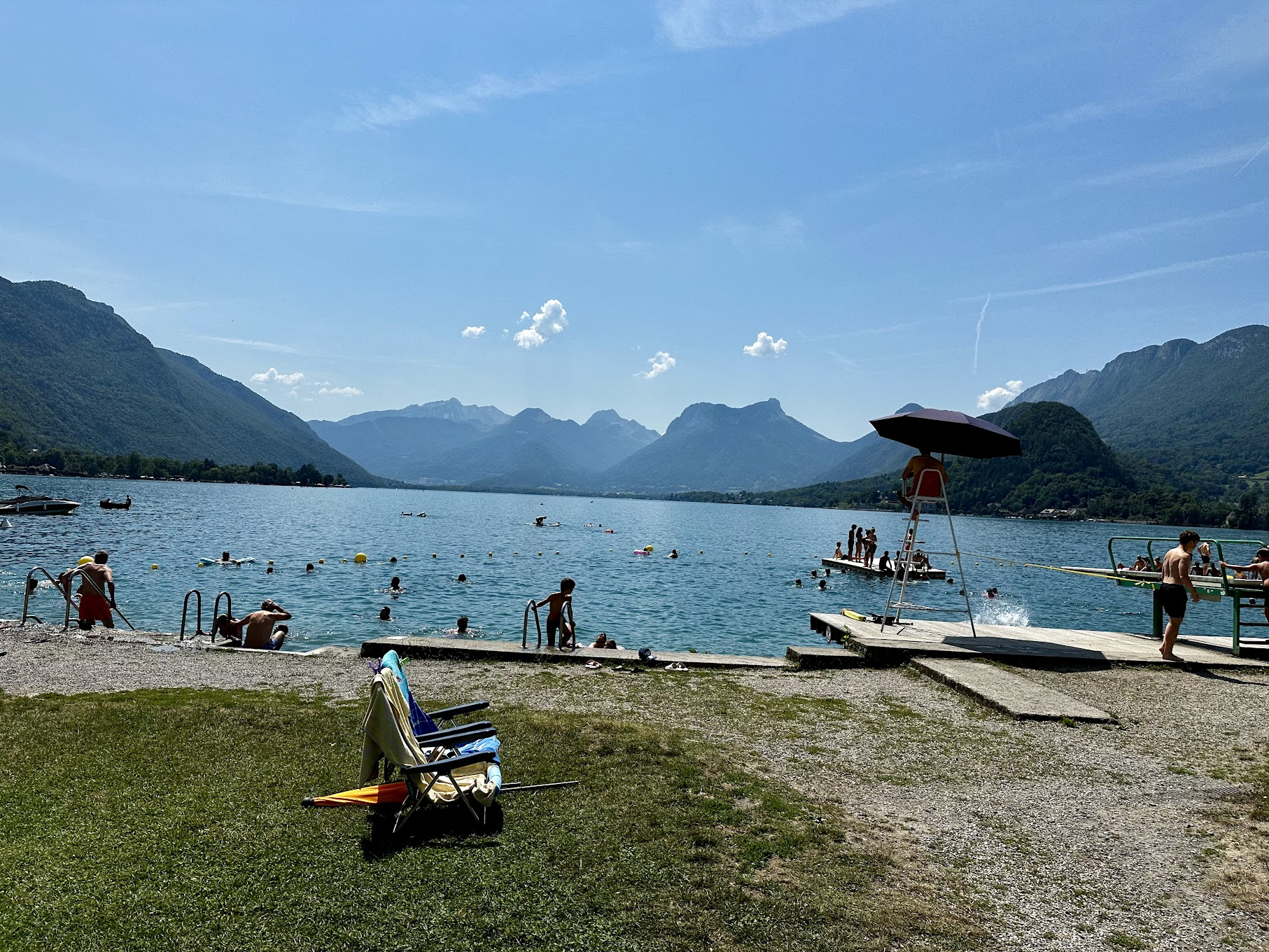
    We tried several swimming spots around the lake, but Talloires was probably our favourite.

    It was extremely pretty without feeling overdone. The setting felt relatively low-key, the water was beautiful and there were still proper diving boards and swimming facilities to make it fun rather than simply scenic.

    You could spend time in the water, sit looking across the lake towards the mountains and feel as though you were somewhere quite special without the place feeling too formal or crowded.

    If we went back to Lake Annecy tomorrow, Talloires would be one of the first places we would return to.

    Lakeside swimming area and diving facilities at Talloires, with mountains across Lake Annecy.
    For a side-by-side look at all three places, read our Lake Annecy swimming comparison of Talloires, Doussard and Saint-Jorioz.

    Saint-Jorioz was bigger and busier — but still well worth visiting

    We also swam at Saint-Jorioz.

    It had a different feel to Talloires. It was larger and noticeably busier, but we still enjoyed it a lot.

    The swimming area was very good, and the larger diving platform was great fun. It felt more like a substantial lakeside bathing area than the quieter experience at Talloires.

    We would not choose one and dismiss the other. Talloires was our favourite aesthetically, but Saint-Jorioz was still very much worth including.

    That became something of a theme around Lake Annecy: the beaches were not identical, so trying more than one was part of the fun.

    Doussard and the quieter southern end

    We also visited Doussard, close to the southern end of the lake.

    This part of Lake Annecy had a particularly attractive setting, with plenty of mountain scenery and a slightly calmer feel than the busier northern end around Annecy itself.

    The south end suited us well as a base.

    It was scenic, gave us easy access to beaches and outdoor activities, and meant we could enjoy the quieter side of the lake while still driving up to Annecy and the busier villages whenever we wanted.

    Annecy town was even better than we expected

    We left Annecy itself until later in the week.

    That was probably a mistake.

    We visited once, but if we had realised beforehand quite how much we would like it, we would almost certainly have gone twice.

    Annecy was beautiful, but it was more than simply picturesque. It felt grand, lively, elegant and exceptionally clean.

    The canals and historic buildings gave the old town a completely different character from the lakeside villages. Flowers seemed to be everywhere, the water running through the town had that distinctive green-blue Alpine colour, and parts of it looked almost theatrical.

    At times it felt like walking through a medieval film set.

    Purple flowers beside a tree-lined canal with moored boats in Annecy.

    There was enough going on to give the town real energy without spoiling its appearance. We wandered around the canals, saw the Palais de l’Île, stopped for food and drinks and generally enjoyed being there without needing a rigid sightseeing plan.

    We only spent part of a day there, but you could easily spend a full day and evening in Annecy.

    It was busy when we visited, including the roads and parking areas, but we did not have any particular difficulty finding somewhere to leave the car. There seemed to be plenty of parking; you just had to accept that a beautiful Alpine town in the middle of summer was never going to be empty.

    Annecy ended up being one of the highlights of the French half of the trip.

    The stone Palais de l’Île between two channels in Annecy old town.
    Clear shallow water, boats and mountains along the lakeside at Annecy.

    Cycling around Lake Annecy

    Lake Annecy is clearly a place built for cycling.

    We hired bikes from K2 Outdoor, down the road from Les Fontaines, rather than relying on bikes from the campsite.

    Cycling gave us another way of experiencing the lake and its surroundings, and we could easily see why so many people choose to explore the whole area this way.

    The only problem was the weather.

    It was very hot during our visit.

    That did not stop plenty of other people cycling long distances around the lake, but we were less enthusiastic about spending hours melting in the midday sun. We still enjoyed riding, but the heat meant we sometimes chose the car when we might otherwise have cycled further.

    In more moderate temperatures, cycling would be very high on our list of ways to explore Lake Annecy.

    Did we need a car?

    Not necessarily — but we were very glad we had one.

    If you booked accommodation close to the lake, were happy staying relatively locally and were prepared to cycle or use public transport, you could certainly have a good Lake Annecy holiday without driving all week.

    For the way we wanted to explore, though, the car made a big difference.

    It meant we could visit beaches on different parts of the lake, get into Annecy town easily, reach the viewpoints above the water and change our plans depending on the heat.

    So we would describe the car as useful rather than essential.

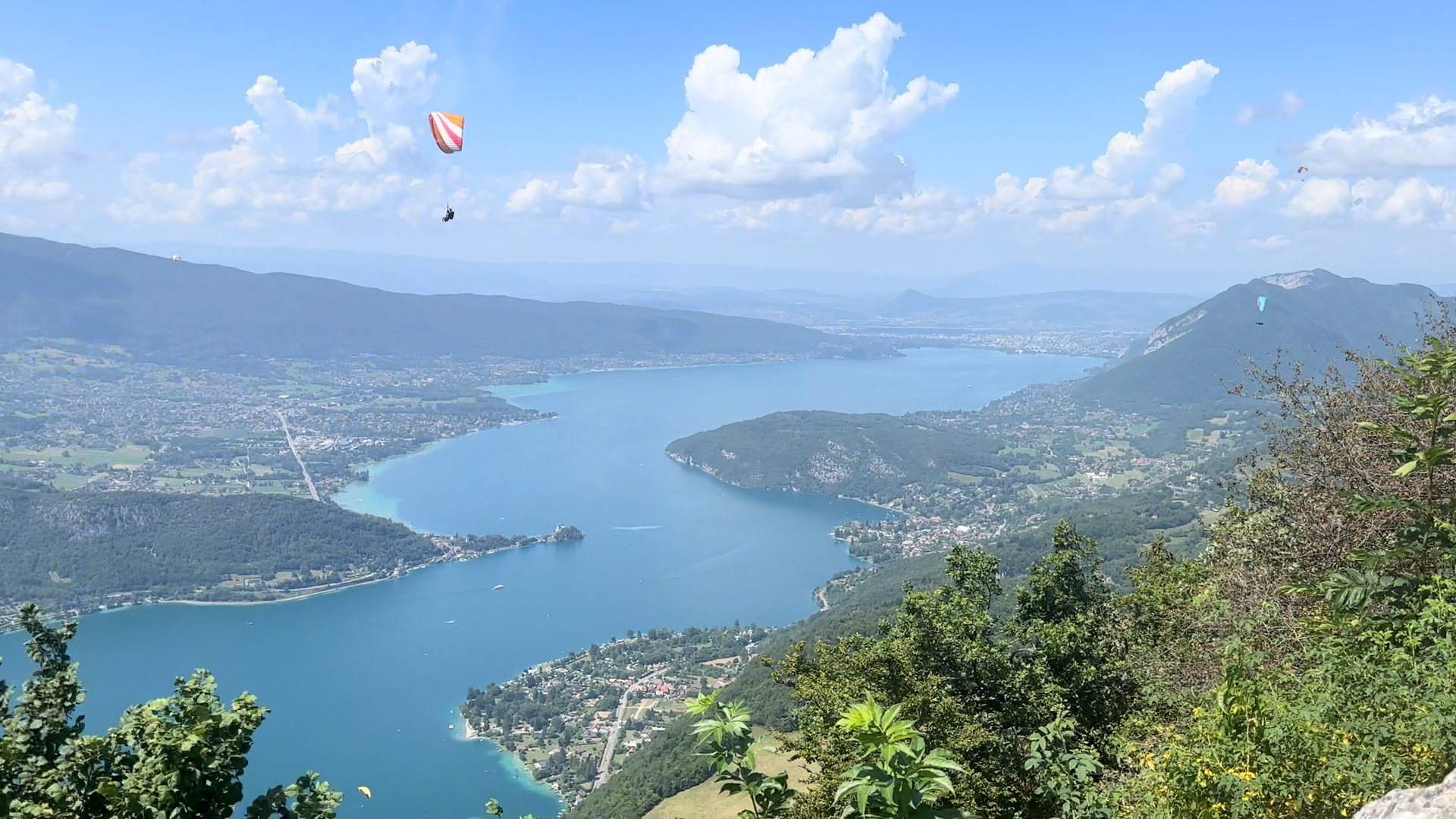
    Above the lake at Montmin and Col de la Forclaz

    One experience I did not personally do, but my wife and son did, was heading up above the lake towards Montmin and the Col de la Forclaz.

    This is the area where many of the paragliders launch.

    They loved it.

    From high above the lake, the views stretched almost the full length of Lake Annecy, with mountains rising either side. The paragliders launching from the hillside added another dimension to it.

    We had already seen plenty of them floating above the lake from below, so seeing where they actually took off from tied the whole thing together.

    The images they brought back are among the strongest views we have from the French part of the trip.

    Even if you have no intention of paragliding yourself, the view alone makes the mountain road up there worthwhile.

    Yellow paraglider canopy raised above the grassy launch slope at Montmin, with mountains beyond.
    Yellow paraglider in flight above the wooded mountains and valley near Lake Annecy.
    Both Montmin images are stills from our family’s video.

    What we would recommend for a first week at Lake Annecy

    We would definitely spend time at Talloires, visit Annecy town properly rather than rushing it, try more than one of the lake beaches and make time for the views from the mountains above the lake.

    Leave some room in the itinerary too, rather than planning an outing for every spare hour.

    Would Lake Annecy work as a holiday on its own?

    Easily.

    There was enough around the lake to fill a full week without needing to combine it with anywhere else. We did not even get around to a boat trip, kayaking or paddleboarding.

    With more time, we would still recommend pairing it with Interlaken: mountain excursions in Switzerland followed by a slower week beside the lake.

    For the Swiss part of the holiday, our Hotel Interlaken review covers our family room, breakfast and the location near Interlaken Ost.

    Would we go back?

    Yes.

    Lake Annecy was beautiful, easy to enjoy and gave us exactly the kind of summer week we had hoped for.

    If we changed anything, we would probably choose accommodation right on the lake or within walking distance of a village. We would also make sure we spent more time in Annecy town.


    For more stories from our travels, browse Travel Guides & Reviews.

  • Is Hotel Interlaken Family-Friendly? Our Honest Review

    Is Hotel Interlaken Family-Friendly? Our Honest Review

    Hotel Interlaken beside the Japanese garden.
    Interlaken – Switzerland 🇨🇭

    An excellent homely base for exploring the Interlaken region.

    Hotel Interlaken beside the Japanese garden.

    This post contains affiliate links. We may earn a small commission, at no extra cost to you.

    We stayed at Hotel Interlaken for four nights in July 2024 during the Switzerland part of our Interlaken and Lake Annecy trip. We expected to spend most of each day out exploring, and wanted somewhere comfortable to return to in the evening.

    Why we chose Hotel Interlaken

    One of the main reasons we chose the hotel was its location close to Interlaken Ost station. Our stay in Switzerland was largely built around public transport, with day trips into the Bernese Oberland, so being able to walk easily to the station mattered much more to us than having a large pool, spa or extensive hotel grounds.

    Even pulling our suitcases, the walk between Interlaken Ost and the hotel took us only about five minutes. That convenience turned out to be one of the biggest advantages of staying here.

    First impressions

    Check-in was friendly and efficient, which pretty much set the tone for the rest of our stay. The hotel felt traditional but modern at the same time. There were plenty of soft furnishings and Swiss touches, but it never tipped over into feeling old-fashioned or overly themed.

    What we particularly liked was that the hotel seemed comfortable with what it was trying to be. It was not attempting to feel glossy or flashy. Instead, it felt homely, well presented and quietly confident in its traditional style. The atmosphere throughout our stay was relaxed and comfortable, and we found the staff friendly and helpful across the hotel.

    Our family room

    Our family room was one of the nicest surprises. Rather than feeling as though extra beds had simply been squeezed into a standard hotel room, it felt more like a small family suite.

    The room was a very good size and the boys had their own built-in bunk beds, which gave them a separate little area and made the arrangement work particularly well for us as a family. The room looked out from the front of the hotel towards the road, with the forested hillside rising beyond it.

    Wooden lower bunk with white bedding and a black ladder at Hotel Interlaken.
    The lower bunk in our family room, July 2024.

    It was not the kind of dramatic Alpine panorama you might get from a mountain hotel, but it still felt very much like Switzerland when we looked outside. The bathroom was perfectly good and we had no problems with it during our stay.

    Is Hotel Interlaken good for families?

    For us, yes. We booked a Family Room, and the built-in bunk beds were fine for our teenage boys, giving them their own corner of the room. The room stayed comfortable in July, too.

    Being five minutes’ walk from Interlaken Ost made day trips by train easy, and we could walk to Höhematte Park and plenty of places to eat in the evenings.

    We also noticed the hotel’s history. It is one of the oldest hotels in Interlaken, and the Japanese garden is right beside it.

    If you’re deciding whether to base yourselves in Interlaken or one of the mountain villages, see Is Interlaken a good base?

    The location was one of its biggest strengths

    The hotel was also well placed for exploring Interlaken on foot.

    Within roughly 10–15 minutes, we could stroll down towards Höhematte Park, with the open grass, mountain views and paragliders landing nearby. That made it easy to eat out in the evenings and explore Interlaken without needing transport.

    Paragliders above Höhematte Park, with mountains beyond.
    Mountain views and paragliders over Höhematte Park, July 2024.

    Although our room faced the road, we did not find traffic noise a problem at night.

    Breakfast

    Breakfast was another strong point. We found it fresh, varied and very well presented, with plenty of choice and everything nicely organised.

    One of our favourite parts was being able to take breakfast outside beside the hotel. We actually ate there and enjoyed sitting out in the morning with views towards the church and mountains beyond. It was a simple detail, but one that made breakfast feel more memorable than eating in a standard hotel dining room.

    Outdoor tables beside Hotel Interlaken, with a church tower and mountains beyond.
    Breakfast seating beside Hotel Interlaken, with the church and mountains beyond, July 2024.

    Eating out and evenings at the hotel

    We ate dinner out every evening, with plenty of places to choose from within walking distance. Before heading out, we enjoyed sitting outside the hotel with a beer.

    Was Hotel Interlaken good value?

    We thought so. Interlaken is not necessarily the sort of destination where you are expecting bargain accommodation, but we felt Hotel Interlaken gave us a good balance.

    We were paying for a comfortable family room, an excellent location, good breakfast, pleasant surroundings and extremely easy access to the railway network.

    Update — September 2026: Our review and photographs reflect our July 2024 stay. The hotel reports room renovations in 2025 and plans to remodel its reception and lobby from mid-October 2026. Online check-in before arrival is now required. Check the hotel’s current information for arrangements during your visit.

    Would we stay again?

    Yes. The spacious family room, homely Swiss feel and breakfasts outside made Hotel Interlaken somewhere we enjoyed staying.

    We would recommend it to anyone planning to explore the Interlaken region by train, whether travelling as a couple, family or independently.

    Planning a stay at Hotel Interlaken?

    Check current prices and availability at Hotel Interlaken on Booking.com

    Affiliate link: if you book through this link, we may receive a commission at no extra cost to you.


    Planning the wider trip? Read our Interlaken & Lake Annecy trip and our week at Lake Annecy for the swimming, cycling and lakeside days that followed our Swiss stay, or browse more first-hand guides in Travel Guides & Reviews.

  • Our Interlaken & Lake Annecy Trip: 11 Nights in Switzerland and France

    Our Interlaken & Lake Annecy Trip: 11 Nights in Switzerland and France

    We planned this as a summer trip in the Alpine region: four nights exploring the mountains and valleys around Interlaken, followed by a week beside Lake Annecy. The two halves had plenty in common — beautiful scenery, lakes and days spent outdoors — but each gave us a different version of an Alpine summer holiday.

    The idea for the trip really started with Lauterbrunnen. We had seen the classic view of the little church beneath steep green valley walls, waterfalls dropping from the cliffs and snow-topped mountains beyond. It was exactly the kind of Alpine scenery we wanted to experience, and unlike anything we had really seen on previous trips.

    Switzerland still exceeded our expectations. Around Interlaken, the scenery seemed to come in layers: green valley floors, huge mountain walls and then snow-topped peaks beyond them against clear blue skies. That combination became one of the defining memories of the trip.

    Trip highlights

    • Jungfraujoch — snow, the Aletsch Glacier and a memorable journey into the high Alps.
    • Cycling Lauterbrunnen Valley — one of our favourite ways to experience the scenery at ground level.
    • Lake Thun and Thun — a relaxing change of pace after the mountain days.
    • Swimming around Lake Annecy — clear water, diving platforms and mountain views.
    • Annecy old town — canals, flowers, historic buildings and one of the most distinctive towns of the trip.

    Lake Annecy brought a slower rhythm rather than a completely separate kind of holiday: more swimming, cycling, campsite evenings and time around the lake, but still with the mountains and outdoor setting tying the whole trip together.

    The trip at a glance

    We flew into Zurich and took the train to Interlaken, where we stayed for four nights at Hotel Interlaken.

    From there we explored Jungfraujoch, Grindelwald, Lauterbrunnen, Wengen, Lake Thun, Thun and Brienz.

    We then travelled by train from Interlaken to Geneva, collected a hire car and drove to Lake Annecy, where we spent seven nights at Camping Les Fontaines.

    For us, the transport split was almost ideal. Switzerland was so easy to explore by train that we never felt we needed a car, while having one in France gave us much more flexibility around Lake Annecy.

    Interlaken made an excellent base

    One of the first things that struck us was just how easy Switzerland was to get around.

    The trains were superb and seemed to run like clockwork. Connections were straightforward, the whole system felt dependable and there was never a point where we thought a hire car would have improved the Swiss half.

    Interlaken itself was ideal for us because it was both a pleasant place to stay and a brilliant base for exploring the surrounding region. We could head out to the mountains and lakes during the day, then come back somewhere with enough restaurants and bars to make the evenings enjoyable.

    We stayed at Hotel Interlaken, which suited the trip perfectly. It was central, neat, tidy and cosy, with an excellent location for getting around. We had not booked this holiday to spend much time inside a hotel, so there was little point paying for facilities we would barely use. What mattered was having somewhere comfortable and convenient to return to after being outdoors all day.

    Hotel Interlaken and its Japanese garden in the summer sunshine.

    We would happily stay there again.

    Four nights gave us enough time to do what we had planned, although we could easily have filled a full week around Interlaken.

    For what we reached from Interlaken without a car, and when a village base might suit you better, read Is Interlaken a Good Base?

    Jungfraujoch — one of the highlights of the trip

    Jungfraujoch was one of the biggest highlights of the entire holiday, and the journey up was part of the experience rather than simply a way of getting there.

    We had booked in advance, and although it was busy at the top, it never felt unmanageable. What surprised us most was how much there was to do once we arrived.

    We stayed for around two hours, spent time out on the snow, admired the extraordinary scale of the Aletsch Glacier and somehow ended up sledging during a summer holiday.

    Despite all the snow, it was much warmer than we expected. We could feel the altitude slightly, but none of us felt unwell.

    The glacier itself was genuinely impressive. Photographs struggle to convey its scale, and seeing it stretching away through the mountains was one of those occasions when the real thing comfortably beat the pictures.

    The boys enjoyed the whole experience, and so did we. Along with Lauterbrunnen, it was one of the stand-out days of our time in Switzerland.

    Grindelwald — worth stopping for in its own right

    We deliberately spent time in Grindelwald rather than simply passing through.

    We had lunch and a few beers in the sun and took the opportunity to sit and enjoy the huge mountain views around us. It was one of those places where not doing very much was part of the appeal.

    Wide Alpine panorama above Grindelwald, with green meadows, chalets and dramatic mountain peaks.

    Grindelwald and Lauterbrunnen are often compared, but we would not really choose between them. Grindelwald felt more open and elevated, while Lauterbrunnen had the drama of being right down on the valley floor with the cliffs rising around us.

    Both were wonderful in their own way.

    Lauterbrunnen — the place that inspired the trip

    Lauterbrunnen was the place we had pictured before we even arrived in Switzerland.

    Seeing that famous valley in real life — the green meadows, church, waterfalls and enormous mountain walls — was a reminder of exactly why we had chosen the area in the first place.

    Lauterbrunnen church beneath steep valley cliffs and Staubbach Falls in Switzerland.

    Rather than just visiting the obvious viewpoints, we had booked bikes before flying out and spent a few hours cycling through the valley. It turned out to be one of the best decisions of the holiday.

    The bike hire was straightforward, the route was moderate rather than difficult and the roads were quiet. Cycling felt like the ideal way to experience the valley: we could cover far more ground than we would have done comfortably on foot, while still stopping whenever we wanted.

    The scenery was exceptional. Green meadows ran alongside the alpine river, waterfalls dropped from the cliffs and snowy mountains rose beyond the valley walls. That layered landscape was probably the defining visual memory of our Swiss stay.

    We stopped at cafés along the way and spent somewhere between two and four hours cycling. On a hot day, it felt about right: long enough to feel like a proper outing without becoming a slog.

    The boys enjoyed it just as much as we did.

    Staubbach Falls felt almost inseparable from Lauterbrunnen itself, while Trümmelbach Falls offered something very different. The enclosed gorge, walkways and water crashing through the rock made it much more immersive.

    Walkways and rushing water inside the rocky gorge at Trümmelbach Falls near Lauterbrunnen.

    We would not rank one above the other. Both were memorable for different reasons.

    After the ride, we also called in at Wengen, which gave us another perspective on the region and reinforced just how many worthwhile places sit within a relatively compact area.

    Lake Thun and Thun — a change of pace

    After spending so much time right inside the valleys and mountains, the Lake Thun boat trip was a welcome change.

    The journey was relaxing, and the colour of the water was striking — that vivid Alpine blue-green that makes the Swiss lakes look so distinctive.

    We passed Merligen, which looked lovely from the boat, although we did not get off there, and we saw the historic Blümlisalp paddle steamer out on the water.

    Historic Blümlisalp paddle steamer on the turquoise waters of Lake Thun, Switzerland.

    The trip took us on to Thun, where we spent around three hours wandering the old town. We really liked it. It felt distinctive without being overly touristy, and part of the afternoon was spent having lunch and a few beers in the square beneath the castle.

    Thun Castle above the historic old town square in Thun, Switzerland.

    We did not go inside the castle, but having it sitting above the town was part of what gave Thun its character.

    Earlier in the stay, we had also walked from Hotel Interlaken to a lido on Lake Brienz for a swim. The setting was lovely and the facilities were good.

    Brienz Lido beside Lake Brienz, with the outdoor pool and mountains beyond.

    The lido pool itself was fine, but when we swam in Lake Brienz the water was very cold.

    Very cold.

    It was still enjoyable, though, and made a memorable first taste of Alpine lake swimming.

    From Switzerland to Lake Annecy

    When our four nights in Switzerland were over, we took the train from Interlaken to Geneva.

    The rail journey was straightforward, and by this point we were very comfortable relying on Swiss public transport.

    In Geneva we collected a hire car and drove on to Lake Annecy. Public transport had been the right choice in Switzerland; having a car then gave us the flexibility we wanted for the French half.

    Camping Les Fontaines — exactly the kind of base we wanted

    For the French half we stayed at Camping Les Fontaines.

    It was not intended to be a luxury hotel experience, and we did not judge it as one. We wanted a clean, comfortable and practical base with enough going on to make time at the campsite enjoyable.

    The lodge suited that perfectly, and having our own outdoor space made a real difference. We could sit outside, have a drink, cook on the plancha and relax without needing to go anywhere.

    Our lodge at Camping Les Fontaines beneath the wooded Alpine foothills.

    The pools and waterslides were a big part of the week, particularly for the boys. The site also had a nice bar with a slightly cosmopolitan feel and a restaurant serving very good food.

    Swimming pools and waterslide at Camping Les Fontaines beneath the mountains.

    The surroundings were still beautiful, with mountains around us and the lake close by. Our only small reservation was that the campsite sat roughly a mile from the water. If we repeated the trip, having a similarly attractive base right beside the lake — or within an easy evening walk of a lakeside village — would make the location even better.

    We would happily stay there again.

    Talloires and swimming around Lake Annecy

    Talloires was one of our favourite places around the lake.

    It felt lively without being overwhelming, and on a beautiful summer day it was exactly the sort of place you wanted to be. The water was clear and refreshing, the mountain backdrop was superb and swimming felt like a proper part of the day rather than simply a way to cool down.

    Swimming area at Talloires on Lake Annecy with mountains across the water.

    One thing the boys particularly enjoyed around Lake Annecy was the number of proper swimming areas with jetties, platforms and diving boards. That made the lake feel like somewhere designed to be enjoyed, not merely admired from the shore.

    The paragliders overhead added to the atmosphere too. There were enough of them to become a spectacle in their own right and they fitted perfectly with the outdoorsy character of the area.

    We also used other swimming spots around the lake, including Saint-Jorioz, where there were proper diving platforms and bathing areas.

    Swimming in Lake Annecy at Saint-Jorioz, with the mountains rising across the water.

    Swimming became a recurring part of the week rather than something we did once and moved on from, and it was a big part of the appeal for us as a family with teenagers.

    For a direct comparison of the three places we tried, read our Lake Annecy swimming guide to Talloires, Doussard and Saint-Jorioz.

    Annecy old town — one of the highlights of the French half

    Annecy itself was one of the standout places of the week.

    The first thing that struck us was the colour. The canals had a rich green-blue tone, flowers seemed to be everywhere and the old stone buildings made the town feel almost theatrical.

    At times it looked like a medieval town from a film.

    There was also something slightly grand about it. The waterfront, old architecture and decorative feel gave Annecy a sort of old Grand Tour atmosphere — elegant, colourful and full of character.

    It was busy, but never unpleasantly so.

    We had beers and lunch at a bar on a bridge somewhere in the old town, wandered along the canals, saw the Palais de l’Île and found some very good ice-cream parlours along the way.

    Annecy did not just feel pretty. It felt genuinely distinctive.

    Cycling around Lake Annecy

    We also hired bikes and cycled around the lake.

    It was a good way to experience more of the area and something we would happily have done more of, but the week was very warm. On the hottest days, longer rides started to feel less appealing, so we sometimes used the car instead.

    That was probably the practical reality of visiting in the middle of summer: cycling is a great way to explore the lake, but when the temperature rises, having another option helps.

    For more detail on the French half, read our week at Lake Annecy, including our favourite swimming spots, Annecy old town, cycling and the views from Montmin.

    Why the combination suited us

    The appeal was that the whole holiday shared the same Alpine theme without feeling repetitive.

    Around Interlaken, the emphasis was on huge mountains, glaciers, trains, valleys, cycling and active days outdoors. The scenery had the strongest wow factor of the trip and remains among the most memorable we have seen.

    Lake Annecy kept the mountains and outdoor setting but softened the pace: more swimming, cycling, campsite evenings, good food and drinks, and time in lakeside villages and Annecy itself.

    That progression — from high-mountain adventure to relaxed lake days — gave the trip variety without making it feel like two unrelated holidays.

    Four nights in Switzerland was enough for our itinerary, although we could easily have stayed longer. Seven nights at Lake Annecy felt about right: enough time to relax properly while still having plenty to do.

    Our only real tweak would be the French base: somewhere equally attractive but right beside the lake or within walking distance of a lakeside village.

    Other than that, the balance of the itinerary felt about right.

    Would we do it again?

    Absolutely.

    There were no real disappointments. The logistics were straightforward, the boys enjoyed both halves and the change of pace kept the holiday interesting from start to finish.

    For us, it was a fabulous Alpine-region summer holiday: adventure around Interlaken followed by fun and relaxation at Lake Annecy.
    Planning the Interlaken part of this trip? Check current prices and availability at Hotel Interlaken on Booking.com.

    Affiliate link: if you book through this link, we may receive a commission at no extra cost to you.

  • The Ahwahnee Review: Is Yosemite’s Historic Hotel Worth It?

    The Ahwahnee Review: Is Yosemite’s Historic Hotel Worth It?

    We chose The Ahwahnee because we only had a short time in Yosemite and wanted to stay right in the heart of the valley.

    That convenience mattered, but it wasn’t the only reason we were so glad we chose it.

    The Ahwahnee is a historic mountain lodge that feels completely at home in Yosemite Valley. The building, the rooms and the surroundings all seem to belong together, which gives the hotel a character very different from the more modern luxury hotels we stayed in elsewhere on the trip.

    For us, that combination of location, history and atmosphere made staying there definitely worthwhile.

    First impressions

    Walking into The Ahwahnee felt like stepping back in time.

    The building immediately reminded us of something from the 1930s, and that sense of history is a huge part of its appeal.

    Importantly, it never felt tired or neglected. The deliberately old-fashioned appearance felt preserved rather than dated, and we suspect that probably reflects a lot of work behind the scenes to keep a hotel of this age in such good condition.

    The balance felt just right.

    Historic lobby interior at The Ahwahnee in Yosemite Valley.

    The room

    Our room continued the historic feel.

    It was almost like a time capsule, and that seemed entirely intentional.

    The room, bathroom and beds were smaller than those in some of the more modern hotels we stayed in, but that felt in keeping with the style and proportions of the building rather than a drawback.

    Our room also had a lovely view across the large lawn and pool area at the back of the hotel, towards the enormous Yosemite rock face beyond.

    That setting mattered more to us than having a huge contemporary room.

    The lawn, pool and river

    The large lawn behind The Ahwahnee was one of our favourite parts of the hotel.

    There was plenty of room for children to play and for everyone else simply to spread out and enjoy the surroundings.

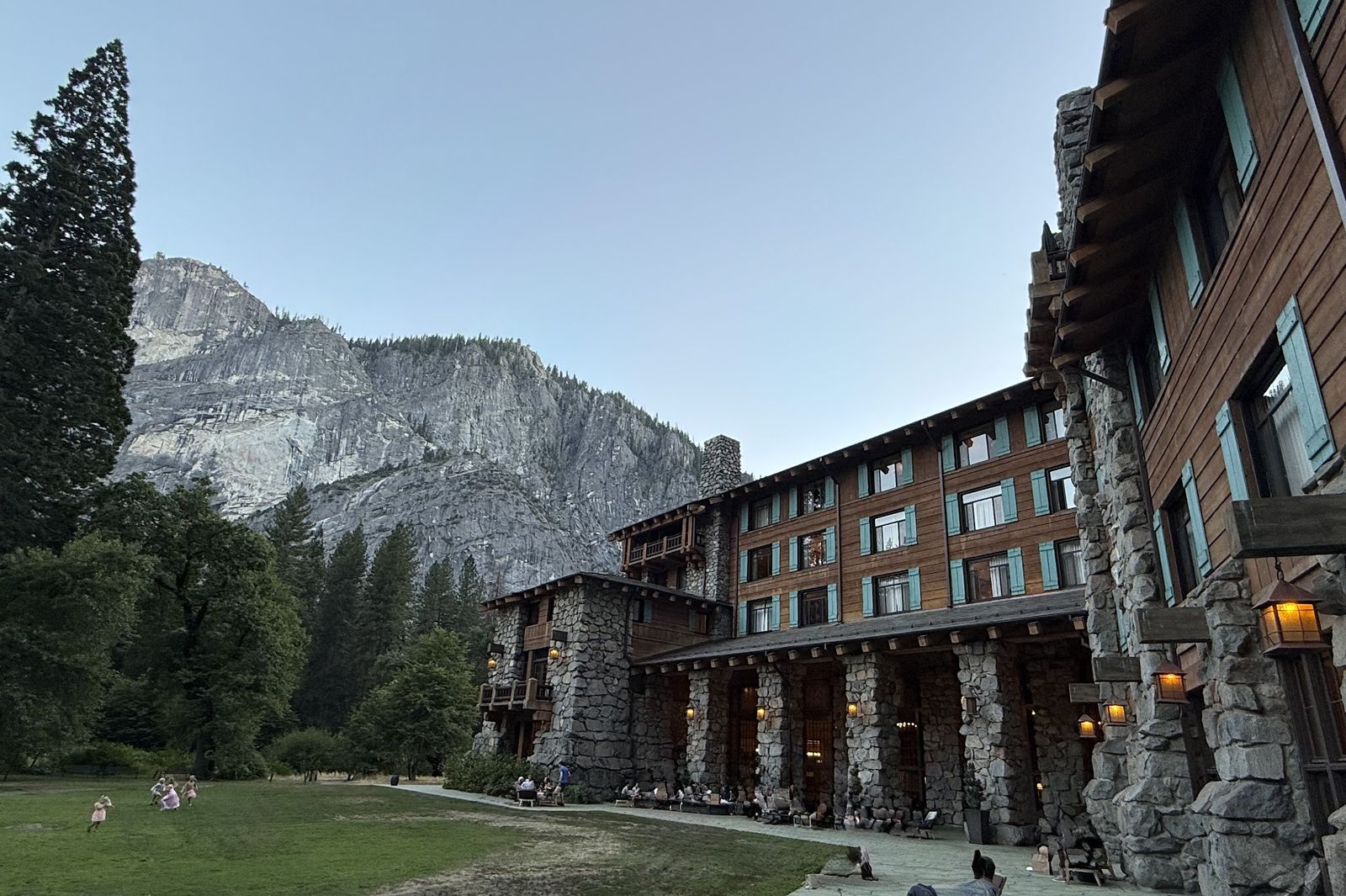
    The hotel wraps around this area, and for us this was probably the view that best captured The Ahwahnee’s grand mountain-lodge character.

    Old gas-lamp-style lights mounted on columns added to the historic atmosphere, while the building itself felt grand without losing its mountain-cabin feel.

    We spent both evenings sitting outside here, having a beer and taking in the surroundings before eating in the hotel bar.

    The Ahwahnee’s stone exterior and rear lawn illuminated at night.

    The pool wasn’t particularly large, but it was perfectly adequate and there were plenty of children enjoying the chance to cool down.

    Another great feature was being able to take rubber rings through the woods behind the hotel and float along a beautiful stretch of the river.

    It was a simple but memorable way to enjoy Yosemite and made the hotel feel even more connected to its surroundings.

    Service

    The staff were friendly, attentive, professional and helpful, but the service never felt overdone.

    In some luxury hotels, service can become a little suffocating, with staff constantly hovering around you.

    The Ahwahnee wasn’t like that.

    People simply got on with their jobs, were there when we needed them and otherwise allowed us to enjoy the hotel.

    That matched the character of the place perfectly. The Ahwahnee felt unassuming and comfortable with itself and its surroundings.

    Eating at the hotel bar

    We ate in the hotel bar and really liked it.

    The menu was a little quirky, but the food was very good quality.

    There was also a good choice of beers, wines and cocktails, served by proper bar staff.

    The bar was usually bustling, but in a good way. It had a lively, comfortable atmosphere without becoming noisy or hectic.

    Service was good, and the relaxed feel of the bar suited the hotel.

    We stayed for two nights in July 2026 and picked up breakfast near the bike-hire area rather than eating breakfast at The Ahwahnee, so we wouldn’t try to judge the hotel’s breakfast from personal experience.

    Staying right in Yosemite Valley

    For us, this was the biggest practical reason for choosing The Ahwahnee.

    Because our Yosemite stay was short, we wanted to be right in the heart of things.

    Staying in the valley meant we could minimise time spent driving, dealing with parking or travelling backwards and forwards.

    Once we’d arrived, we could concentrate on Yosemite.

    We spent time at El Capitan Meadow, explored the valley by bike, stopped for a swim at Cathedral Beach and generally enjoyed being able to experience Yosemite without constantly thinking about the car.

    If The Ahwahnee had been an ordinary hotel, that convenience alone would still have been valuable.

    What made it special was that the hotel itself added something to the experience.

    Yosemite Valley with granite cliffs and pine trees

    Is The Ahwahnee good for families?

    We thought so.

    The lawn gave children plenty of room to play, the pool was popular with families, and the river added another way of enjoying the natural surroundings.

    Despite its history and reputation, the hotel didn’t feel precious or overly formal.

    We felt comfortable there as a family, which fitted the relaxed atmosphere of the whole place.

    What could be better?

    There wasn’t much we’d change, and some limitations are simply part of staying in a historic hotel.

    If we owned it, though, we’d probably make the pool larger. It was perfectly usable, but felt relatively small compared with the scale of the hotel and the number of families enjoying it.

    We’d also try to bring a little more life into the grand hall.

    It’s such a magnificent room that it felt a shame when it was quiet. A space like that deserves to be full of people and atmosphere.

    Neither point materially affected how much we enjoyed staying there.

    Is The Ahwahnee a luxury hotel?

    It depends what you mean by luxury.

    If your priority is an enormous contemporary room, huge bathroom and highly polished modern interiors, The Ahwahnee offers something quite different.

    That isn’t really what it is trying to be.

    Its appeal lies more in the historic character, grand mountain-lodge atmosphere and extraordinary Yosemite Valley location.

    That is why we wouldn’t compare it directly with somewhere like Edgewood Tahoe or Regent Santa Monica Beach.

    They offered more conventional modern luxury.

    The Ahwahnee offered an experience that felt much more tied to the place itself.

    Our verdict

    Yes, we would absolutely recommend The Ahwahnee and we’d stay there again.

    If you’re visiting Yosemite for only one or two nights and can afford it, the location in Yosemite Valley is the biggest practical advantage.

    We were able to spend our limited time enjoying Yosemite rather than travelling backwards and forwards or worrying about parking.

    But location isn’t the whole story.

    The Ahwahnee is memorable because it feels like a historic mountain lodge that belongs in Yosemite Valley.

    For us, that combination of convenience, history and atmosphere made the stay worthwhile — and memorable for reasons that had very little to do with conventional modern luxury.

    Planning a stay at The Ahwahnee? Check current prices and availability at The Ahwahnee on Booking.com.

    Affiliate link: if you book through this link, we may receive a commission at no extra cost to you.

    Part of our wider USA road trip

    The Ahwahnee was one of seven hotels we stayed in during our 18-night road trip through Nevada, Arizona, Utah and California. For how Tahoe compared with Yosemite and how we split our six nights, see Can You Do Lake Tahoe and Yosemite in One Trip? Our Six Nights.

    For the complete journey, see Our 18-Night USA Road Trip Itinerary: Las Vegas, Grand Canyon, Yosemite and LA.

    And for our comparison of all seven hotels — including how The Ahwahnee compared with Edgewood Tahoe, Regent Santa Monica, Amara Sedona and our Las Vegas hotels — see Where We Stayed on Our USA Road Trip: Our Honest Hotel Reviews.

    Planning a similar trip? This trip took a lot of research and planning. About a week of evenings, 30 to 40 hours. Our 36-page USA Road Trip Pack puts all that planning in one place, to help you plan your trip in a fraction of the time: every base and how many nights, which legs we drove and which we flew, what to book first, where we ate and a printable checklist. £14.99 launch price until 31 January (usually £19.99).

  • Edgewood Tahoe Review: Was It Worth It?

    Edgewood Tahoe Review: Was It Worth It?

    We chose Edgewood Tahoe because Lake Tahoe had been somewhere we’d wanted to visit for years, and we wanted one of the hotels on the trip to feel genuinely special.

    We went in with high expectations.

    Edgewood still exceeded them.

    It was as near to perfect as I think we’ve ever seen in a hotel we’ve stayed in. The stunning lakeside setting, excellent facilities and the overall standard of the resort combined to create a wonderful Lake Tahoe experience.

    It ended up being our favourite hotel of the entire USA trip.

    The room

    Our room was probably the best room of the whole trip.

    It had two large, luxurious beds which were extremely comfortable, and the balcony looked out over the rear lawns towards tall pine trees. The view was peaceful and beautiful rather than dramatic, and suited the whole alpine feel of the resort perfectly.

    Inside, the room combined rich wood, copper-toned soft furnishings, warm beiges and crisp whites. It felt luxurious, but still natural and appropriate for Lake Tahoe rather than overly polished or flashy.

    The bathroom was immediately to the left as you entered and included a large square jacuzzi bath. A sliding wooden screen could close the bathroom off from the sleeping area, which was a really nice design feature.

    For us, the whole room just worked.

    It felt warm, calm, luxurious and completely right for the setting.

    The setting

    The lakeside location was one of the main reasons we chose Edgewood, and it was even better in person than we expected.

    The hotel sits directly beside Lake Tahoe, with large lawns, tall pines, a private beach and beautiful alpine-style buildings.

    The whole resort had a grand, luxurious feel, but it never felt showy.

    What really stood out was how perfectly everything seemed to fit together — the hotel, the lake, the lawns, the beach and the mountain setting.

    Grand mountain-lodge lobby at Edgewood Tahoe with stone walls, timber beams, geometric pendant lights and a fireplace.

    The private beach

    Edgewood’s private beach was lovely and a big part of the appeal.

    There was always plenty of room, it was clean and well looked after, and towels were readily available.

    The views were a real highlight too.

    Looking out across Lake Tahoe was stunning, but turning back towards Edgewood itself was just as impressive, with the hotel and grounds framed by the lake.

    Edgewood Tahoe private beach with Lake Tahoe and pine-covered mountains beyond.

    The private beach helped make the lakeside setting feel like part of the actual stay rather than simply something nice to look at from the hotel.

    The pool

    The pool area was smart, neat, clean, comfortable and classy.

    It could get busy, but it never felt chaotic or overcrowded.

    There were plenty of staff around, including waiters and pool attendants, so it always felt well looked after.

    It also struck a good balance between being family-friendly and still working well for couples wanting a relaxing few hours by the pool.

    Overall, it was a really enjoyable pool experience rather than just another hotel facility.

    Breakfast

    Breakfast was excellent.

    We ordered from the menu rather than using a buffet, and there was plenty of choice.

    Like the rest of Edgewood, breakfast managed to feel polished without becoming formal or stuffy.

    The whole experience was relaxed, which suited the hotel perfectly.

    Service

    The service at Edgewood was excellent across the board — friendly, attentive and consistently polished without feeling overly formal.

    The resort also felt very well organised. Everything seemed to run smoothly, and the property was maintained to an exceptionally high standard.

    The only thing that occasionally felt a little less seamless was the valet parking, which could creak at busier times.

    That was a minor issue rather than a real complaint, and it didn’t detract from the overall experience.

    The golf club bar

    We really liked the golf club bar and brasserie.

    There was a great choice of food and drinks, the quality was high, and although it wasn’t cheap, the prices didn’t feel excessive for the standard of the resort.

    It was a particularly nice place to stop for a beer before dinner.

    The atmosphere was relaxed, with both indoor and outdoor seating, and it had more of a smart golf-club brasserie feel than the rest of the hotel.

    That gave it a slightly different character, which we liked, and the views across the golf greens were lovely.

    Eating at Edgewood

    We had dinner at the golf club, which we really enjoyed, but we didn’t eat in Edgewood’s main hotel restaurants during our stay.

    We chose to dine out on the other evenings, so we wouldn’t try to judge the hotel’s wider restaurant offering from personal experience.

    What we can say is that the golf club food and drinks were very good, and the setting made it an easy, relaxed option when we didn’t want to head elsewhere.

    Location and getting around

    Edgewood is close to South Lake Tahoe, but the restaurants, bars and other places we wanted to visit were fairly spread out.

    Some were easy enough to walk to, while others were better reached by Uber or car.

    For us, that worked well.

    We had the peaceful lakeside setting of Edgewood, but could still head into South Lake Tahoe when we wanted a livelier evening or a different choice of food and drink.

    Is Edgewood good for families?

    For us, yes.

    The room gave us plenty of space, and the combination of the pool, beach, lawns and relaxed atmosphere worked extremely well with teenagers.

    The hotel felt genuinely luxurious, but not so formal that you felt you had to behave differently simply because you were travelling as a family.

    That balance was one of the things we liked most about it.

    Did Edgewood live up to expectations?

    More than that — it exceeded them, and we had gone in with high expectations.

    The two biggest surprises were the sheer beauty of the setting and just how immaculate the hotel itself felt.

    The finish throughout the resort was exceptional, and everything looked and felt incredibly well cared for.

    Edgewood was one of those rare hotels that looked impressive beforehand but was even better once we were actually there.

    Pink and orange sunset over Lake Tahoe, viewed across Edgewood Tahoe’s pine-framed lakeside lawn.

    Anything to know before booking?

    Not really.

    We didn’t come away with any significant warnings or caveats.

    Our advice would simply be:

    Don’t overthink it — prepare to really enjoy your stay.

    Was Edgewood worth the money?

    For us, yes.

    The important thing is that we didn’t feel we were paying simply for a smart room.

    The room, setting, private beach, pool, grounds and service all contributed to the experience.

    That is the kind of hotel where paying more made sense to us because the resort itself became such an enjoyable part of the holiday.

    Would we stay again?

    Absolutely.

    Edgewood was our favourite hotel of the entire USA trip and one of the best hotels we’ve ever stayed in.

    The setting was stunning, the facilities were superb and the whole experience felt exceptionally well judged.

    For us, it came about as close to perfect as a hotel stay gets.

    Planning a stay at Edgewood? Check current prices and availability at Edgewood Tahoe on Booking.com.

    Affiliate link: if you book through this link, we may receive a commission at no extra cost to you.

    Part of our wider USA road trip

    We stayed at Edgewood during our 18-night road trip through Nevada, Arizona, Utah and California. For how Tahoe compared with Yosemite and how we split our six nights, see Can You Do Lake Tahoe and Yosemite in One Trip? Our Six Nights.

    For the full route, including Las Vegas, Sedona, the Grand Canyon, Monument Valley, Yosemite and Los Angeles, see Our 18-Night USA Road Trip Itinerary: Las Vegas, Grand Canyon, Yosemite and LA.

    And for a comparison of all seven hotels from the trip, see Where We Stayed on Our USA Road Trip: Our Honest Hotel Reviews.

    Planning a similar trip? This trip took a lot of research and planning. About a week of evenings, 30 to 40 hours. Our 36-page USA Road Trip Pack puts all that planning in one place, to help you plan your trip in a fraction of the time: every base and how many nights, which legs we drove and which we flew, what to book first, where we ate and a printable checklist. £14.99 launch price until 31 January (usually £19.99).